GearAndFish is reader-supported. As an Amazon Associate I earn from qualifying purchases. When you buy through links on our site, we may earn an affiliate commission, at no extra cost to you. Learn more.
Fly fishing for beginners gets much easier when you ignore the giant gear catalogs and focus on one simple freshwater setup, one cast, two knots, a small fly box, and an easy place to practice. This guide walks through that first setup and first trip without assuming you already know the vocabulary.
For most beginners, start with a matched 5-weight outfit and keep the first trip simple
A 9-foot 5-weight rod with a matching weight-forward floating line is the common all-around starting point for trout and light freshwater fishing. Add a tapered leader, tippet, a few proven flies, polarized sunglasses, nippers, and forceps. Practice an overhead cast with yarn or a hookless leader first, then fish an open pond or an accessible stretch of river where you have room behind you.
How fly fishing works differently
With conventional spinning gear, the lure or sinker provides much of the weight that carries the line forward. In fly fishing, the fly is often too light to do that job. The mass of the fly line loads the rod and carries the leader and fly to the target.
That one difference explains why the tackle looks unusual at first. The reel stores backing and fly line, a tapered leader transitions from thick fly line to a much finer end, and a short tippet section gives you a replaceable final connection to the fly. You do not need to master every variation before fishing. You only need to understand how the pieces connect and how to move the line with the rod.

The beginner fly fishing setup you actually need
For a first general-purpose freshwater outfit, a 5-weight system is a practical middle ground. Orvis currently recommends a 9-foot 5-weight as its beginner starting point, and that general size is versatile enough for much trout fishing plus lighter bass and panfish work. A shorter rod or a different line weight can make more sense on tiny brushy streams, for large bass bugs, or for saltwater, but those are special cases you can solve later.
| Part | Simple starting point | Why it matters |
|---|---|---|
| Rod | About 9 feet, 5-weight | Versatile freshwater size with enough length for line control |
| Reel | Matched to a 5-weight line | Stores line and backing; balance and a smooth drag are more important than exotic features |
| Fly line | Weight-forward floating 5-weight | Easy general-purpose choice for learning casts and many dry-fly, nymph, and small-streamer presentations |
| Leader | About 9 feet, commonly 4X or 5X for trout-size flies | Tapers energy from the fly line down to the fly |
| Tippet | Match the leader end and fly size | Lets you replace the thin end of the system instead of shortening the whole leader |
| Tools | Nippers, forceps, polarized sunglasses | Cover line trimming, hook removal, eye protection, and seeing into the water |
About 9 feet, 5-weight
Versatile freshwater size with enough length for line control
Matched to a 5-weight line
Stores line and backing; balance and a smooth drag matter more than exotic features
Weight-forward floating 5-weight
Simple general-purpose choice for learning casts and common freshwater presentations
About 9 feet, commonly 4X or 5X
Tapers energy from the fly line down to trout-size flies
Match the leader end and fly size
Creates a replaceable fine connection without shortening the whole leader
Nippers, forceps, polarized sunglasses
Cover trimming, hook removal, eye protection, and glare control
You do not need waders just because you are fly fishing. Bank fishing is often easier for a first session. If the water you plan to fish requires wading, choose footwear for the bottom and current, wear a wading belt with chest waders, and avoid water that is faster or deeper than your experience supports. Our fishing waders guide can help when waders become necessary rather than automatic.
Two current matched outfits that remove setup guesswork
You can buy every component separately, but a matched outfit is easier when you are still learning what rod weight, reel size, and line weight mean. These are examples, not a ranking, and neither is required to learn the technique.
Redington Original Freshwater Kit 590-4
The current 590-4 is a 9-foot, 4-piece 5-weight kit. Redington lists a Crosswater reel, backing, RIO Mainstream WF5F floating fly line, a tapered leader, and a protective case with the outfit. That makes it a straightforward fit for the all-around 5-weight setup described above.
Wild Water Standard Fly Fishing Kit 5/6wt, 9ft
Wild Water’s current Standard 9-foot 5/6-weight kit is a more all-inclusive starter package. The current Amazon listing pairs the rod with a preloaded reel, WF5-F floating line, backing, a 9-foot 5X leader, a small fly box, nine flies, a spare leader, nippers, and a carrying case. The broader 5/6-weight rod label is a little different from a dedicated 5-weight outfit, but the included 5-weight floating line keeps the setup close to the general-purpose freshwater system described here.

Learn the line system from the reel to the fly
The order is simple: reel, backing, fly line, leader, tippet, fly. Backing stays deep on the reel and gives extra reserve if a fish takes more line than the fly line itself. The fly line is the thick, weighted casting line. The leader tapers toward the fly. Tippet is the fine, replaceable end section.
For a first day, you usually do not need to rebuild the backing-to-line connection or create a custom leader. A pre-rigged outfit often has the hard parts handled already. Your useful beginner skills are attaching the leader if necessary, adding tippet when the leader gets short, and tying on a fly cleanly.
Learn two knots before you learn ten
A beginner does not need a knot encyclopedia. Start with one knot for attaching a fly and one for adding tippet.
1. Clinch knot for fly to tippet
Run the tippet through the hook eye, make several wraps around the standing line, pass the tag through the small loop near the eye, wet the knot, then draw it down smoothly. The improved clinch adds one more pass through the larger loop. Both are widely taught; the important part is tying one version consistently and checking that it seats cleanly.
2. Double surgeon’s knot for tippet to leader
Overlap the leader end and new tippet, form a loop with both strands, pass the two ends through twice, wet the knot, and tighten evenly. It is not the only leader-to-tippet knot, but it is easy to learn and practical in the field.
Practice both at home with thicker line until you can tie them without thinking about every movement. That saves much more fishing time than learning six additional knots badly.
How to make your first overhead fly cast
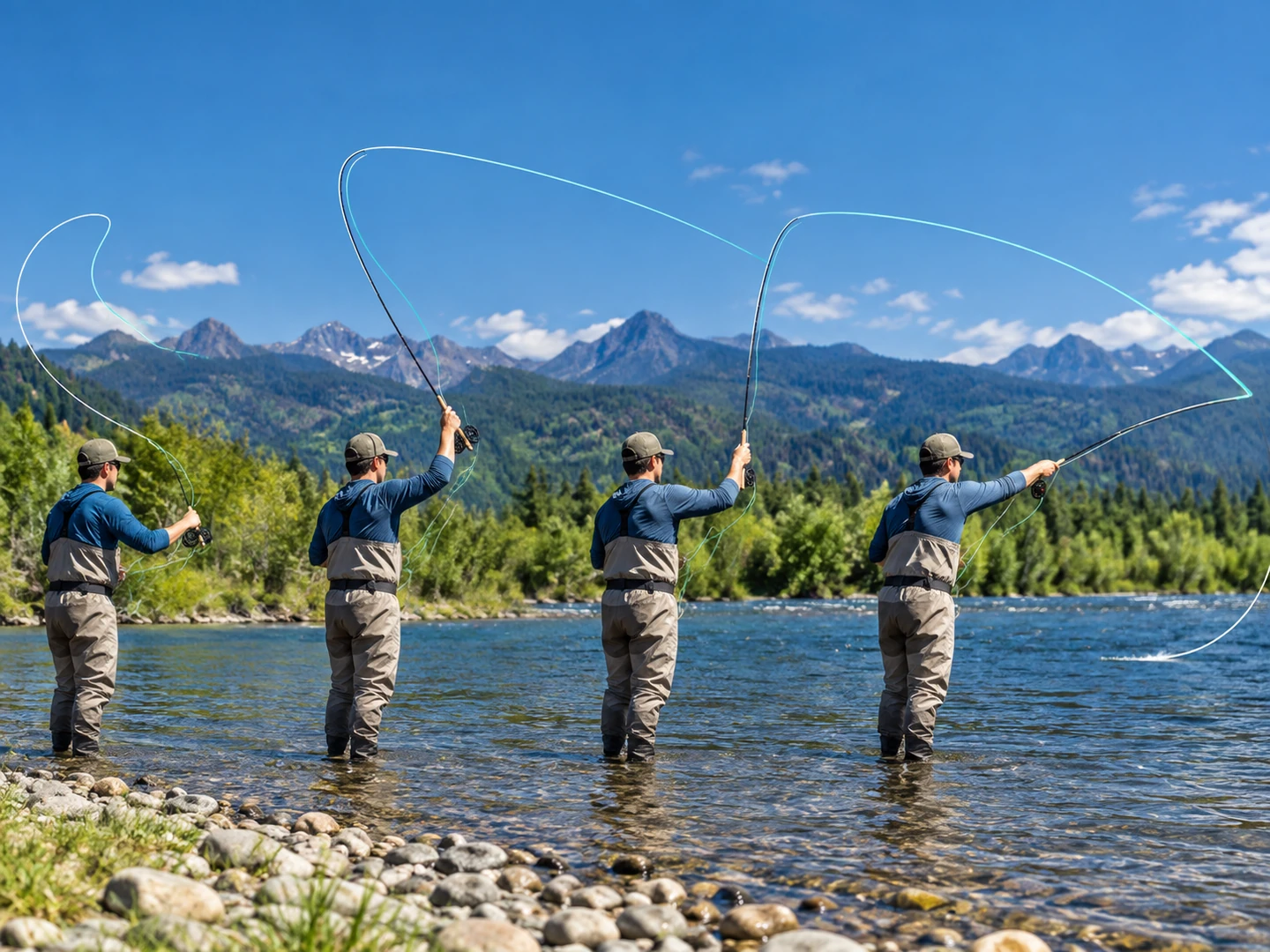
Practice in an open grassy area with yarn at the end of the leader, or over water with plenty of clear space behind you. Wear glasses even during practice. A fly can travel quickly, and polarized fishing glasses also become useful later for glare reduction on the water. If you need a pair, see our fishing sunglasses guide.
- Start with a short amount of line. Twenty to thirty feet is enough. Long casts hide mistakes and are not needed to learn timing.
- Lift smoothly. Begin with the rod tip low and the line fairly straight in front of you.
- Accelerate into a firm stop on the backcast. The stop helps the rod transfer energy into the line.
- Pause long enough for the line to straighten behind you. Starting the forward cast too early collapses the loop and wastes energy.
- Accelerate forward and stop again. Let the line unroll in front instead of pushing the rod tip all the way down immediately.
- Lower the rod as the line finishes. The goal is a controlled loop and a useful presentation, not maximum distance.
The most common beginner problem is trying to force the cast with the whole arm. Smooth acceleration and a clear stop matter more than strength. If the line cracks behind you, the forward cast is often starting before the backcast has finished or the rod is being driven too abruptly.
Pick easy water for your first session
A beginner-friendly place has room to cast, legal public access, fish that are reasonably available, and water you can approach safely. A small pond with bluegill or other panfish can be easier than a fast trout river because you can practice from shore and get more repetitions without managing current. A stocked trout stream with an open bank is another good option.
On moving water, begin by looking for changes rather than memorizing dozens of river terms. Fish often use seams where faster and slower current meet, the softer water behind rocks, the edges of riffles, and transitions into deeper runs. In ponds, work visible structure, shade lines, drop-offs, weed edges, and areas where insects or small bait are active.
Check access rules and local regulations before you go. The U.S. Fish and Wildlife Service notes that every state has somewhat different license rules, so use the state-specific licensing information for the place you actually fish.
Build a tiny beginner fly box, not a hundred-fly collection
Local hatch and forage patterns matter, so a fly shop near your water can narrow the choice quickly. For a basic freshwater learning box, carry a few patterns that let you fish the surface, below the surface, and with a small baitfish or leech-like profile.
- Dry fly: a Parachute Adams or Elk Hair Caddis gives you a visible surface presentation.
- Nymph: a Pheasant Tail or Hare’s Ear covers common subsurface insect shapes.
- Streamer: a small Woolly Bugger is useful for trout, bass, and panfish in many waters.
- Panfish option: a small foam popper can make pond practice simple because the fly is easy to see.
Do not obsess over having every size and color. A handful of local, proven flies and more time learning line control usually helps a new angler more than a crowded box.
Make the first presentation simple
In moving water
Start close. Cast slightly upstream or across the current and try to let a dry fly or nymph move at the same pace as nearby bubbles. Extra fly line lying in different current speeds can drag the fly unnaturally, so shorter casts often give a beginner better control.
In still water
Cast to an edge, visible rise, weed line, or shallow-to-deep transition. With a Woolly Bugger or similar streamer, begin with a slow, steady retrieve and change speed before you change everything else. With a small dry fly or popper, let the rings settle, then add small movements.
Distance is rarely the first problem to solve. A clean 25-foot cast placed where fish actually hold is more useful than a 60-foot cast you cannot control.
Your first fly fishing trip checklist
- Fishing license and any water-specific permit required for the location
- 5-weight outfit or another setup matched to the target species and water
- Leader plus one or two tippet spools that match your flies
- Small fly box with dry flies, nymphs, and one or two simple streamers
- Polarized glasses and a hat for eye protection and glare control
- Nippers and forceps or hemostats
- Water, sunscreen, weather layers, and a simple pack
- Waders, boots, and a wading belt only if the water requires them
If you are fishing alone, tell someone where you are going and when you expect to return. On rivers, check weather and flow conditions before entering the water. If you are unsure about a crossing, do not make the crossing.
Handle fish with the same care you put into catching them
If you are releasing a fish, minimize handling time. The National Park Service recommends keeping fish wet and calm, supporting them properly, using wet hands or gloves, avoiding the gills, and working quickly when removing the hook. A small pair of forceps makes hook removal faster and gives your fingers more distance from the hook point.
Regulations can also require specific hook types, seasons, harvest limits, or tackle rules. Check the exact state and waterbody rules rather than assuming a general fly-fishing rule applies everywhere.
What you can skip at the beginning
Most new fly anglers can delay specialized sinking lines, multiple rods, expensive reels, a full fly-tying station, huge fly assortments, and technical packs. Those purchases make sense when a specific water or technique creates a reason for them.
Spend the first few trips learning whether you enjoy dry flies, nymphs, streamers, ponds, small streams, or larger rivers. Your second purchase can then solve a real limitation instead of a problem you have not experienced.
A 30-minute practice plan before your first trip
- 5 minutes: assemble the rod correctly, thread the line, and learn how the reel drag and spool work.
- 5 minutes: tie the clinch knot and double surgeon’s knot several times.
- 10 minutes: make short overhead casts with yarn, focusing on smooth acceleration and a clean stop.
- 5 minutes: practice picking the line up and laying it down in the same target zone.
- 5 minutes: practice stripping line with the line hand while keeping the rod hand relaxed.
Stop before fatigue turns into sloppy repetitions. Two or three short sessions are more useful than trying to force an entire casting lesson into one afternoon.
Research and source notes
This beginner plan was built from current instructional guidance and current manufacturer specifications rather than personal-use claims. Helpful references include Orvis beginner fly fishing gear guidance, Far Bank’s beginner learning series, the U.S. Fish and Wildlife Service license directory, and the National Park Service catch-and-release guidance. Product details were checked against current Redington and Wild Water manufacturer pages and current Amazon US listings on October 7, 2026.
Fly fishing for beginners FAQ
Is fly fishing hard to learn?
The basics are learnable without mastering advanced casting. Start with short overhead casts, two knots, and one simple presentation. The learning curve gets steeper when you add specialized casts, complex currents, or very small flies.
Is a 5-weight fly rod good for beginners?
For general freshwater trout fishing, a 5-weight is one of the most common beginner choices. A 9-foot 5-weight is especially versatile, but tiny streams, large bass flies, and saltwater can justify a different length or line weight.
Can you learn fly fishing on a pond?
Yes. A pond with panfish can be an excellent place to learn because you can often cast from shore, avoid strong current, and get frequent chances to practice presentation and line control.
Do you need waders to fly fish?
No. Many ponds, lakes, and accessible riverbanks can be fished from shore. Buy waders when entering the water genuinely improves access or presentation, not because they seem mandatory for the sport.
How far should a beginner be able to fly cast?
You do not need long casts to start. A controlled cast of roughly 20 to 30 feet is enough for useful practice and can catch fish in many situations. Accuracy, loop control, and line management matter more than maximum distance.