
GearAndFish is reader-supported. As an Amazon Associate I earn from qualifying purchases. When you buy through links on our site, we may earn an affiliate commission, at no extra cost to you. Learn more.
Spooling a spinning reel is simple once you control four things: the bail must be open before the line is tied on, the filler spool must feed line in a direction that does not add twist, the line needs steady tension, and the reel spool should stop just short of the lip. Get those right and fresh mono, braid, or fluorocarbon should sit evenly and behave much better on the first cast.
How to spool a spinning reel in 7 steps
- Mount the reel on the rod and run the new line through the first guide.
- Open the bail before attaching the line to the reel spool.
- Tie the line to the spool arbor and trim the tag end.
- Close the bail by hand and put light, steady tension on the line.
- Start with the filler spool lying flat and reel 10 to 15 handle turns.
- Pause and check for twist. If loose line springs into tight coils, flip the filler spool and continue.
- Fill the reel evenly, stopping about 1/8 inch below the spool lip unless your reel manufacturer specifies a different fill point.
What you need before you start
- Your spinning reel, preferably mounted on its rod.
- A filler spool of mono, braid, or fluorocarbon in a diameter the reel is designed to handle.
- Scissors or line cutters.
- A clean cloth or your fingers to apply light tension.
- For braid on a smooth spool arbor, a short section of monofilament backing unless the reel is specifically braid-ready.
You do not need a special line-spooling tool for a normal spinning reel. A helper, a clean floor, and controlled tension are enough. A spooler becomes useful when you respool often, want more repeatable tension, or simply prefer a hands-free way to hold the filler spool.

Choose line that matches the reel
Check the capacity markings on your reel spool before buying line. The listed capacities are a useful guide because line diameter, not just pound-test, determines how much line will fit. Two lines with the same breaking strength can have noticeably different diameters.
| Line type | Spooling note | Main caution |
|---|---|---|
| Monofilament | Easy to tie to the arbor and generally beginner-friendly. | Memory can create coils if it is loaded with excessive twist. |
| Braid | Use mono backing or a braid-ready spool surface so the entire line load cannot slip around the arbor. | Loose wraps can dig into lower layers under load. |
| Fluorocarbon | Keep tension consistent and avoid forcing a stiff, oversized diameter onto a small spool. | High memory can make loops jump off the spool, especially on small reels. |
Buy line by diameter and by the capacity printed on your reel spool, not by pound-test alone. The same breaking strength can vary noticeably in diameter from one line family to another, so the reel maker’s capacity markings are the safer starting point.
Step-by-step: how to put line on a spinning reel
1. Mount the reel and thread the first guide
Spooling is easier when the reel is fixed to the rod instead of moving around on a table. Run the line through at least the first guide closest to the reel. Using the guide helps keep the incoming line centered and makes it easier to control tension.
2. Open the bail before tying the line
This is the small step that causes a surprising number of do-overs. Open the bail first, then wrap the line around the spool arbor. If you tie the line with the bail closed, the line will not be captured correctly by the bail and line roller.
3. Tie the line to the spool arbor
An arbor knot is a simple choice for mono or backing. Cinch it against the spool and trim the tag end close enough that it cannot create a lump under the first wraps. The knot only needs to hold the line in place while the first wraps build friction around the spool.
With braid, do not assume a tight knot alone will stop the line load from slipping around a smooth metal arbor. Use a short mono backing section unless your reel has a braid-ready grip surface or the manufacturer specifically allows direct-to-spool braid.
4. Close the bail and apply light tension
Close the bail by hand, make sure the line is sitting in the line roller, then pinch the line lightly between your fingers or through a clean cloth. The goal is firm, even wraps, not maximum pressure. Too little tension creates loose coils. Too much pressure can bury thin braid into lower wraps or make the job harder than it needs to be.

5. Set the filler spool flat and check direction
Start with the filler spool lying flat on the floor or a clean surface. Many line manufacturers package spinning-friendly mono so label-up works as a starting position, but do not treat that as a universal rule. Reel several turns, stop, and give the line a little slack between the filler spool and rod.
If the loose line relaxes in smooth loops, keep going. If it twists into tight coils or pigtails, flip the filler spool over and repeat the check. The practical goal is to avoid feeding additional twist into the line as the bail lays it onto the stationary reel spool.
6. Reel slowly and watch the line lay
Turn the handle at a steady pace. Watch the reel spool as it oscillates up and down. The line should build in even layers without large gaps, crossed loose loops, or a pronounced pile at only the top or bottom.
If the reel lays line heavily at one end, stop. Some spinning reels include spool-height washers or model-specific adjustments for line lay. Check the reel manual before changing anything, because the correct adjustment depends on the reel design.
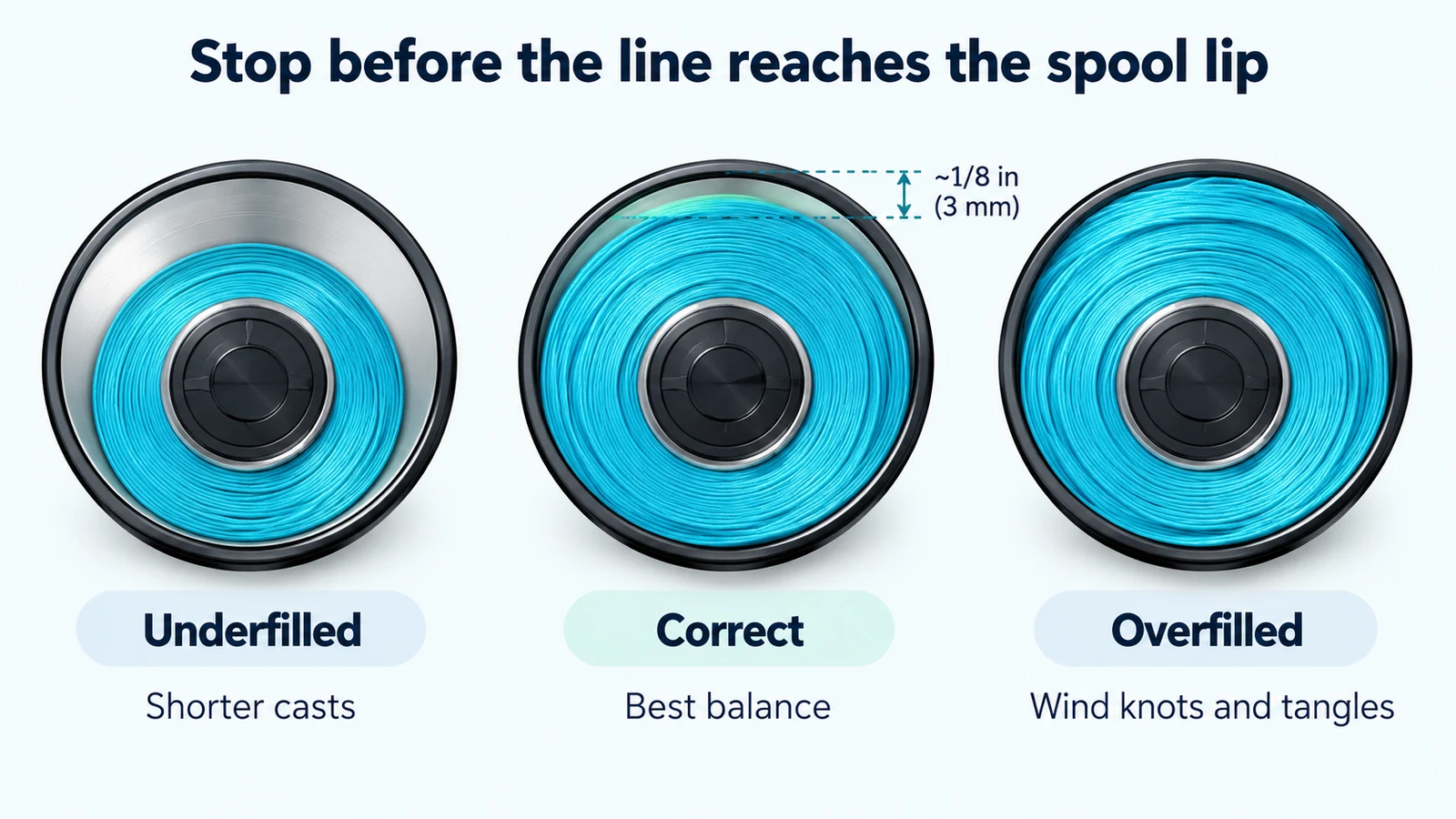
7. Stop before the line reaches the lip
As a safe general target, stop with roughly 1/8 inch of space between the line and the outer spool lip. An underfilled spool wastes capacity and can shorten casting distance. An overfilled spool makes it easier for loose coils to spring over the lip when the bail opens.
How the process changes for braid, mono, and fluorocarbon
Spooling braid
Braid has very little stretch and can slip as a complete bundle on a smooth spool arbor. A short mono backing layer solves that on many reels. Tie the mono to the arbor, add enough wraps to create a grippy base, join the braid to the backing with a compact line-to-line knot, then finish filling under steady tension.
If the reel is explicitly braid-ready, follow the reel maker’s instructions instead of adding backing automatically. Some modern spools use rubber inserts, textured surfaces, or dedicated anchor systems designed to grip braid.
Spooling monofilament
Mono is forgiving, but it also has memory from the filler spool. Direction matters. Use the short twist check after the first 10 to 15 handle turns, and keep tension consistent until the reel is filled.
Spooling fluorocarbon
Full-spool fluorocarbon can be less manageable than mono on small spinning reels, especially in heavier diameters. Use a line size the reel can handle comfortably, keep the filler spool under control, and stop if coils are jumping off faster than you can manage them. In many freshwater situations, anglers instead use braid or mono as the main line with a fluorocarbon leader.
Common spinning-reel spooling mistakes
- Tying the line on before opening the bail. The line ends up outside the normal bail path and must be retied.
- Ignoring line twist during the first few turns. A quick check at the start is easier than removing a full spool later.
- Spooling with almost no tension. Loose wraps can create loops, wind knots, and braid that digs into itself.
- Overfilling. Extra line is not automatically better. Leave a small gap below the spool lip.
- Putting braid directly on a smooth arbor without a grip system. The entire line load can rotate around the spool under pressure.
- Using line that is too stiff or too thick for the reel. Reel capacity and line diameter matter more than a generic pound-test rule.
Troubleshooting after you spool the reel
The line jumps off the spool when I open the bail
First check for overfilling. If the fill level is reasonable, pull off several feet of line and look for tight coils. Excess twist or very stiff line can make loops spring over the lip. If the problem is severe, remove the line and respool with the filler spool flipped or use a more manageable line diameter.
The line piles up at the top or bottom of the spool
This can be a reel setup or spool-height issue rather than a spooling-direction problem. Stop before adding more line and check the manual for your exact reel. Do not randomly add or remove washers unless the manufacturer describes that adjustment for the model.
Braid spins around the spool instead of retrieving
The braid is probably slipping on the arbor. Remove it and add mono backing, or use the reel’s braid-ready attachment method if one is provided.
Fresh mono is coiling badly
Check both direction and diameter. If direction is correct but the line still springs aggressively from the reel, the line may have strong memory or may simply be too stiff for the spool size. Moving to a softer mono or a smaller diameter can improve manageability.
Do you need a fishing line spooler?
No. A spinning reel can be spooled correctly without a dedicated tool. A line spooler is mainly a convenience purchase when you respool often, work alone, or want a more repeatable way to control the supply spool and incoming tension.
The Beyond Braid EZ Fishing Line Spooler clamps to a flat surface, accepts multiple filler-spool sizes, and uses an adjustable holder to add line tension. If you use a spooler that lets the filler spool rotate on an axle, follow that tool’s spinning-reel setup instead of combining it with the flat-spool method described above.
Safety and line disposal
Do not wrap fishing line tightly around bare fingers to create heavy tension. Thin braid can cut skin when pulled hard. Keep children and pets away from loose line, hooks, scissors, and open tackle while you work.
Collect old line instead of leaving it outdoors or throwing loose coils where wildlife can reach them. Many tackle shops and marinas accept used monofilament for recycling, and even when local recycling is not available, cutting old line into short sections before disposal reduces entanglement risk.
FAQ
Which way should line come off the spool for a spinning reel?
Start with the filler spool lying flat. Reel 10 to 15 turns, then create a little slack. If the line relaxes in smooth loops, keep that orientation. If it twists into tight coils, flip the filler spool and check again. The goal is to avoid adding twist as the bail wraps line onto the reel.
How full should a spinning reel spool be?
About 1/8 inch below the outer spool lip is a safe general target. Follow a marked fill line or model-specific instruction if your reel provides one.
Do I need backing for braid on a spinning reel?
You usually need a short mono backing layer when the reel has a smooth spool arbor. If the reel is specifically braid-ready and has a grip surface or approved direct-attachment system, follow the manufacturer instructions instead.
Can I put fluorocarbon directly on a spinning reel?
Yes, but full-spool fluorocarbon can be stiff and high-memory, especially in larger diameters. Match the line diameter to the reel and consider braid or mono with a fluorocarbon leader if line management becomes difficult.
Why does new line keep jumping off my spinning reel?
The common causes are overfilling, excessive line twist, loose spooling tension, or line that is too stiff for the spool size. Check fill level first, then inspect the line for tight coils and respool if necessary.