

GearAndFish is reader-supported. As an Amazon Associate I earn from qualifying purchases. When you buy through links on our site, we may earn an affiliate commission, at no extra cost to you. Learn more.
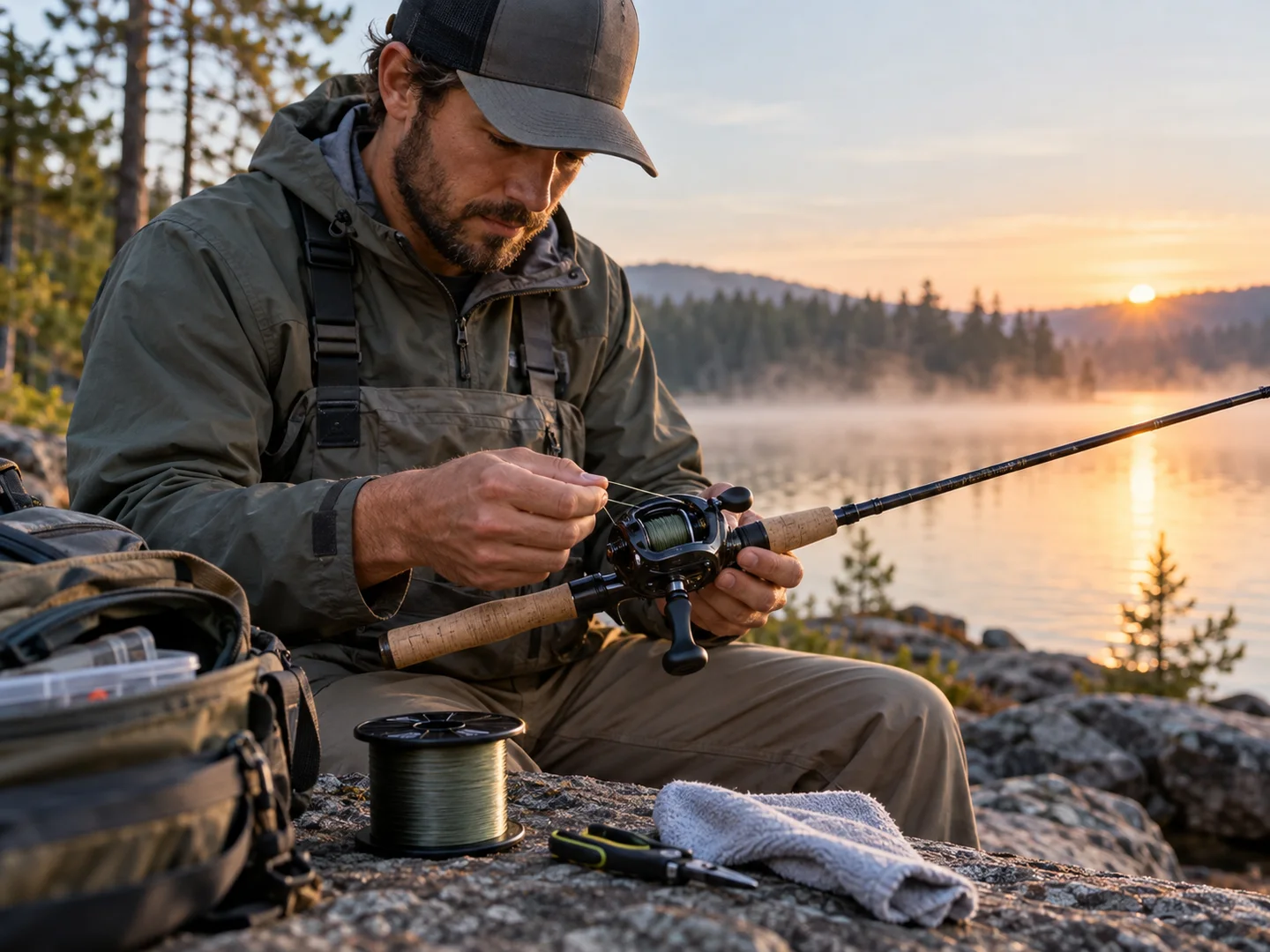
Spooling a baitcaster is straightforward once you control three things: line direction, spool attachment and steady tension. The goal is a firm, even line pack that stops just below the spool edge without trapping loose coils underneath.
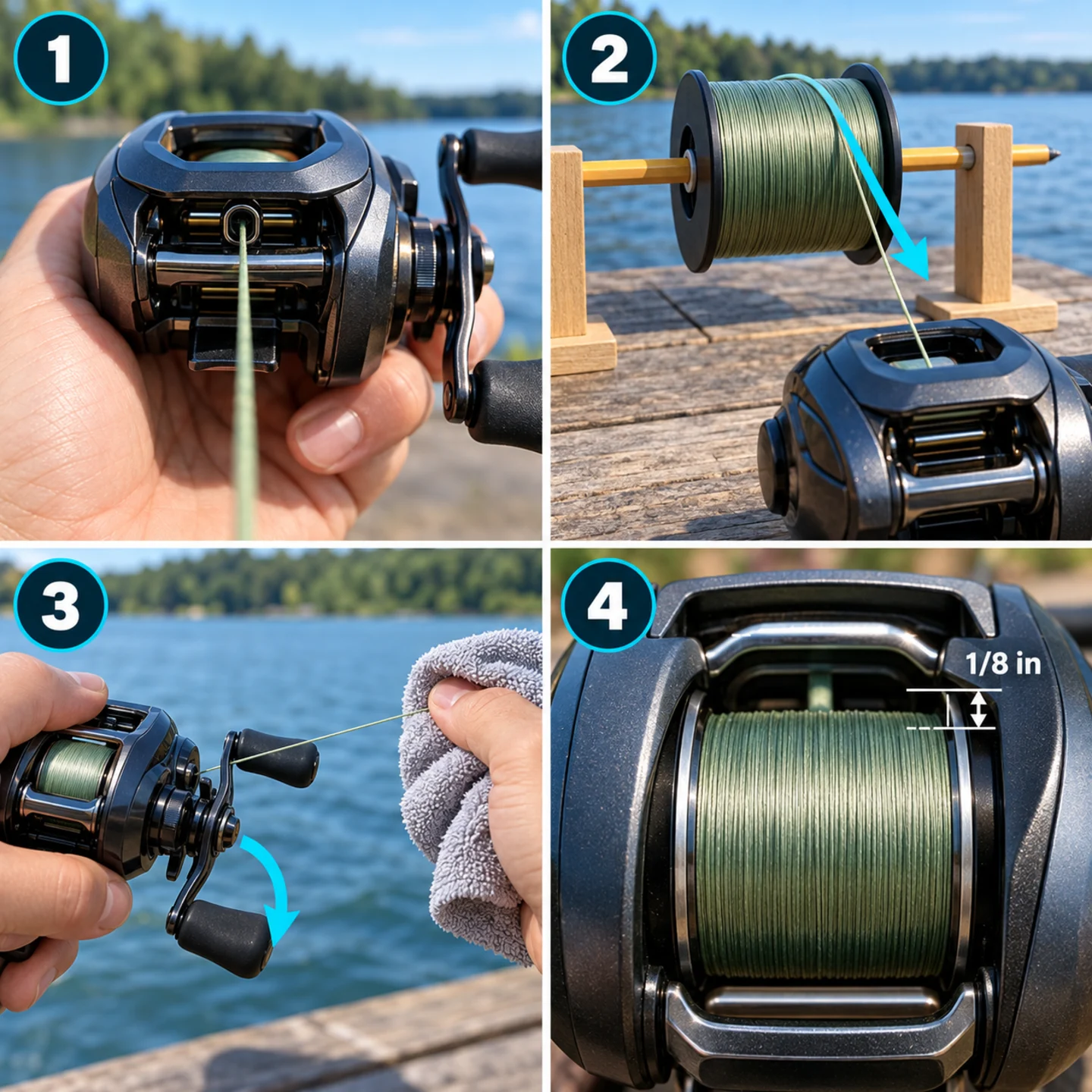
How to spool a baitcaster in six steps
- Mount the reel on the rod and run the line through at least the first rod guide and the reel’s level-wind guide.
- Attach mono or fluorocarbon to the spool with an arbor knot. For braid, use a short mono backing unless your reel specifically supports direct braid attachment.
- Put the filler spool on a pencil, dowel or spooling tool so it can rotate freely.
- Feed line off the top of the filler spool toward the reel.
- Reel slowly while keeping steady tension on the line with a cloth or gloved fingers.
- Stop before the line reaches the spool edge. Roughly 1/8 inch is a useful rule of thumb, but follow any fill mark or instruction supplied with your reel.
What you need before you start
- Your baitcasting reel, preferably mounted on its rod.
- The correct line type and pound test for the reel and technique.
- Scissors or line clippers.
- A soft cloth or light glove for applying tension.
- A pencil or dowel plus a helper, or an optional line-spooling tool.
- A small amount of monofilament if you plan to use braid on a smooth spool.
You do not need a dedicated machine to do this correctly. A helper holding the filler spool on a pencil works fine. A spooling tool mainly makes it easier to keep the filler spool aligned and under consistent resistance when you are working alone.
Step-by-step: putting line on a baitcaster
1. Run the line through the guide before tying anything
Start by passing the line through the first rod guide nearest the reel, then through the baitcaster’s level-wind guide. If you prefer, you can thread every rod guide first, but the important part is that the line enters the reel through the level wind before it reaches the spool.
Skipping the level wind is a common setup mistake. The guide is what moves side to side and distributes line across the spool during normal retrieve.
2. Attach the line to the reel spool
For monofilament or fluorocarbon, wrap the line around the spool arbor and secure it with a compact arbor knot. Trim the tag end close enough that it cannot catch loose line, while leaving the knot intact.
If your spool has a dedicated attachment hole or braid-ready feature, follow the reel manufacturer’s instructions for that design rather than forcing a generic knot method.
3. Add backing before braid when the spool needs it
Braid is very slick and can rotate around a smooth spool arbor as one complete layer. When that happens, the handle turns but the line pack can slip instead of transferring drag and retrieve force normally.
A short layer of monofilament backing gives braid something to grip. Attach the mono to the spool first, add enough to cover the arbor, then join the braid to the backing with a compact line-to-line knot. The exact amount of backing depends on spool capacity and how much braid you want on top, so there is no universal yardage.
4. Position the filler spool correctly
For a baitcaster, let the filler spool rotate on an axle, pencil or spooling tool and feed line from the top of that spool toward the reel. This keeps the line traveling in the same basic path it was wound on the supply spool instead of peeling off loose coils.
Do not confuse this with the common spinning-reel method where the supply spool may lie flat. A baitcaster’s spool itself rotates, so the cleanest setup is usually filler spool rotating on an axle and line coming off the top.
5. Reel under steady tension
Turn the handle at a controlled pace while pinching the line lightly through a soft cloth several inches in front of the reel. You want enough resistance that the line packs firmly, but not so much that you are fighting the reel or heating the line against your fingers.
Watch the line pack for the first few dozen handle turns. It should build evenly from side to side as the level wind travels. If the line is loose, stop and correct it before adding more line on top.
6. Stop before you overfill the spool
Do not try to squeeze the entire filler spool onto the reel. A useful general target is to leave about 1/8 inch of space below the spool edge. Some reel manufacturers specify a slightly different gap, such as about 2 mm, so the reel manual or spool fill mark takes priority over a generic number.
When the reel is full, cut the line from the filler spool and keep the tag controlled so it cannot spring loose and bury itself in the line pack.

What changes with braid, mono and fluorocarbon?
| Line type | Spool attachment | What to watch while spooling |
|---|---|---|
| Monofilament | Usually can tie directly to the spool arbor. | Keep it snug and avoid loading loose coils under the outer layers. |
| Fluorocarbon | Usually can tie directly to the spool arbor. | Its stiffness can make loose wraps more obvious, so steady tension matters. |
| Braid | Use mono backing on a smooth spool unless the reel specifically supports direct braid attachment. | Prevent the entire line pack from slipping around the arbor and keep the braid packed firmly. |
Do you need a line spooler?
No. A line spooler is an optional convenience, not a requirement. It becomes more useful if you respool several reels, work alone or want repeatable filler-spool tension without asking someone to hold a pencil.
Piscifun Speed X Fishing Line Spooler
A compact option for anglers who want a controlled one-person spooling setup that works with baitcasting reels as well as other reel types.
Piscifun Fishing Line Spooler Portable Winder
A simpler portable winder with adjustable tension that can replace the helper-and-pencil method when you prefer a compact dedicated tool.
Five baitcaster spooling mistakes to avoid
- Skipping the level wind. Thread through it before tying the line to the spool.
- Letting line go on loose. Loose lower layers can compress, dig in or create an uneven pack once the line is under fishing load.
- Tying braid directly to a smooth arbor without a supported anchor. The whole line pack can slip around the spool.
- Feeding the filler spool the wrong way. Let it rotate on an axle and feed the line from the top toward the reel.
- Overfilling. Stop short of the spool edge instead of using every last yard.
Troubleshooting after you spool the reel
The line is loose or soft when you press the spool
Strip off the loose section and rewind it under more consistent tension. Do not leave a loose foundation and simply pack tight line over it.
The line piles up more on one side
Check that the line is entering through the level-wind guide and that the guide is traveling normally as you turn the handle. If the level wind is not moving correctly, stop spooling and inspect the reel rather than trying to guide a full spool by hand.
The handle turns but braided line slips
This usually points to braid rotating on the spool arbor. Remove enough braid to reach the base and add a proper mono backing or use the reel’s documented braid attachment method.
The reel backlashes immediately on the first cast
Spooling is only one part of baitcaster setup. Check spool fill, then set spool tension and braking for the lure you are casting. Fresh line does not replace proper brake and tension adjustment.
Small safety details that matter
Do not clamp thin braid tightly between bare fingers while cranking quickly. Under tension, small-diameter line can cut skin. Use a cloth or light glove, keep fingers away from the rotating spool and handle, and use line clippers instead of your teeth.
FAQ
How full should I spool a baitcaster?
Leave a small gap below the spool edge. About 1/8 inch is a common rule of thumb, while some manufacturers specify around 2 mm. Follow your reel’s own fill mark or manual when it provides one.
Do I need backing when spooling braid on a baitcaster?
Usually yes on a smooth spool. A short mono backing helps prevent braid from slipping around the arbor. If the reel has a documented braid-ready attachment system, follow that design instead.
Should line come off the top or bottom of the filler spool?
For a baitcaster, set the filler spool on an axle so it rotates and let the line feed off the top toward the reel.
Can I spool a baitcaster without putting it on a rod?
Yes, but mounting the reel on a rod makes it easier to control line path and tension. At minimum, make sure the line runs through the reel’s level-wind guide before it reaches the spool.
Why is my new braid slipping even though the knot is tight?
The knot can be tight while the entire braid layer still rotates around a smooth spool arbor. Add mono backing or use the reel’s approved braid attachment method.