

GearAndFish is reader-supported. As an Amazon Associate I earn from qualifying purchases. When you buy through links on our site, we may earn an affiliate commission, at no extra cost to you. Learn more.
The best fishing kayak is not simply the widest hull or the boat with the most accessories. It is the one you can transport, launch, control and fish comfortably in your real water. For most buyers, that means choosing the propulsion system first, then balancing stability, hull weight, capacity and rigging space.
Choose the kayak around how you move and fish
For maximum fishing capability: the Old Town Sportsman PDL 120 Pro is the most complete pedal platform in this shortlist, but its 131 lb assembled weight makes transport planning essential. For a simpler paddle-first setup: the Perception Pescador Pro 12 offers a more manageable 64 lb hull, useful storage and fishing-specific rigging. For stand-up stability on a tighter budget: the Perception Outlaw 11.5 and Pelican Catch Mode 110 put width and deck space ahead of paddling efficiency.
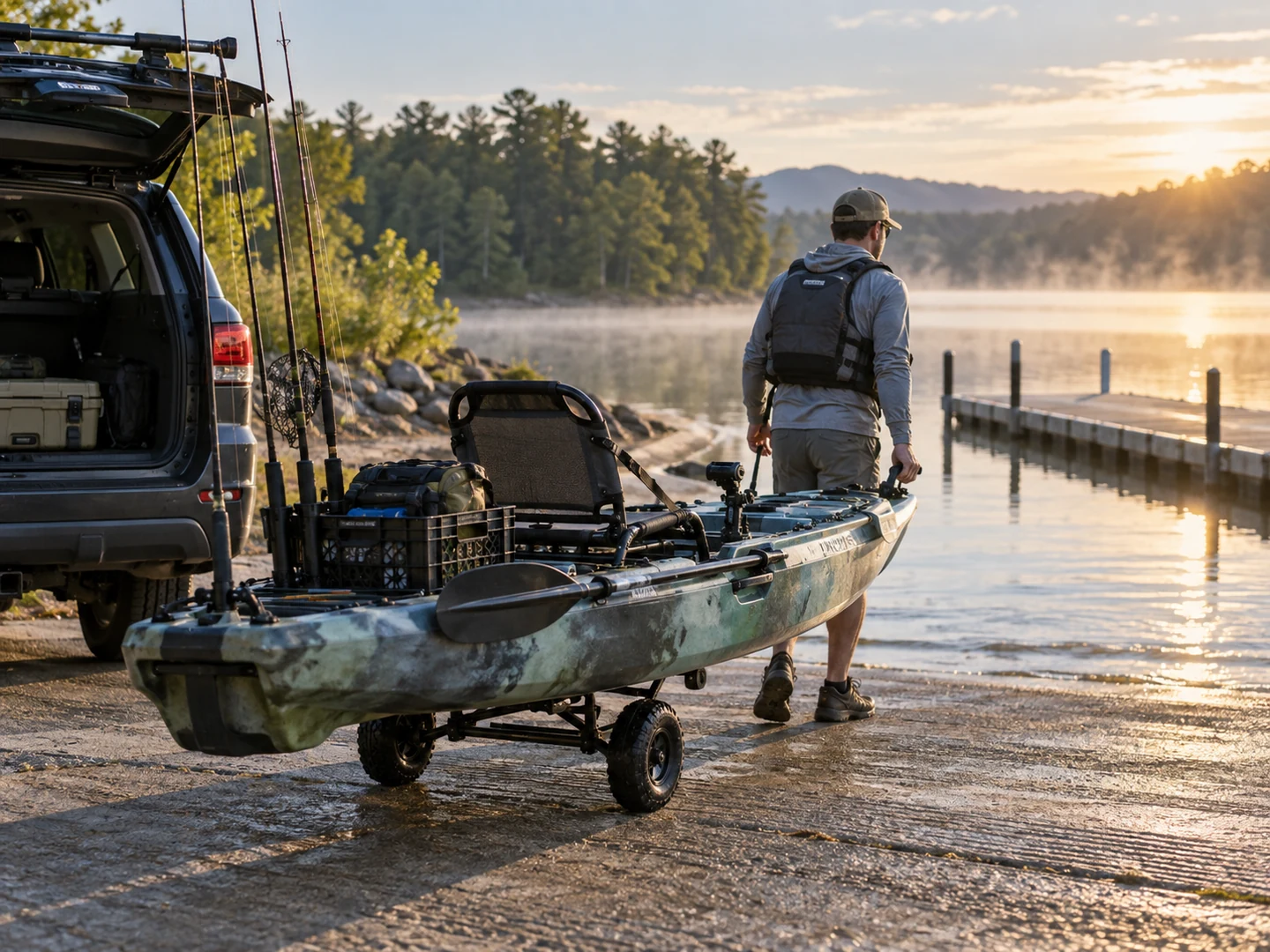
If you need to roof-load alone, carry down stairs, or launch far from the parking lot, give hull weight nearly as much importance as on-water features.
Quick picks
Old Town Sportsman PDL 120 Pro
High-capacity pedal platform with a rudder, gear tracks, mounting plates and substantial storage.
Perception Pescador Pro 12
A 12-foot fishing sit-on-top that stays relatively manageable at 64 lb without stripping away core rigging features.
Perception Outlaw 11.5
Wide 35-inch deck, elevated seat and 425 lb capacity for anglers who value room and stability over speed.
Pelican Catch Mode 110
Compact 10-foot-8-inch platform with a broad deck, raised seat and fishing-focused layout.
Pelican Catch Kicker 110 HDII
A 59 lb pedal kayak that reduces one of the biggest transport penalties of many pedal-drive boats.
Lifetime Tamarack Angler 100
A simple 10-foot fishing kayak with rod holders, storage and a much easier-to-handle hull weight.
Fishing kayak comparison
The dimensions below are for the current models or variants cited in this guide. Capacity labels are manufacturer figures and are not a substitute for leaving a sensible safety margin for the paddler, tackle, battery, motor and other gear.
| Kayak | Best for | Propulsion | Length | Width | Weight | Capacity | Buy |
|---|---|---|---|---|---|---|---|
| Old Town Sportsman PDL 120 Pro | Premium pedal fishing | Pedal | 12 ft | 36 in | 131 lb assembled | 565 lb total | View on Old Town |
| Perception Pescador Pro 12 | Balanced paddle setup | Paddle | 12 ft | 32.5 in | 64 lb | 375 lb | View on Perception |
| Perception Outlaw 11.5 | Stand-up stability | Paddle | 11 ft 6 in | 35 in | 77 lb | 425 lb | Check availability on Amazon |
| Pelican Catch Mode 110 | Compact stable platform | Paddle | 10 ft 8 in | 34.5 in | 67 lb | 375 lb | Check availability on Amazon |
| Pelican Catch Kicker 110 HDII | Lighter pedal setup | Pedal | 10 ft 5.5 in | 33 in | 59 lb | 300 lb | View on Pelican |
| Lifetime Tamarack Angler 100 | Basic starter fishing | Paddle | 10 ft | 31 in | 49.8 lb | 275 lb | Check availability on Amazon |
Old Town Sportsman PDL 120 Pro
Perception Pescador Pro 12
Perception Outlaw 11.5
Pelican Catch Mode 110
Pelican Catch Kicker 110 HDII
Lifetime Tamarack Angler 100
Old Town Sportsman PDL 120 Pro
PDL
Choose it when fishing control, storage and rigging matter more than easy solo transport.
Current Old Town specifications list a pedal drive, included rudder, bow and stern hatches, rod holders, accessory tracks and mounting plates. The manufacturer lists 420 lb of usable weight capacity after the assembled boat is accounted for.
The Sportsman PDL 120 Pro is the most feature-complete fishing machine here. A pedal drive keeps both hands available for rod work and boat control, while the 36-inch beam and Double-U hull design target stability. The deck and stern mounting provisions also make more sense for electronics-heavy anglers than a basic paddle kayak.
The compromise is obvious before launch day: weight. At 131 lb assembled, this is not the boat to buy first and solve transportation later. A trailer, bed extender, low rack, cart or a second set of hands can be part of the ownership plan.
Why it made the list
- Pedal propulsion leaves hands free while fishing
- High usable capacity for angler and gear
- Integrated rudder, tracks, hatches and mounting plates
- Wide fishing-oriented platform
Watch-outs
- 131 lb assembled weight changes transport logistics
- Overkill for short casual pond sessions
- Higher-complexity ownership than a paddle kayak
Perception Pescador Pro 12
64 lb
A useful middle ground for anglers who want real fishing features without moving into heavy pedal-platform territory.
Perception lists front and rear open storage, gear tracks, a fish-finder console, two molded-in rod holders and a replaceable skid plate on the current Pescador Pro 12.
The Pescador Pro 12 is the straightforward answer for someone who wants a fishing-specific sit-on-top but still expects to paddle, load and store it like a kayak rather than a small boat. Its 12-foot length gives more room for gear and more waterline than compact 10-foot models, while the 32.5-inch beam avoids chasing maximum width at all costs.
That balance is also its limitation. If stand-up casting is your main priority, a 35-inch platform such as the Outlaw is more purpose-built. If hands-free propulsion is non-negotiable, a pedal model belongs higher on your list.
Why it made the list
- 64 lb listed weight is manageable for a full-size fishing hull
- Useful bow and stern storage
- Accessory tracks and fish-finder-friendly center console
- 375 lb maximum capacity
Watch-outs
- No pedal drive
- Narrower than stand-up-first platforms
- Open storage favors dry bags and secured tackle
Perception Outlaw 11.5
35 in
A wide, roomy fishing deck for anglers who accept extra drag and transport weight in exchange for stability and space.
Current Perception specifications list a 35-inch beam, 77 lb hull weight and 425 lb maximum capacity. The current layout includes an elevated removable seat, large bow and stern storage areas, transducer scupper, rod storage and multiple accessory-mount locations.
The Outlaw is a better fit for anglers who think of the deck as a casting platform. The raised seat and broad open area make lure changes, tackle access and position changes easier than on narrower recreational hulls. It also gives larger paddlers and heavier fishing loads more capacity headroom than many entry-level kayaks.
Width is not free performance. A broad hull takes more effort to push through the water, and 77 lb is still meaningful when loading a roof rack. Buy it because you value stability and deck utility, not because it is the fastest way to cover several miles.
Why it made the list
- 35-inch beam and open deck favor stand-up fishing
- 425 lb maximum capacity
- High removable frame seat
- Fishing-specific storage and transducer provision
Watch-outs
- Wide hull is not built around paddling speed
- 77 lb can be awkward for solo roof loading
- No pedal propulsion in the base boat
Pelican Catch Mode 110
10’8
A compact wide-deck option for anglers who want fishing-platform stability without moving to a 12-foot hull.
The current Amazon US listing mapped here is ASIN B0CV841DJB, the Granite Catch Mode 110 with Transom Mount variant. Its product details list 128 x 34.5 x 13 inches, 67 lb and a 375 lb maximum capacity.
The Catch Mode 110 uses its width to create a broad fishing deck in a shorter hull. That makes it appealing for lakes, ponds and protected water where stability, seating position and tackle access matter more than maximizing glide. The transom-mount variant also gives buyers a clearer upgrade path if they plan a compatible motor setup later.
Short and wide is not automatically easier to move. At 67 lb, the boat still deserves a cart or a practical loading system. And if your normal day involves long crossings, a longer, narrower hull can be more efficient.
Why it made the list
- Wide 34.5-inch platform in a compact hull
- 375 lb maximum capacity
- Raised Ergoboost-style seating layout
- Exact current Amazon US variant is mapped
Watch-outs
- Wide compact hull gives up some paddling efficiency
- 67 lb still needs a transport plan
- Confirm motor compatibility and local rules before adding power
Pelican Catch Kicker 110 HDII
59 lb
A lighter pedal kayak for buyers who want hands-free propulsion but cannot justify a 100-plus-pound platform.
Current retail specifications for model MHP10P105-00 list a 59 lb assembled weight, 125.5-inch length, 33-inch width and roughly 300 lb maximum capacity. The current Amazon listing identifies the HyDryve II pedal system, but the listing was not strong enough at research time to justify an affiliate CTA in this package.
The Kicker’s reason to exist in this shortlist is not maximum capacity or maximum deck space. It is the weight gap. Pedal fishing kayaks can become difficult to handle on land, and a 59 lb boat is fundamentally different to load and cart than the Old Town at 131 lb assembled.
The lower capacity ceiling is the trade. A larger angler carrying a battery, electronics, crate, cooler and several rods can run out of comfortable payload margin sooner. Do the real load math before treating the light hull as an automatic win.
Why it made the list
- 59 lb listed weight is unusually manageable for a pedal kayak
- Hands-free pedal propulsion
- Compact dimensions for storage and transport
Watch-outs
- 300 lb capacity gives less payload headroom
- Amazon listing quality can vary by seller and time
- Not the choice for maximum rigging space
Lifetime Tamarack Angler 100
10 ft
A simple, lighter fishing kayak for calm-water anglers who would rather start fishing than build a complex rig.
Lifetime’s current Tamarack Angler 100 specifications list 120 x 31 x 14 inches, 49.8 lb and a 275 lb maximum capacity for current paddle-included versions. The Amazon mapping uses model 90508, which Amazon names the Lifetime Muskie Angler.
The Tamarack Angler 100 is here because transport friction can kill kayak use. A boat near 50 lb is easier to store, cart and load than the wider fishing platforms above. It also includes the fishing basics: rod holders, storage, a paddle keeper and a stable flat-bottom design.
It is not a substitute for a modern premium fishing platform. The capacity is lower, the seating is simpler and the 31-inch hull gives you less stand-up-focused deck than wider boats. But for short calm-water sessions, a simpler kayak that actually gets launched can be a better first purchase than an oversized rig.
Why it made the list
- About 50 lb manufacturer-listed weight
- Basic fishing storage and rod holders
- Paddle-included versions are available
- Simple ownership and storage needs
Watch-outs
- 275 lb capacity is modest for heavier fishing loads
- Basic seat compared with framed fishing seats
- Not designed around electronics-heavy rigging
How to choose a fishing kayak without buying too much boat
1. Start with propulsion, not accessories
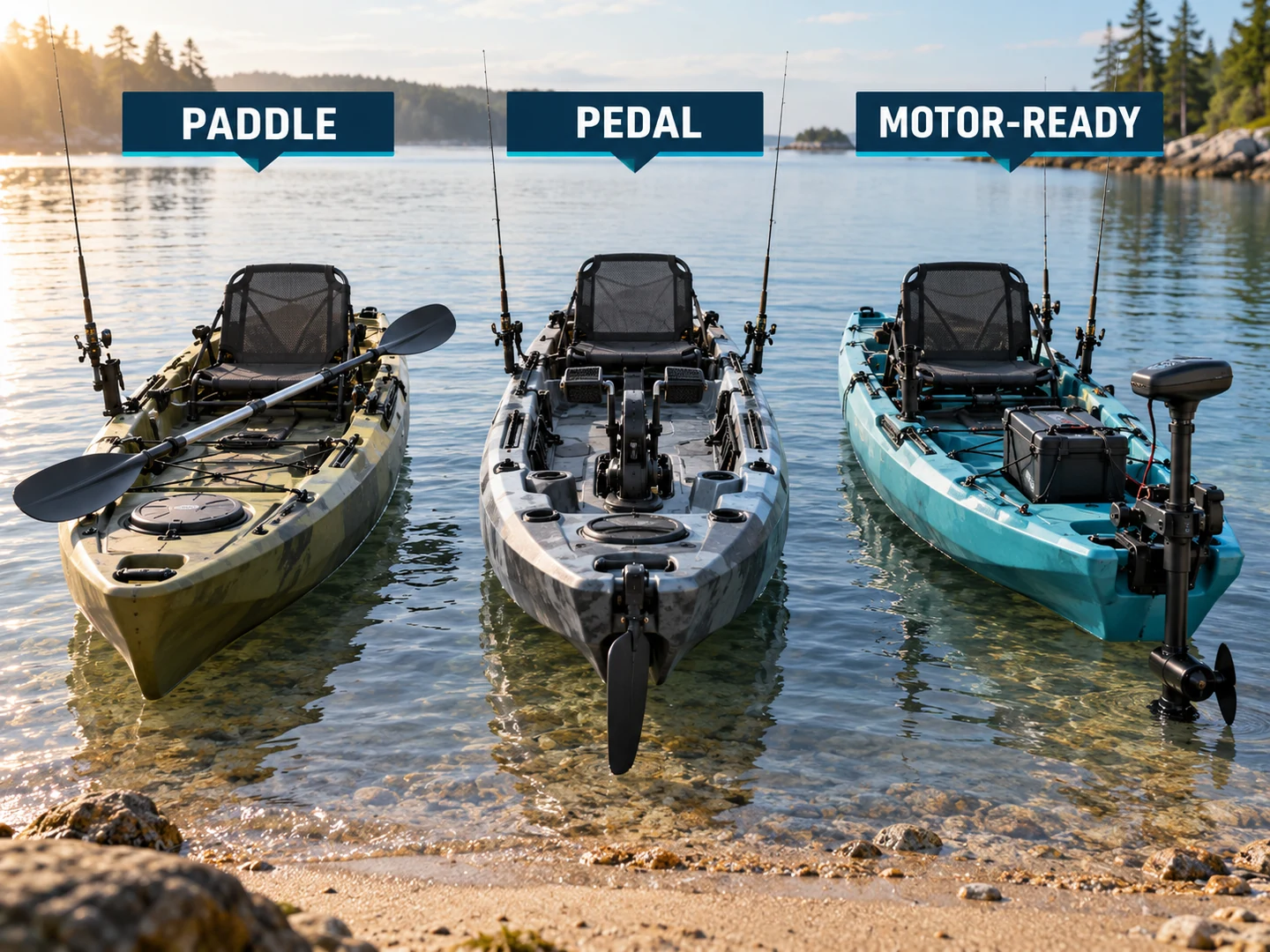
A paddle kayak is mechanically simple, usually lighter and easier to own. A pedal kayak frees your hands and can make boat positioning easier while casting or working a lure, but the drive adds cost, parts and usually weight. Motor-ready layouts can extend range, but a motor also adds battery weight, wiring, registration questions in some jurisdictions and another layer of transport planning.
For a first fishing kayak, choose the simplest propulsion system that solves your normal fishing problem. Do not pay for a complex drive because it looks impressive in a parking-lot demo.
2. Treat width as a trade-off
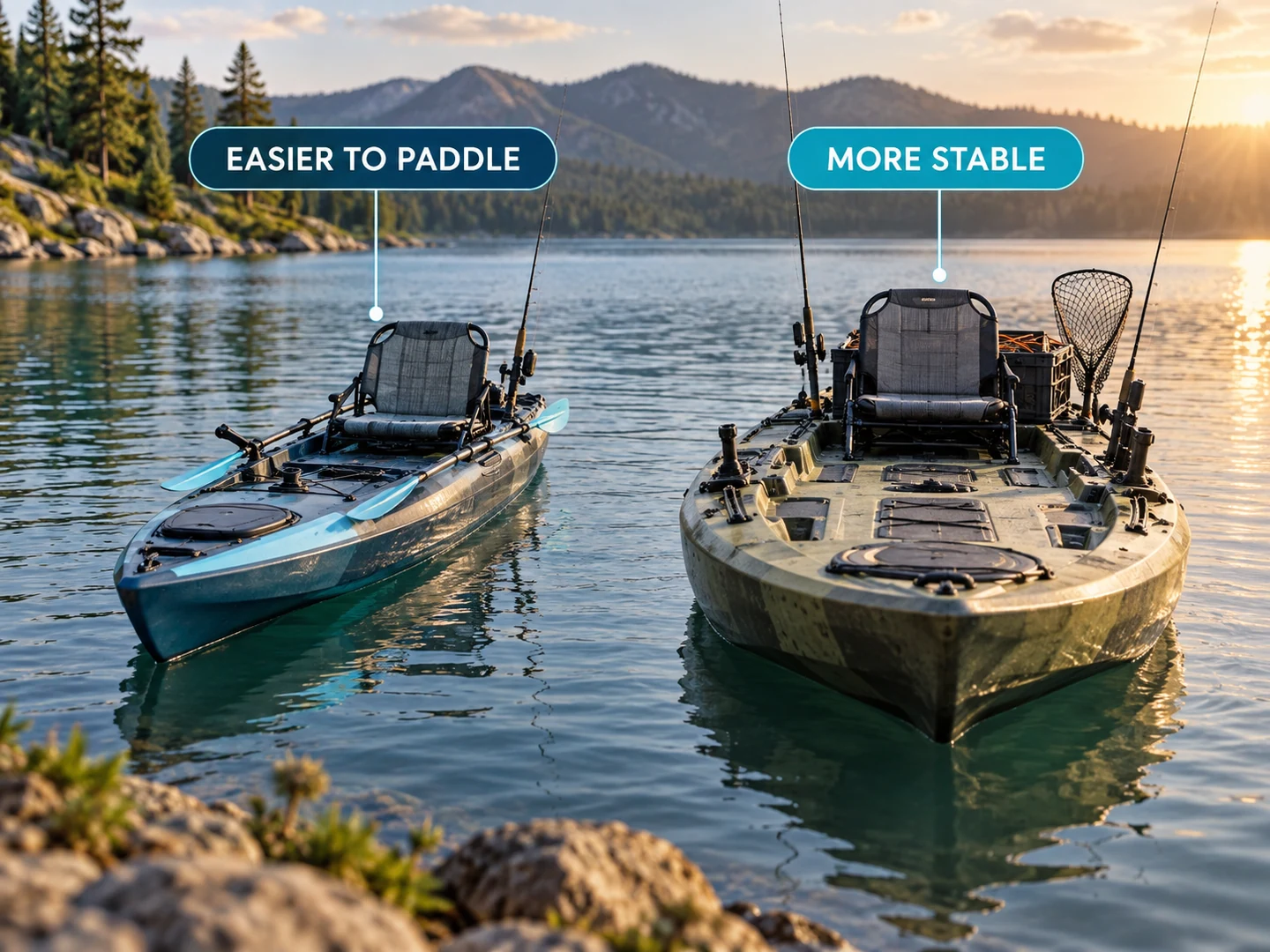
Wider fishing kayaks often feel more reassuring at rest and can provide more usable deck space for standing and moving around. The same width also increases wetted area and frontal area, which can make the boat slower to accelerate and more work to paddle. A 35- or 36-inch fishing platform makes sense when stability is central to how you fish. A narrower 31- to 33-inch hull can be the better ownership choice when you mostly sit, cover distance and load the boat alone.
3. Calculate payload with real gear
Maximum capacity is not a target operating weight. Add the paddler, PFD, water, tackle, rods, crate, cooler, electronics, battery, anchor system and anything else that actually goes aboard. Then leave useful margin rather than planning to live at the published maximum. On pedal and motor-oriented rigs, the equipment load climbs faster than many first-time buyers expect.
4. Measure the trip from garage to water
Hull weight matters every time you lift, drag, cart or rack the kayak. A 50- to 65-lb fishing kayak can still be awkward because of its length and width, but it is a different problem from a 100-plus-pound pedal platform. Measure your rack height, garage opening, storage length and launch carry before buying. If a cart is required, budget and store it as part of the system.
5. Buy fishing features that match your rig
Accessory tracks are useful when you actually plan to mount a fish finder, camera, rod holder or light. A transducer recess matters when electronics are part of the setup. Large tankwells matter for crates and coolers. Rod storage matters when you bring multiple combos. These features are valuable only when they reduce clutter or solve a repeatable fishing need.
Paddle vs pedal vs motor-ready: the practical difference
Paddle: lowest complexity and usually the best path to a lighter, cheaper boat. It remains the default for anglers who fish smaller water, launch frequently and value simple transport.
Pedal: strong choice when maintaining position and moving while keeping the rod in hand matters. The drive and rudder system add capability, but also weight, maintenance points and cost.
Motor-ready: useful when range, current or long approaches justify powered assistance. The boat is only one part of the system. Motor, battery, mount, wiring and legal requirements all need to be considered together.
This broad roundup intentionally stops at those decision-level differences. Dedicated pedal, inflatable, tandem and motor-kayak roundups should go deeper into their own product universes rather than being duplicated here.
How GearAndFish selected these kayaks
This guide was built from the current US search landscape and current product documentation. GearAndFish did not conduct original performance testing for this article, so the recommendations are based on verifiable specifications, fishing-specific design, transport burden, propulsion, capacity and the trade-offs each layout creates.
FAQ
What size fishing kayak is best for most adults?
There is no single ideal length, but many general-purpose solo fishing kayaks fall around 10 to 12 feet. Longer hulls can improve storage and tracking, while shorter hulls are easier to store and maneuver. Width, weight and capacity matter just as much as length.
Is a wider fishing kayak always more stable?
Width often contributes to initial stability and deck space, but hull shape matters too. Extra width can also make a kayak slower and harder to paddle. Choose width around whether you actually stand, carry heavy gear or prioritize relaxed stability over distance efficiency.
Is a pedal fishing kayak worth it?
It can be when hands-free movement and boat positioning materially improve how you fish. The trade-offs are higher purchase cost, more moving parts and usually more transport weight. For short calm-water trips, a lighter paddle kayak may be the better ownership fit.
How much capacity should a fishing kayak have?
Add the paddler plus all real fishing gear, electronics, battery, cooler and accessories, then leave margin below the manufacturer’s maximum. Do not choose a kayak whose published limit is only barely above your expected loaded weight.
Can you stand in a fishing kayak?
Some fishing kayaks are specifically designed around wide, stable standing platforms, but not every sit-on-top is intended for standing. Check the manufacturer’s design, your balance, water conditions and deck layout before making stand-up casting part of your plan.