
GearAndFish is reader-supported. As an Amazon Associate I earn from qualifying purchases. When you buy through links on our site, we may earn an affiliate commission, at no extra cost to you. Learn more.
Learning how to use a conventional reel starts with three controls: the free-spool release, the drag, and your thumb. The spool must turn freely when you cast or lower bait, stop when you need it to, and stay engaged when you retrieve. Once that sequence makes sense, a conventional reel becomes far less intimidating.
This is a technique guide based on conventional-reel operating manuals and public fishing-education resources, not a report of personal fishing trips or product tests. Control positions vary by model. Check your reel’s manual before adjusting anything unfamiliar.
How to use a conventional reel in seven steps
- Mount the reel above a compatible conventional rod and check the line path.
- Engage the reel, then set a sensible drag that can release line before your weakest connection fails.
- Hold the spool with your thumb before moving the clutch or lever into free spool.
- Cast smoothly or lower the rig under thumb pressure, depending on the reel and your technique.
- Slow the spool as the bait decelerates, and stop it at the target or when the weight reaches bottom.
- Return the reel to its engaged or fishing position and confirm that turning the handle collects line.
- Keep controlled tension during retrieval and let the drag work when a fish makes a strong run.
If you are fishing straight down from a boat, you may never need to make a cast. The free-spool, stop, engage, and retrieve sequence is still the same core skill.
Know the controls before you touch the clutch
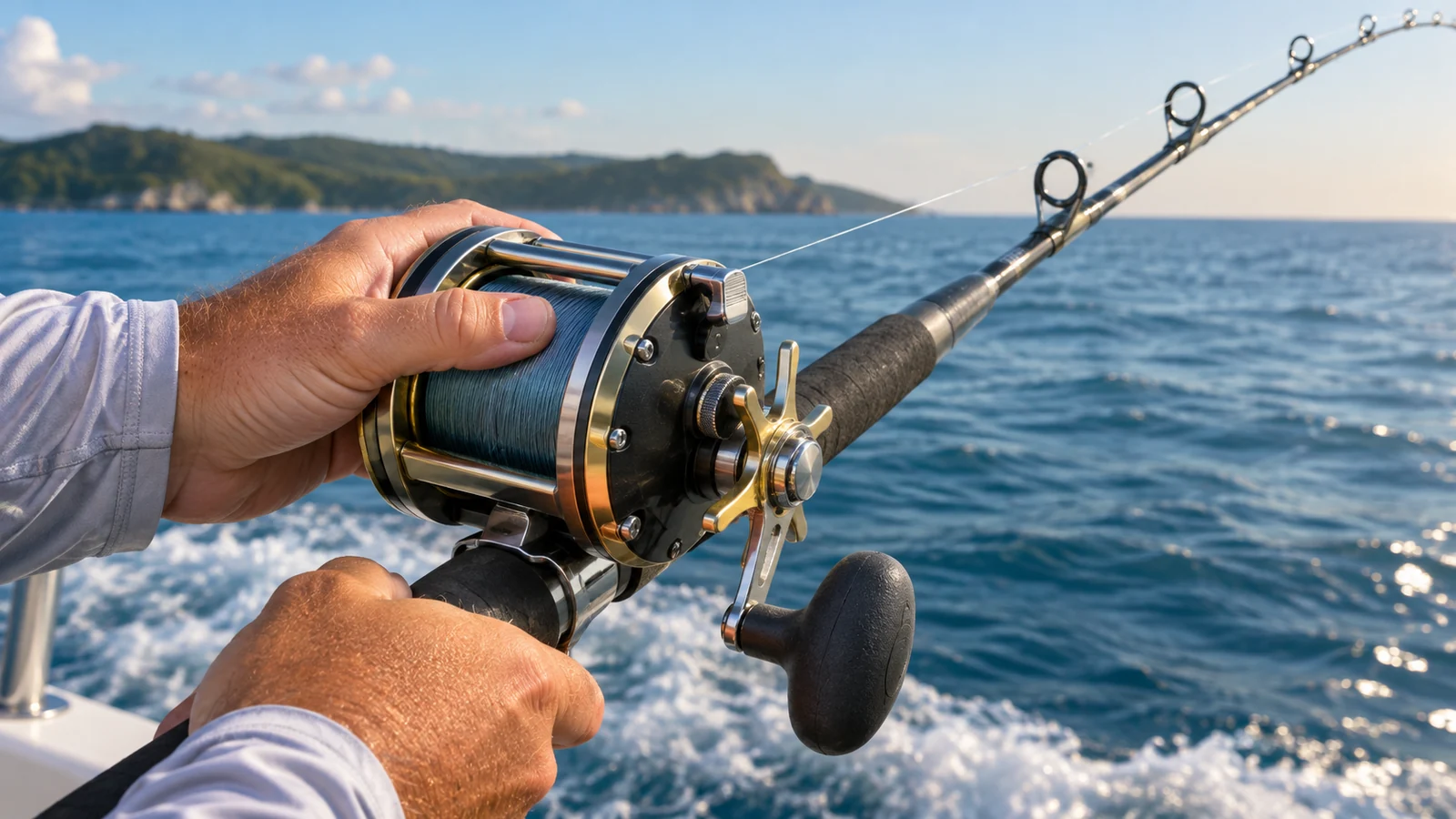
Most conventional reels mount on top of the rod and pay out line from a revolving spool. Unlike a spinning reel, the spool itself turns as line leaves. That direct connection explains both their appeal for boat fishing and their tendency to overrun when the spool keeps spinning after the bait slows.
- Free-spool lever or clutch: Disconnects the spool from the retrieve gears so line can leave. On some reels the handle re-engages it automatically; on others the lever must be moved back manually.
- Star drag: The star-shaped wheel by the handle controls resistance to a running fish when the reel is engaged. It is not the same thing as a casting brake.
- Lever drag: A drag lever moves between free, strike, and higher drag positions on many offshore reels. Its preset and strike-stop mechanism are model-specific.
- Spool-tension control and casting brakes: Present on some, not all, conventional models. They affect free-spool behavior. Do not overtighten a bearing cap just to suppress backlash.
- Clicker: When fitted, it makes an audible sound as line leaves. It is not a substitute for proper drag or thumb control.
- Level wind: A moving line guide that helps distribute incoming line across the spool. A reel without one requires manual line guidance during retrieval.
The word conventional covers compact casting-oriented star drags, traditional level-wind boat reels, and heavy two-speed lever drags. A low-profile freshwater baitcaster uses the same basic revolving-spool principle, but its thumb bar and braking layout are not universal instructions for all conventional reels.
Set up the rod, line, and drag before fishing
1. Mount the reel and inspect the line
Use a rod built for a conventional reel with guides above the blank. Seat the reel foot securely, tighten the reel seat, and use the reel clamp if the setup requires one. Thread the line through the reel’s level-wind guide, if present, and every rod guide. Look for a wrap around the blank or tip.
Check that the spool has line packed firmly and evenly, that the line is not buried under loose wraps, and that the capacity suits the reel and technique. If the spool needs completely new line, that is a separate, more detailed job than learning the controls here. Our spinning rod vs casting rod guide explains the basic reel-position difference, although offshore conventional rods may use specialty layouts.
2. Set fishing drag, not casting tension
On a star-drag reel, engage the clutch and pull line from the rod tip against the drag. Adjust the star gradually until the reel holds normal retrieving pressure but pays out line when the load becomes too high. A spring scale at the end of the rig gives a more repeatable reading than a hand pull.
On a lever-drag reel, use the manufacturer’s free-spool, preset, and strike procedure. Many lever-drag manuals require setting the preset while in free spool, then checking actual drag at strike with a scale. Turning the preset while heavily loaded can damage some models. Follow the exact manual rather than treating the preset as another star drag.
A common starting point is roughly one-quarter to one-third of a suitable line’s rated breaking strength, but this is not a universal setting. The rod, knot, leader, hook, species, and measured drag under load determine the safer working value. A weak leader or delicate hook may call for much less. Never set drag simply to the maximum number printed on the box.
3. Check free-spool movement with no hooks exposed
With your thumb resting on the spool, disengage it and let a safe practice weight pull a short length of line in a clear space. The spool should turn without grabbing or unusual grinding. If the model includes a casting tension control, begin with the maker’s setting and add only the resistance appropriate for your rig. Some traditional reels specify minimal side play at the bearing cap rather than using it as a brake.
How to cast a conventional reel without a backlash
Only cast a reel and rig designed for casting. A compact star-drag conventional reel can be cast effectively, but a large trolling-first reel, a heavy two-speed setup, or a rig that exceeds the rod’s casting rating is a poor practice platform. Use a hookless practice plug where casting is permitted, away from other people, pets, vehicles, and power lines.
- Start with control. Hold the rod securely and place your thumb on the spool. Allow an appropriate amount of line below the tip for the rod and practice weight; do not use a weight outside the rod’s rating.
- Release the clutch while holding the spool. Move the free-spool lever or casting release to the correct position without letting the sinker drop. Do not confuse the star drag with the release lever.
- Make a smooth forward stroke. Load the rod rather than snapping it. As the rod moves toward the target, ease your thumb off the spool to let line leave.
- Feather the spool. Apply light thumb pressure as the lure slows in flight. A revolving spool can keep feeding line even after the lure has lost speed.
- Stop the spool at splashdown. Press your thumb down before the weight hits the water or ground. That timing is the main defense against the loose loops that start a backlash.
- Engage and retrieve. Shift the clutch into gear as directed by your manual, or turn the handle on a model designed for automatic re-engagement. Confirm the spool is engaged before starting the retrieve.
Start with controlled, moderate casts. If you are constantly fighting overruns, reduce the effort, check line fill and spool condition, and adjust available braking according to the reel’s instructions. Distance can come later.
How to drop bait straight down from a boat
For bottom fishing, drifting bait, or vertical jigging, casting technique is often unnecessary. The important skill is controlling a sinking weight so the spool does not overrun when the rig reaches bottom.
- Check that the bait, sinker, and leader are clear of the rail, other lines, and passengers.
- Hold the spool with your thumb and move the reel into free spool.
- Ease off pressure so the weight lowers at a controlled pace. Keep a finger or thumb on the spool rather than letting it spin without supervision.
- As the rig approaches bottom, slow the spool. Stop it immediately when the sinker touches down or the line suddenly goes slack.
- Re-engage the reel and reel up slack until you can feel the weight or bait without pulling it out of the intended zone.
Use a clicker when its purpose suits your setup, such as alerting you to line movement while a bait is out. A clicker may add resistance and is not necessarily appropriate during every free drop. Consult the reel’s operating instructions.
Retrieve line and fight a fish without forcing the reel
Once the reel is engaged, maintain enough tension for line to wind in evenly. On a level-wind reel, the guide travels side to side. On a reel without a level wind, guide incoming line across the spool with your thumb or finger, keeping clear of pinch points. If line piles up against one side, stop and correct it before it jams against the frame.
When a fish pulls hard, keep the rod under controlled load and allow the drag to release line. Avoid grinding the handle while the spool is slipping against drag: it may recover little or no line. Instead, regain line when the fish eases pressure. Use the rod and reel together without high-sticking or lifting a heavy fish by the rod tip.
If you have a two-speed lever-drag reel, high gear recovers line faster while low gear provides greater mechanical advantage for sustained resistance. Shift only as the manufacturer’s mechanism allows. The lower ratio is not an invitation to exceed rod, line, or drag limits.
Star drag and lever drag: what changes in the sequence?
A star-drag conventional reel usually separates the fish-fighting drag (the star wheel) from the free-spool release (a lever or clutch). With a lever-drag reel, moving the lever to free spool and later to strike or a working drag position is part of the normal operating sequence.
- Star drag: Preset fishing drag with the reel in gear; hold the spool; disengage for the cast or drop; stop the spool; engage and retrieve.
- Lever drag: Establish the manufacturer’s strike preset correctly; hold the spool; move the lever to free; pay out line under control; then move to the appropriate fishing drag position.
Do not move a lever straight to full drag to compensate for a weak hookset or a running fish. Strike and full positions are not identical, and the preset determines the drag range. A scale and the reel’s instructions matter more than a generic setting.
Seven conventional-reel mistakes that cause problems
- Releasing the spool without a thumb on it: The weight can accelerate the spool unexpectedly, then slacken and produce a backlash.
- Confusing drag with spool tension: One manages the pull of a fish; the other, where fitted, influences free-spool resistance.
- Assuming every reel re-engages when cranked: Some conventional clutches must be shifted manually. Check your specific model.
- Overtightening a spool-bearing cap: A bearing adjustment is not always intended to function as a casting brake. Overadjustment can harm the reel.
- Letting line pile up on a non-level-wind spool: Uneven line can bind against a sideplate or bury subsequent wraps.
- Cranking against a slipping drag: You can waste effort and introduce line-management problems without gaining line.
- Trying to cast a trolling-first rig: A long heavy rod, oversized sinker, or bulky reel can make practice unsafe and frustrating.
Backlash fix: Stop reeling and keep the spool from spinning. Ease tension on the loose loops and work out the overrun carefully rather than pulling hard against a tight knot. If the line is deeply embedded or damaged, cut out the compromised section and check the remaining spool fill before fishing again.
Three conventional reels that illustrate the different controls
You do not need to buy a new reel to learn these steps. These are exact-model retail references for three distinct control layouts, not rankings or claims of first-party use. They are here to help you recognize the controls on real equipment. Verify the specific selection and current seller availability before ordering.
PENN Squall II Star Drag 12: a compact star-drag example
The SQLII12SD is a right-hand star-drag conventional reel with PENN’s Live Spindle design. It is a useful reference for learning the sequence of thumb-on-spool, free-spool release, cast or drop, then manual engagement. The size 12 version is a different reel from the Squall II 15 Casting Special; do not assume their casting-control features are identical.
Check the Squall II 12 on Amazon
PENN General Purpose Level Wind 209M: a line-guide example
The traditional 209M, boxed version has a level-wind guide that helps lay line across the spool. It illustrates why some conventional reels do not require you to distribute incoming line manually. That does not remove the need for thumb control when letting line out. This model makes more sense as a boat-fishing control example than as a long-distance casting recommendation.
Shimano SpeedMaster II 12: a two-speed lever-drag example
The SPM12II is a right-hand two-speed lever-drag reel with published 5.7:1 and 3.1:1 ratios. Its control sequence is different from a star-drag Squall: the lever moves between free spool and fishing drag, and its high/low gear selection is a separate operation. It suits the explanation of heavier vertical fishing rather than beginner casting drills.
Check the SpeedMaster II 12 on Amazon
For a fuller comparison by fishing job, read our best conventional reels guide. That page handles the buying decision; this one stays focused on actually operating the reel.
What to do after a saltwater trip
Follow the maker’s rinse and maintenance instructions. A gentle freshwater rinse and drying are common recommendations, but blasting a reel with high-pressure water can push salt and grit deeper into its internals. Inspect the exposed line, level-wind mechanism, drag function, and spool rotation before storage. Servicing intervals and lubrication points differ by model.
How GearAndFish prepared this guide
We reviewed conventional-reel operating instructions from Fin-Nor and Okuma, basic fishing-education material on revolving-spool casting, the current GearAndFish conventional-reel buying guide, and exact Amazon.com US product pages for the three reference reels. The control instructions are deliberately separated by star-drag, level-wind, and lever-drag designs because the mechanisms are not interchangeable.
Research check: October 31, 2026. No personal fishing, casting-distance measurements, or direct product-testing claims are implied. Product links are keyed to the exact listed variations; live prices and inventory are not promised.
How to use a conventional reel: FAQ
Do you need to cast a conventional reel?
No. Many conventional reels are used for dropping bait, jigging vertically, bottom fishing, and trolling. The same free-spool control is useful even when you never make an overhead cast.
Why does my conventional reel backlash?
The spool continues rotating after the bait or sinker slows, so loose line accumulates faster than it can leave. Use steady thumb pressure and stop the spool at splashdown or when a bottom-fishing weight lands.
Is the star drag the same as the spool-tension knob?
No. The star drag changes how much pressure a fish must apply to pull line when the reel is engaged. A spool-tension control, when fitted, changes how freely the spool rotates in free spool.
How do I engage a conventional reel after dropping bait?
Stop the spool with your thumb, then use the clutch or lever as your model directs. Some reels engage when the handle turns and others require you to shift the lever manually. Confirm the reel is collecting line before lifting the rig.
Should I use a level-wind reel as a beginner?
A level wind can simplify line distribution during retrieval, especially when lowering bait from a boat. It does not prevent every backlash or guarantee suitability for repeated casting. Choose the reel for your fishing job, not only for the line guide.