
GearAndFish is reader-supported. As an Amazon Associate I earn from qualifying purchases. When you buy through links on our site, we may earn an affiliate commission, at no extra cost to you. Learn more.
Saltwater spinning reels live a harder life than general-purpose freshwater reels. Salt spray, grit, hard-running fish, wet kayak decks, and surf exposure all punish the body, bearings, drag, and line roller. The best choice is not simply the reel with the highest drag number. It is the reel whose size, protection level, line capacity, weight, and retrieve speed match how and where you actually fish.
The best saltwater spinning reel for most demanding all-around use
Our best overall pick is the Shimano Saragosa SW A 6000HG. It combines a rigid metal body, Shimano’s saltwater-focused protection systems, an IPX8-rated body, practical 30-pound braid capacity, and a 5.7:1 gear ratio that is fast enough for casting work without turning the reel into a pure speed specialist.
The main trade-off is weight. At 16 ounces, the 6000HG is better suited to medium-heavy inshore, surf, nearshore, and light offshore setups than to all-day finesse casting on a light rod. For a lighter inshore build, the Daiwa Saltist MQ 4000D-XH is easier to balance. For harder surf use and frequent spray, the PENN Slammer IV 4500 is a more sealed workhorse. For budget-conscious anglers who can keep the reel out of the sand and water, the Daiwa BG 4000 remains a strong value.
Quick picks
- Best Overall: Shimano Saragosa SW A 6000HG – strong sealing and broad inshore to offshore usefulness.
- Best Budget: Daiwa BG 4000 – rigid aluminum body and proven saltwater value if you do not need explicit waterproof sealing.
- Best Inshore: Daiwa Saltist MQ 4000D-XH – 10.2-ounce body, fast retrieve, and strong drag in a compact saltwater-focused package.
- Best Heavy-Duty Workhorse: PENN Slammer IV 4500 – IPX6 body and spool sealing, 30-pound max drag, and a tough metal platform.
- Best Premium Protection: PENN Authority 4500 – IPX8 sealed body and spool with stainless steel main and pinion gears.
- Best High-Speed Value: PENN Battle IV 4000HS – a 7.0:1 retrieve and Hydro Armor protection for anglers who want speed without moving into premium pricing.
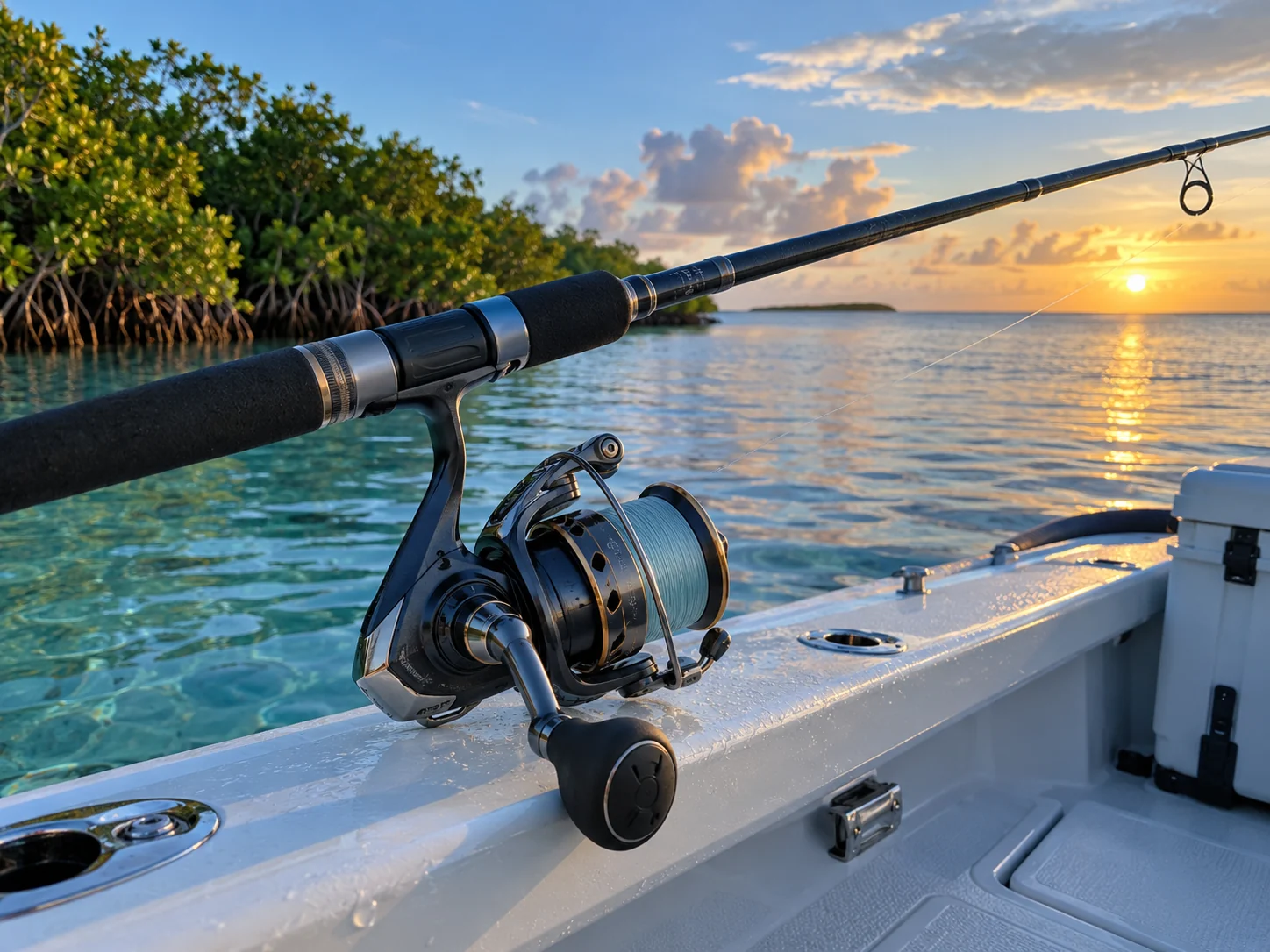
Saltwater spinning reel comparison
These are exact variants, not family-level averages. Reel size labels are not standardized across brands, so compare the listed weight, capacity, drag, and use case rather than assuming every 4000 or 6000 is physically equivalent.
| Reel | Exact variant | Gear ratio | Max drag | Braid capacity example | Salt protection | Best fit | Amazon |
|---|---|---|---|---|---|---|---|
| Shimano Saragosa SW A | 6000HG | 5.7:1 | 22 lb | 30 lb / 295 yd | IPX8 body, X-Protect, waterproof Cross Carbon drag | Versatile hard-use saltwater | Check availability on Amazon |
| Daiwa BG | BG4000 | 5.7:1 | 17.6 lb | 30 lb / 280 yd | No published IP rating | Budget inshore and boat use | Check availability on Amazon |
| Daiwa Saltist MQ | 4000D-XH | 6.2:1 | 26.4 lb | 20 lb / 280 yd | Magsealed main shaft, MQ weather-resistant body design | Light inshore and kayak casting | Check availability on Amazon |
| PENN Slammer IV | 4500 | 6.2:1 | 30 lb | 20 lb / 320 yd | IPX6 sealed body and spool | Surf, kayak, and rough salt use | Check availability on Amazon |
| PENN Authority | 4500 | 5.7:1 | 30 lb | 20 lb / 320 yd | IPX8 sealed body and spool | Premium durability and harsh exposure | Check availability on Amazon |
| PENN Battle IV | 4000HS | 7.0:1 | 15 lb | 20 lb / 295 yd | Hydro Armor protection on critical components | Fast lure work on a value budget | Check availability on Amazon |
Shimano Saragosa SW A 6000HG
5.7:1
22 lb
30 lb / 295 yd
IPX8 body
Daiwa BG 4000
5.7:1
17.6 lb
30 lb / 280 yd
No published IP rating
Daiwa Saltist MQ 4000D-XH
6.2:1
26.4 lb
10.2 oz
Magsealed main shaft
PENN Slammer IV 4500
6.2:1
30 lb
20 lb / 320 yd
IPX6 body and spool
PENN Authority 4500
5.7:1
30 lb
15 oz
IPX8 body and spool
PENN Battle IV 4000HS
7.0:1
15 lb
20 lb / 295 yd
Hydro Armor
Our picks in detail
Shimano Saragosa SW A 6000HG
Best
Overall
The Saragosa SW A 6000HG is the most balanced choice here for anglers who want one serious saltwater reel that can move from heavier inshore work to surf, nearshore jigging, live bait, and light offshore duty. Shimano lists a rigid HAGANE Body and Gear, Infinity Drive, X-Protect, an IPX8-rated waterproof body, and a waterproof Cross Carbon drag. The exact 6000HG variant uses a 5.7:1 ratio, weighs 16 ounces, and holds 295 yards of 30-pound PowerPro.
That combination matters more than a headline drag figure. A reel this size needs enough capacity to handle long runs, enough body rigidity to stay aligned under load, and protection that makes sense around salt spray. Recent saltwater roundups from Field & Stream and Outdoor Life also continue to treat the Saragosa family as a serious saltwater workhorse rather than a freshwater reel that merely tolerates salt.
Best for
- Medium-heavy inshore and nearshore setups
- Surf anglers who want high water resistance
- School tuna, tarpon, cobia, big striped bass, and similar demanding saltwater work
Skip if
- You are building a light 7-foot finesse setup
- You mainly throw small artificials all day
- You do not need the capacity or 16-ounce mass of a 6000-class reel
Important spec note: Shimano’s current US specification chart lists 22 pounds of max drag for the 6000HG. Some marketplace data for the same ASIN shows a higher number, so we use the manufacturer figure here.
Daiwa BG 4000
Best
Budget
The BG 4000 remains one of the clearest value plays for saltwater anglers who want a rigid aluminum body and useful line capacity without paying for premium sealing. Daiwa positions the BG family for both freshwater and saltwater use. The exact BG4000 uses a 5.7:1 gear ratio, weighs 14.3 ounces, carries 17.6 pounds of max drag, and holds 280 yards of 30-pound J-Braid.
The reason it does not rank above the more expensive reels is protection, not basic strength. Daiwa does not publish an IP waterproof rating for the BG 4000. That makes it a better fit for boat and controlled inshore use than for reels that routinely sit in breaking surf, get splashed on a low kayak deck, or risk submersion. Community discussions repeatedly make the same distinction: the BG is respected for value, but anglers who expect constant wet exposure often step up to more sealed models.
Best for
- Budget-minded inshore anglers
- Boat fishing where the reel can be kept out of the water
- Anglers who value a rigid metal body over minimum weight
Skip if
- You regularly dunk reels
- Your reel gets heavy surf wash or kayak spray
- You want explicit IP-rated protection
Rinse it gently with fresh water after salt use, wipe it dry, and follow Daiwa’s maintenance guidance. Do not treat an unsealed reel like a surf reel simply because it can catch saltwater fish.
Daiwa Saltist MQ 4000D-XH
Best
Inshore
If your priority is repeated casting rather than maximum line capacity, the Saltist MQ 4000D-XH is the compact standout in this group. The exact variant weighs 10.2 ounces, uses a 6.2:1 ratio, has 26.4 pounds of max drag, and carries 280 yards of 20-pound braid. Daiwa combines an aluminum Monocoque body, a larger internal gear, and a Magsealed main shaft to improve rigidity and reduce exposure to salt and grit.
That light weight is the big reason to consider it over the heavier PENN and Shimano options. A 10.2-ounce reel is much easier to balance on a 7- to 8-foot inshore rod when you spend hours casting topwaters, soft plastics, bucktails, or small metals. The trade-off is that Daiwa does not give this model a simple IP rating that can be compared directly with an IPX6 Slammer or IPX8 Authority.
Best for
- Redfish, snook, striped bass, trout, and similar inshore targets
- Kayak or skiff anglers who care about weight
- Fast lure presentations and frequent casting
Skip if
- You want a published waterproof IP rating
- You need heavy offshore line capacity
- Your reel is likely to spend time underwater
PENN Slammer IV 4500
Hard
Use
The Slammer IV 4500 is the pick for anglers who care more about hard-use durability than shaving every ounce. PENN gives the Slammer IV an IPX6 sealed body and spool, a sealed Slammer drag system, all-brass CNC gearing, and a hydrophobic line roller bearing. The exact standard 4500, not the 4500HS, uses a 6.2:1 ratio and 30 pounds of max drag.
Its 15-ounce weight is noticeable on a light rod, but that same robust construction makes more sense in surf, kayak, jetty, and nearshore settings where spray is routine and a reel may get knocked around. Angler discussions about Slammer alternatives often frame the same trade-off: plenty of strength and protection, with more mass than smoother or lighter competitors.
Best for
- Surf, jetty, kayak, and rough boat use
- Anglers who prioritize sealing and drivetrain strength
- Heavier inshore and nearshore fish
Skip if
- You want the lightest possible setup
- You mainly fish small lures on a medium-light rod
- You prefer a more refined feel over a rugged build
PENN Battle IV 4000HS
Fast
Value
The Battle IV 4000HS is the high-speed option in this list. The HS designation matters: this is the 7.0:1 variant, not the standard BTLIV4000 with a 6.2:1 ratio. PENN lists 15 pounds of max drag, 295 yards of 20-pound braid capacity, a full metal body and sideplate, CNC Gear technology, HT-100 carbon drag, and Hydro Armor protection for critical components.
A faster reel can be useful when you need to pick up slack quickly, burn a lure, or keep contact with a fish that changes direction. The downside is that speed is not the same thing as torque, sealing, or durability. If you routinely fish rough surf or dunk-prone situations, a more heavily sealed reel makes more sense.
Best for
- Fast lure retrieves
- Anglers who want a newer saltwater-focused reel below premium pricing
- Inshore use where 15 pounds of max drag is enough
Skip if
- You prefer a slower, more torque-focused retrieve
- You need IP-rated body sealing
- You are targeting fish that demand larger line capacity
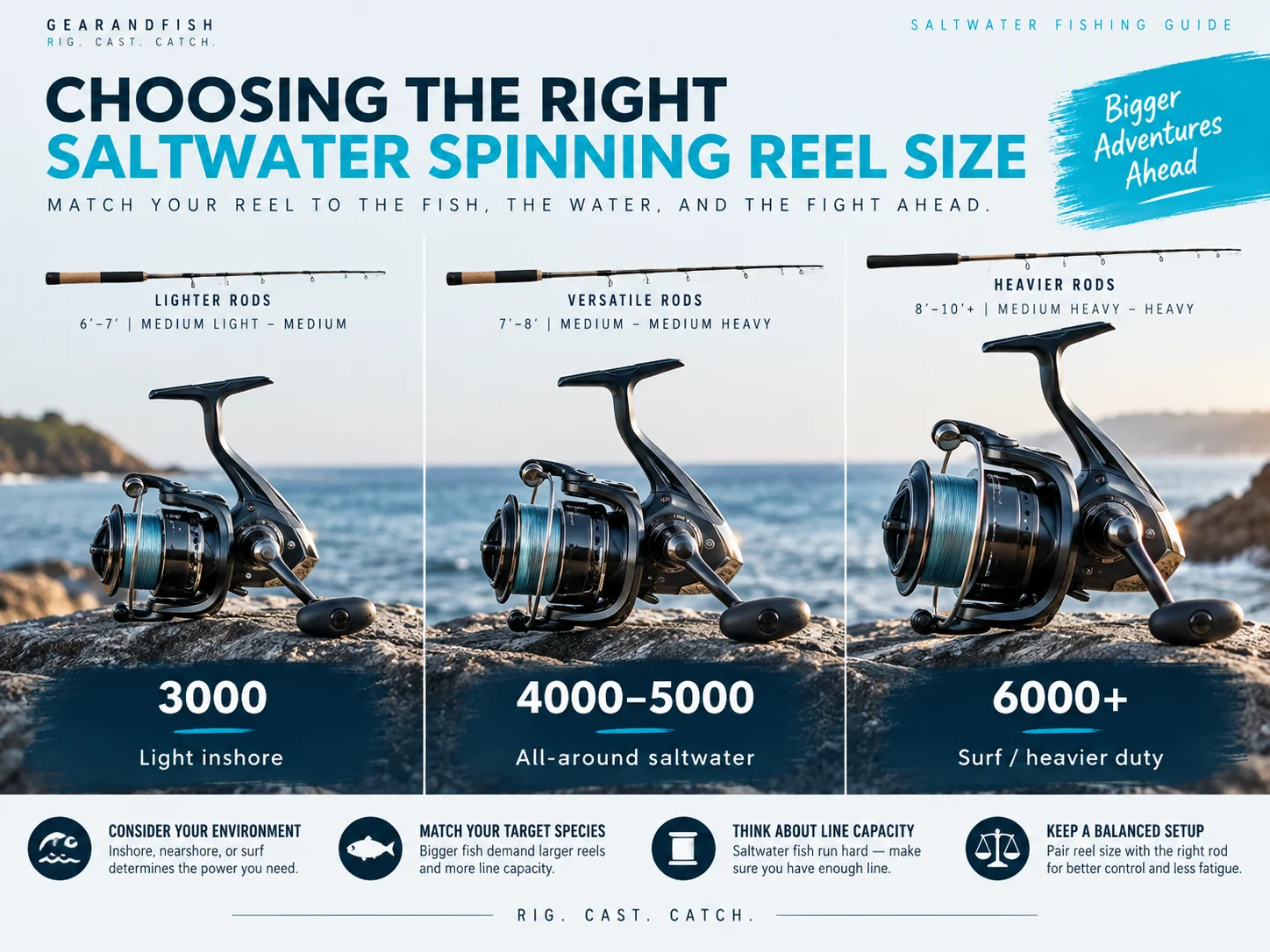
How to choose the right saltwater spinning reel
1. Start with reel size, but do not trust the number by itself
A 4000 reel from one brand can differ substantially from a 4000 from another. Use size labels as a family guide, then verify the exact model’s weight, line capacity, and drag. For most inshore lure work, 3000 to 4000 class reels are common. A 4000 to 5000 class reel is often a versatile middle ground for heavier inshore, light surf, and nearshore use. A 6000 and larger reel makes more sense when line capacity, larger fish, heavier rods, or offshore applications drive the decision.
The correct size should balance the rod. A reel that is technically powerful enough can still be a poor match if it makes a 7-foot rod feel tip-light and handle-heavy, or if it adds unnecessary fatigue during a full day of casting.
2. Match protection to real salt exposure
There is a practical difference between a reel that occasionally sees salt spray from a boat and one that lives on a surf rod, kayak, or jetty. If your reel stays mostly above the water, corrosion-resistant construction plus careful rinsing may be enough. If it gets frequent spray, a protected body, sealed drag, and better line roller protection become more valuable. If submersion or breaking surf is a realistic risk, look for a manufacturer that explicitly publishes a waterproof or IP rating for the exact model.
3. Treat max drag as a limit, not a buying target
The highest drag number rarely wins the comparison by itself. In many real setups, line strength, knots, leader material, rod power, hook size, and the fish’s mouth all place lower practical limits on drag. Smoothness, heat management, repeatability, and the ability to maintain alignment under load can matter more than a huge headline number.
4. Buy enough line capacity for the water and species
In shallow inshore water, you may not need hundreds of yards of heavy braid. In surf, around bridges, or offshore, additional capacity can provide a useful buffer when a fish makes a long run or current increases effective load. Compare the braid capacity for the pound test you actually plan to use, not just the largest number printed in the chart.
5. Pick retrieve speed around technique
High-speed reels recover slack quickly and can help with fast-moving lures, topwaters, metals, or fish that run toward the angler. Moderate ratios can feel more natural when working heavier resistance or when you value torque and control over raw pickup speed. The 7.0:1 Battle IV 4000HS is a good example of a purpose-specific high-speed variant, while the standard 4500 Slammer and 6000HG Saragosa sit closer to all-around saltwater gearing.
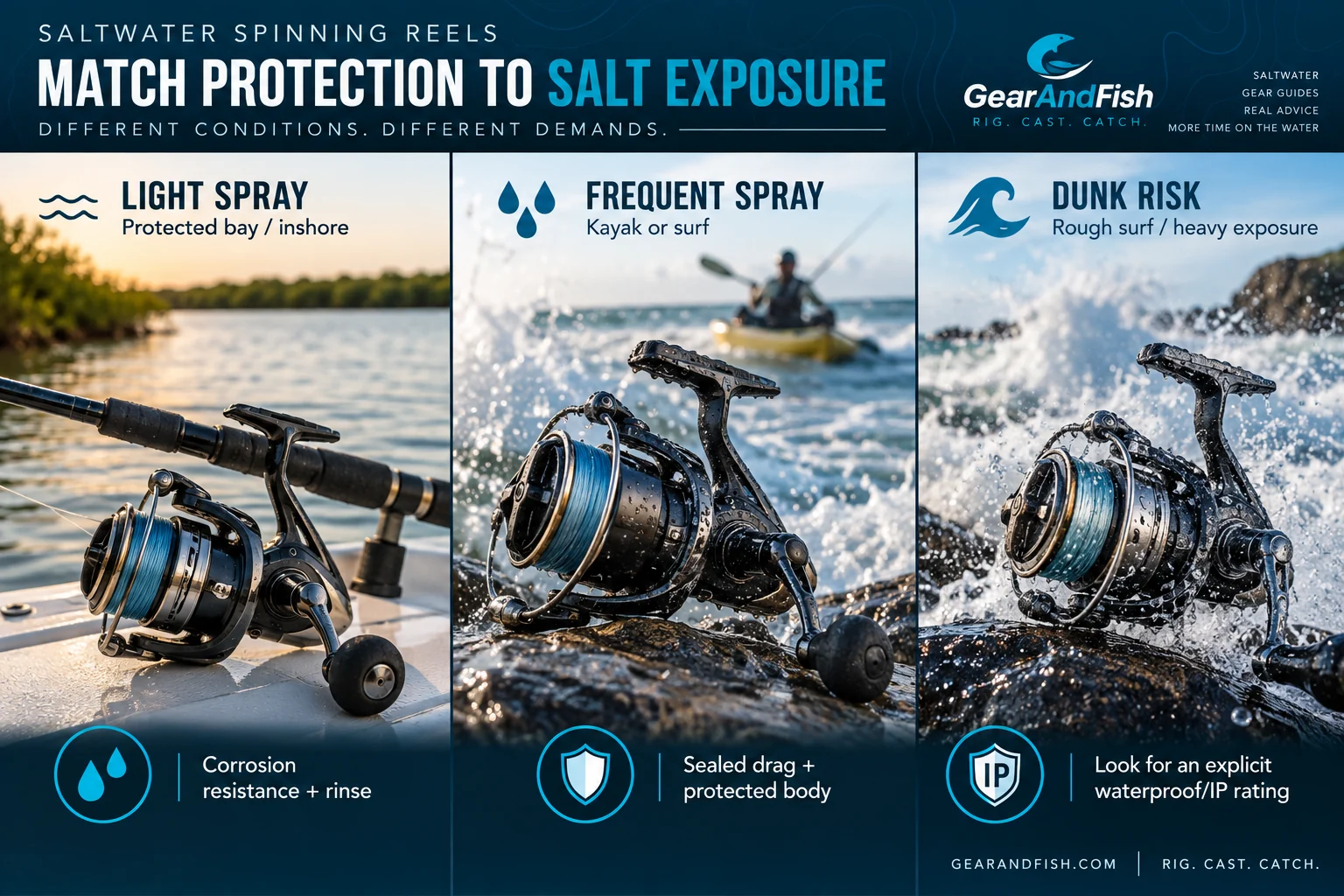
Saltwater reel care matters almost as much as the reel you buy
Even a well-protected saltwater reel benefits from routine care. After saltwater use, follow the manufacturer’s instructions, rinse gently with fresh water, avoid forcing high-pressure water into seals and bearings, wipe the reel dry, and inspect the line roller, bail, handle, and spool for trapped salt or sand. Periodic lubrication and professional service intervals depend on the model and how heavily it is used.
Also remember that an IP rating is not permission to neglect the reel. Waterproof ratings describe controlled ingress resistance, not immunity to sand, salt crystals, impact damage, or poor maintenance.
How we built this shortlist
GearAndFish did not run its own on-water test program for this article. This is a research-based buyer’s guide built from current manufacturer specifications, exact Amazon.com US variant checks, recent professional saltwater reel roundups, retailer data used to cross-check exact variants, and angler discussions used as a secondary signal for recurring trade-offs.
We gave the most weight to five things: saltwater protection, exact variant specifications, line capacity, weight and balance, and whether the model fills a distinct buyer need. We did not copy another publication’s rankings, score products numerically, or treat a single review as a universal owner pattern.
Amazon links were checked against the exact model numbers shown in this guide. Marketplace prices, star ratings, review counts, and stock can change, so we do not hard-code those values into the article.
Final verdict
For a single serious saltwater spinning reel that can cover a wide range of demanding situations, the Shimano Saragosa SW A 6000HG is the most convincing all-around choice in this group. Its main downside is the 16-ounce weight, so anglers building a lighter inshore setup should look first at the Daiwa Saltist MQ 4000D-XH.
If your budget matters more than waterproofing, the Daiwa BG 4000 remains a practical value. If the reel will see heavy spray, surf, kayak use, or rough treatment, the PENN Slammer IV 4500 makes the stronger durability case. The PENN Authority 4500 is the premium choice when maximum published sealing is worth the price, while the PENN Battle IV 4000HS is the more focused pick for anglers who specifically want a fast 7.0:1 retrieve.
FAQ
What size spinning reel is best for saltwater fishing?
There is no single best size. A 3000 to 4000 class reel often suits lighter inshore fishing, 4000 to 5000 can cover a broad middle range, and 6000 or larger makes sense when you need more line capacity, heavier tackle, surf capability, or offshore power. Always compare the exact model’s weight and capacity because size labels are not standardized across brands.
Is a 4000 reel big enough for saltwater?
Yes for many inshore and light surf applications. The bigger question is whether that exact 4000 has enough line capacity, drag, salt protection, and rod balance for your target species and environment.
Do I need a fully sealed reel for saltwater?
Not always. A reel used carefully from a boat can last with good corrosion resistance and maintenance. Frequent surf wash, kayak spray, or dunk risk makes stronger sealing much more valuable. Look for explicit manufacturer protection claims rather than assuming a reel is sealed because it is marketed for saltwater.
Is more max drag always better?
No. Enough smooth, controllable drag for your line and target fish matters more than the highest number. Rod power, knots, leader strength, hooks, and line test often set lower practical limits.
Should I choose a high-speed saltwater spinning reel?
Choose high speed when your technique benefits from fast line pickup, such as quick topwater work, metals, or rapidly recovering slack. For heavier resistance or a more general-purpose setup, a moderate ratio can be easier to control.