
GearAndFish is reader-supported. As an Amazon Associate I earn from qualifying purchases. When you buy through links on our site, we may earn an affiliate commission, at no extra cost to you. Learn more.
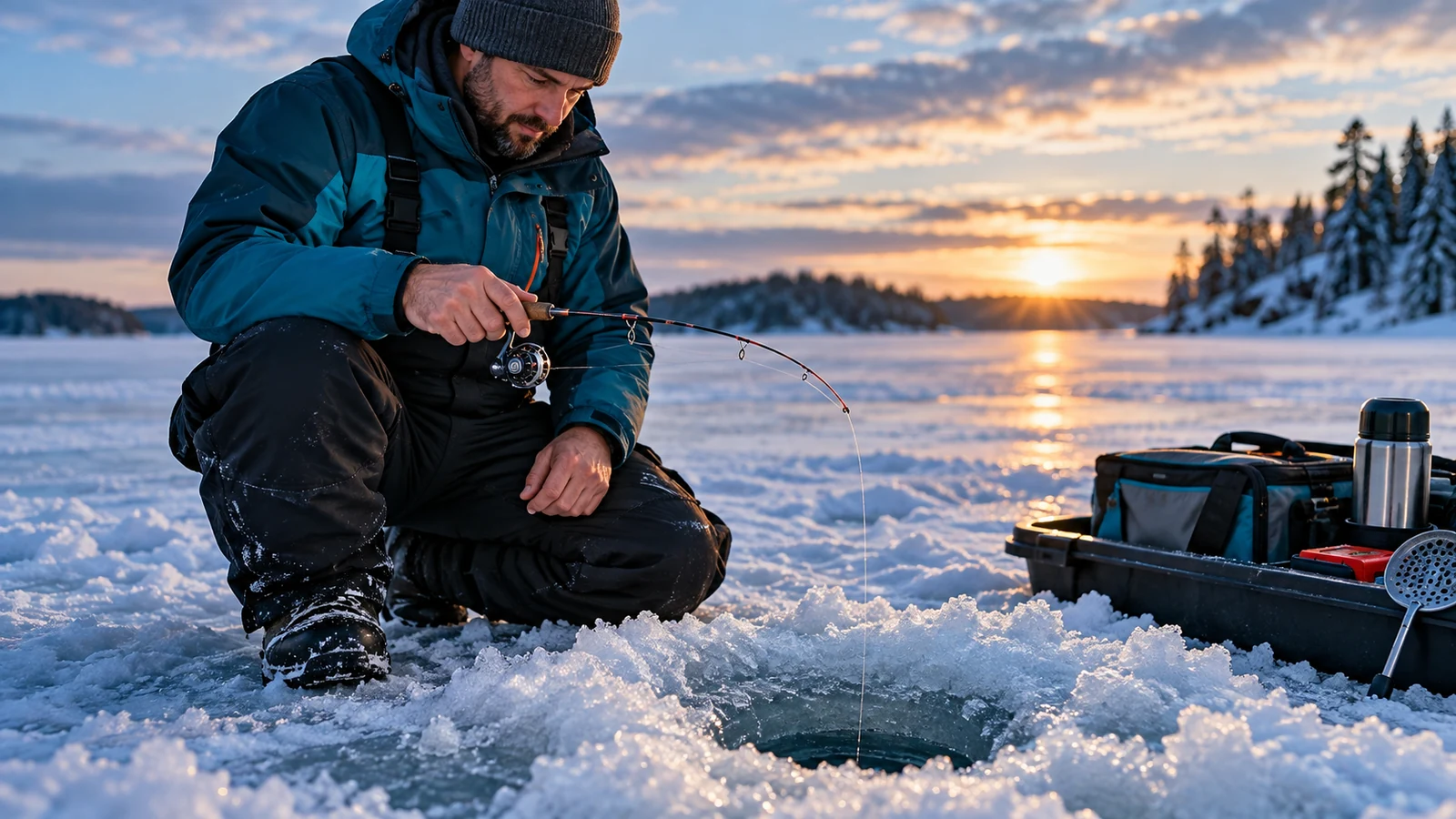
The best ice fishing reels are not simply the smallest reels you can bolt to a short rod. Hard-water fishing puts the reel close to slush and freezing water, makes glove-friendly controls more important, and turns line twist into a real presentation problem. For most anglers, the decision comes down to a purpose-built inline reel for controlled vertical jigging or a compact spinning reel for familiar handling and broader versatility.
Best ice fishing reels: choose the reel style before the brand
Choose the Shimano Sedona FJ 1000 if you want a polished spinning reel that works on the ice and still makes sense for light open-water fishing. Choose the 13 Fishing FreeFall Ghost Aluminum if you want a dedicated inline reel with one-handed drop control and minimal line twist. The Pflueger President Inline is the value play, the Piscifun ICX Carbon is the light inline option, and the Daiwa QR750 is a compact panfish-friendly spinner.
Quick picks
Shimano Sedona FJ 1000
A balanced 1000-size spinner with a 7 lb drag rating, proven Shimano architecture and enough versatility to earn use after ice-out.
13 Fishing FreeFall Ghost Aluminum
A current-generation inline built around a FreeFall trigger, aluminum spool, drop-speed control and 2.5:1 gearing.
Pflueger President Inline
One-handed free spool plus a magnetic brake, with a faster 5.0:1 ratio than many dedicated inline reels.
Piscifun ICX Carbon
A 5.8 oz carbon-frame inline with magnetic drop control, 8+1 bearings and a 3.2:1 ratio.
Daiwa QR750
A compact 750-size spinning reel that Daiwa specifically positions for trout, panfish and ice fishing.
Ice fishing reel comparison
| Reel | Type | Key specs | Best for | Amazon |
|---|---|---|---|---|
| Shimano Sedona FJ 1000 | Spinning | 5.0:1, 3+1 bearings, 7 lb drag, 7.6 oz | Versatile panfish and walleye setups | Check availability |
| 13 Fishing FreeFall Ghost Aluminum | Inline | 2.5:1, 3+1 bearings, FreeFall trigger | Controlled vertical jigging | Check availability |
| Pflueger President Inline | Inline | 5.0:1, 5+1 bearings, magnetic brake | Fast-pickup inline value | Check availability |
| Piscifun ICX Carbon | Inline | 3.2:1, 8+1 bearings, 5.8 oz | Lightweight jigging setup | Check availability |
| Daiwa QR750 | Spinning | 750 size, 5.1:1, 3 ball bearings | Light-line panfish and trout | Check availability |
Shimano Sedona FJ 1000
Type: Spinning
Key specs: 5.0:1, 7 lb drag, 7.6 oz
Best for: Panfish, walleye and crossover use
13 Fishing FreeFall Ghost Aluminum
Type: Inline
Key specs: 2.5:1, 3+1 bearings, FreeFall trigger
Best for: Precise vertical drops
Pflueger President Inline
Type: Inline
Key specs: 5.0:1, 5+1 bearings, magnetic brake
Best for: Faster pickup and controlled drops
Piscifun ICX Carbon
Type: Inline
Key specs: 3.2:1, 8+1 bearings, 5.8 oz
Best for: Low-fatigue jigging
Daiwa QR750
Type: Spinning
Key specs: 750 size, 5.1:1, 3 ball bearings
Best for: Panfish, trout and light line
Inline vs spinning reels for ice fishing
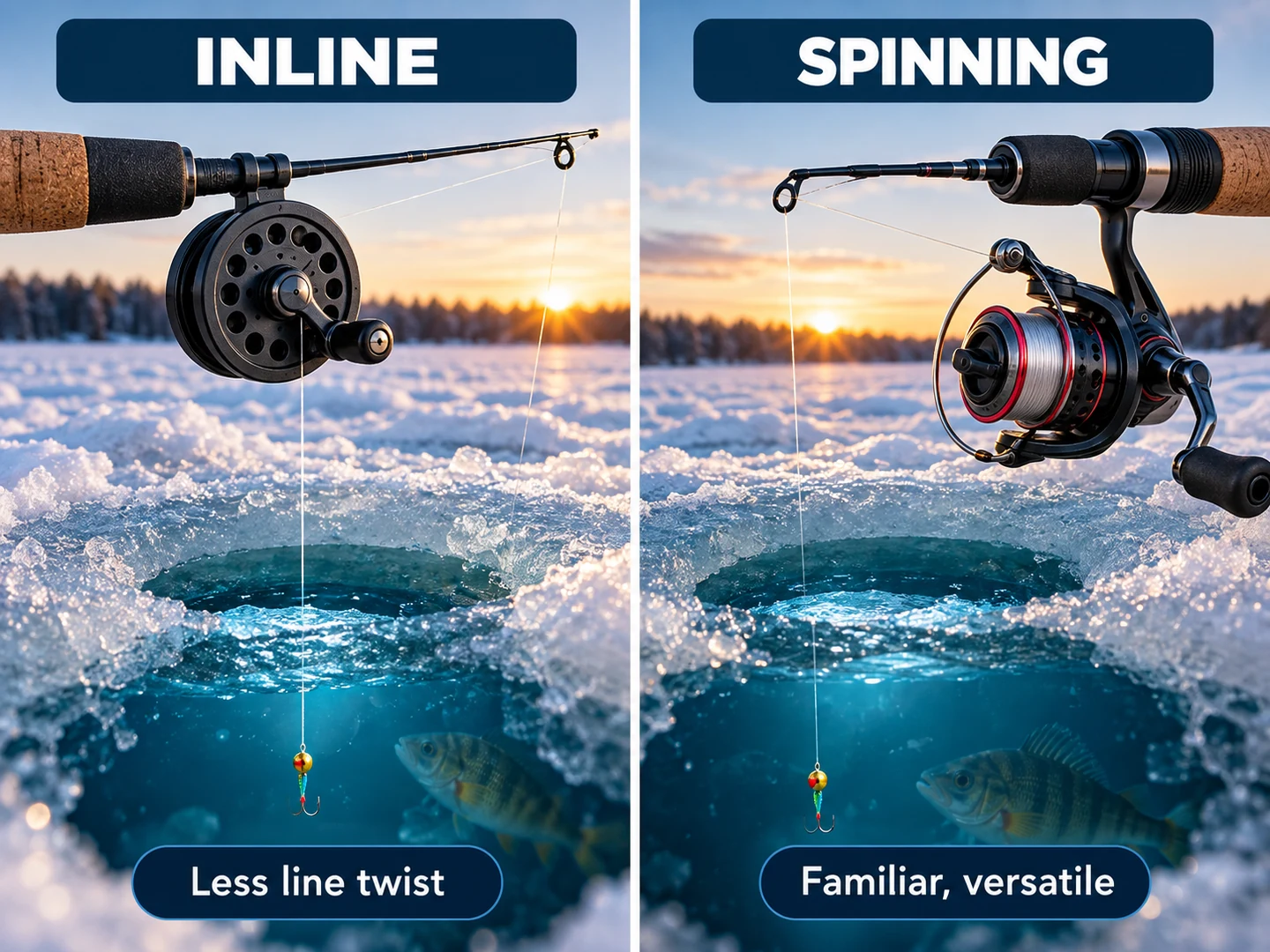
Inline and spinning reels solve different problems. An inline reel keeps the spool in the same plane as the line, so the line can leave the reel in a straighter path during a vertical drop. That is useful when you are working small tungsten jigs and want to reduce the corkscrew effect that line twist can pass into a lure. Many dedicated inline models also add a trigger or lever that lets you free-spool a jig with one hand.
A compact spinning reel is easier to understand if you already fish spinning tackle. It also crosses over to open-water use more naturally. The tradeoff is that the bail and spool geometry can add twist over repeated vertical drops, and the exposed bail, roller and drag area give slush more places to collect. This does not make spinning reels a bad choice. It means a 500 to 1000-size spinning reel is the better fit when familiarity, versatility and stronger conventional drag matter more than eliminating as much twist as possible.
For shallow panfish and finesse jigging, inline reels make a strong case. For anglers who move between ice and open water, or who simply prefer conventional controls, a small spinning reel is usually the lower-friction decision.
Shimano Sedona FJ 1000
Pick #1
The Sedona FJ 1000 is the safest choice for anglers who want one compact spinning reel that feels at home on an ice rod but is not trapped in winter-only duty.
The main advantage here is balance. A 1000-size body gives you enough spool and drag for walleye while remaining reasonable on short light and medium-light ice rods. Shimano’s G Free Body layout shifts the reel’s center of gravity closer to the rod, which is relevant when a short setup spends hours in your hand.
The Sedona is not an ice-specific inline reel, so it does not solve line twist the way a straight-line spool can. It is the pick for an angler who wants familiar bail control, conventional drag adjustment and a reel that can keep working on a trout or panfish rod when the lake opens.
Good fit if you want
- A familiar spinning layout with polished Shimano ergonomics
- Enough drag and capacity for panfish through walleye duty
- A reel that can move to open-water ultralight or light spinning
Skip it if you need
- The lowest possible line twist for vertical jigging
- One-handed trigger drops to exact sonar marks
- An ice-only reel with a straight-line spool
13 Fishing FreeFall Ghost Aluminum
Pick #2
Choose the current Ghost Aluminum if your ice fishing revolves around vertical jigging, watching fish on sonar and stopping a lure at a specific depth.
The reason to buy this reel is control on the drop. Pull the trigger to free the spool, stop the lure where you want it, and keep the line in a straight inline path rather than wrapping it around a spinning spool. That is particularly useful when you are moving a small jig up and down in a narrow vertical column.
It is more specialized than a compact spinner. If you are new to inline reels, retrieve orientation and trigger feel deserve attention before you buy. The current Amazon listing we verified is the right-hand FGA-2.5-RH version, so confirm the retrieve you want on the product page.
Good fit if you want
- Fast one-handed free-spool control
- Reduced line twist for vertical presentations
- A current-generation inline reel with an aluminum spool
Skip it if you need
- A reel you will regularly use for casting after ice-out
- The fastest possible retrieve ratio
- A conventional spinning-reel learning curve
Pflueger President Inline Ice Reel
Pick #3
The President Inline stands out because it combines a one-handed free-spool trigger and magnetic brake with unusually fast 5.0:1 gearing for an inline reel.
Many inline reels favor slower gearing because vertical jigging does not require a long cast-and-retrieve cycle. The President’s 5.0:1 ratio changes that feel. It can pick up line faster when you need to move a lure, check bait or bring a fish toward the hole, while the magnetic brake still gives you a way to tune the descent.
The 3.5 lb max drag is a reminder that this is not a brute-force lake-trout winch. It makes more sense for panfish, perch and typical walleye work on light line. For those jobs, the combination of trigger, brake and faster retrieve gives it an unusually practical spec sheet for the price.
Good fit if you want
- Magnetic drop control without a premium-inline price
- A faster retrieve than most dedicated inline reels
- Cold-oriented features such as dedicated gear lubricant
Skip it if you need
- High drag pressure for large lake trout or pike
- The lightest reel in this group
- A multipurpose open-water spinning reel
Piscifun ICX Carbon Inline Ice Reel
Pick #4
The ICX Carbon is a strong fit for anglers who want a lighter inline reel with a faster 3.2:1 ratio and a broad magnetic drop-control range.
Weight matters more on a 24 to 32 inch ice rod than many anglers expect. A reel that is only a few ounces heavier can make a short finesse setup feel butt-heavy. The ICX Carbon keeps the body light while retaining the line-control features that make an inline reel useful in the first place.
The 3.2:1 ratio is also a middle ground. It retrieves faster than 2.5:1 FreeFall designs without jumping all the way to the Pflueger’s 5.0:1. If you spend a lot of time hopping holes and watching a sonar screen, that balance is appealing.
Good fit if you want
- A light inline reel for long jigging sessions
- Magnetic control over lure descent
- More pickup speed than a 2.5:1 inline reel
Skip it if you need
- The simplest possible mechanical layout
- A reel that doubles as an open-water spinner
- A specific retrieve orientation that the listing does not offer
Daiwa QR750 Ultralight Spinning Reel
Pick #5
The QR750 is the compact spinning pick for panfish anglers who want something smaller than a typical 1000-size reel without moving to an inline system.
The QR750 is not trying to be a heavy walleye reel. Its appeal is proportion. On a light ice rod with 2 to 6 lb mono or comparable light braid, a 750-size reel keeps the setup compact and easy to pack while preserving the familiar bail-and-drag controls of a spinner.
If you mostly chase bluegill, crappie and perch, that compactness can be more useful than added line capacity. Anglers who routinely target bigger walleye or lake trout should move up to a stronger 1000-size spinning reel or an appropriately sized inline option.
Good fit if you want
- A very compact spinning reel for short ice rods
- Light-line panfish and trout use
- A folding handle for storage in a rod case or bucket
Skip it if you need
- More line capacity for deep-water larger fish
- Inline-style drop control
- A reel centered on walleye and lake-trout power
How to choose an ice fishing reel
Start with target species and presentation
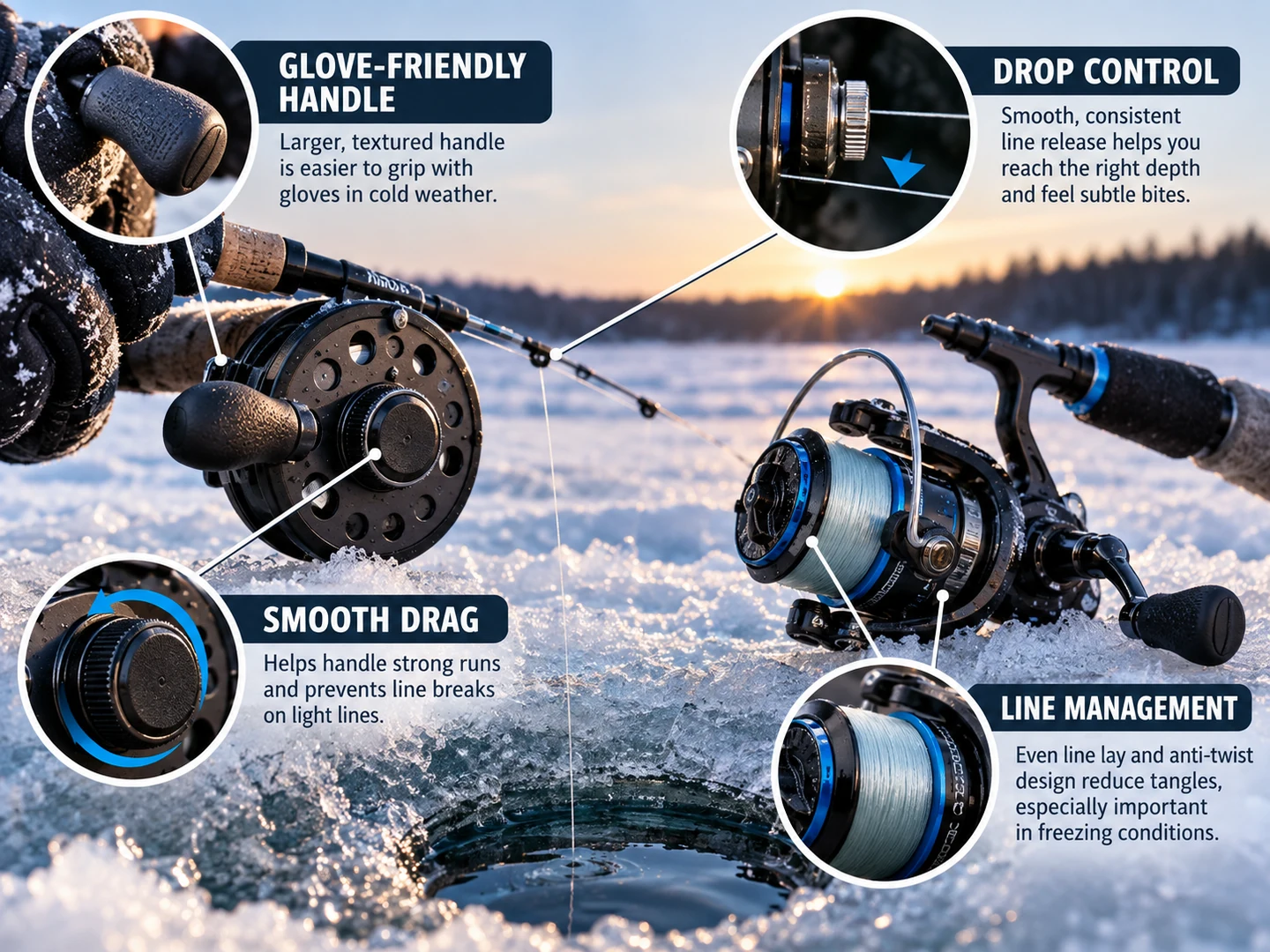
Panfish on tiny jigs place a premium on light weight, line behavior and fine drag adjustment. Walleye add more concern about pickup speed and drag consistency. Larger lake trout and pike push you toward stronger drags, more capacity and reels that remain comfortable with heavier line. The best reel for a shallow crappie basin is not automatically the best reel for 60 feet of lake-trout water.
Match reel size to the short rod
Ice rods magnify imbalance because they are short. A full-size open-water reel can make a 28 inch rod feel clumsy and can place the spool and bail unnecessarily close to snow and slush. For spinning tackle, 500, 750 and 1000 sizes are the most useful starting point for common panfish and walleye setups. Always compare actual reel weight and line capacity because size numbers are not standardized across brands.
Prioritize smooth drag over headline drag pressure
Light ice lines do not need enormous drag numbers. They need predictable startup and fine adjustment. A reel that can release line smoothly at low settings is more useful with 2 to 6 lb line than one with a huge maximum rating but poor low-end control. For bigger species, maximum drag matters more, but line strength and rod power still set the practical limit.
Think about controls with gloves on
Large knobs, obvious drag controls and one-handed free-spool triggers are not cosmetic features in January. Cold fingers make small switches and slippery handles harder to manage. If you fish outside a shelter, simple controls can matter as much as bearing count.
Keep water and slush out of the system
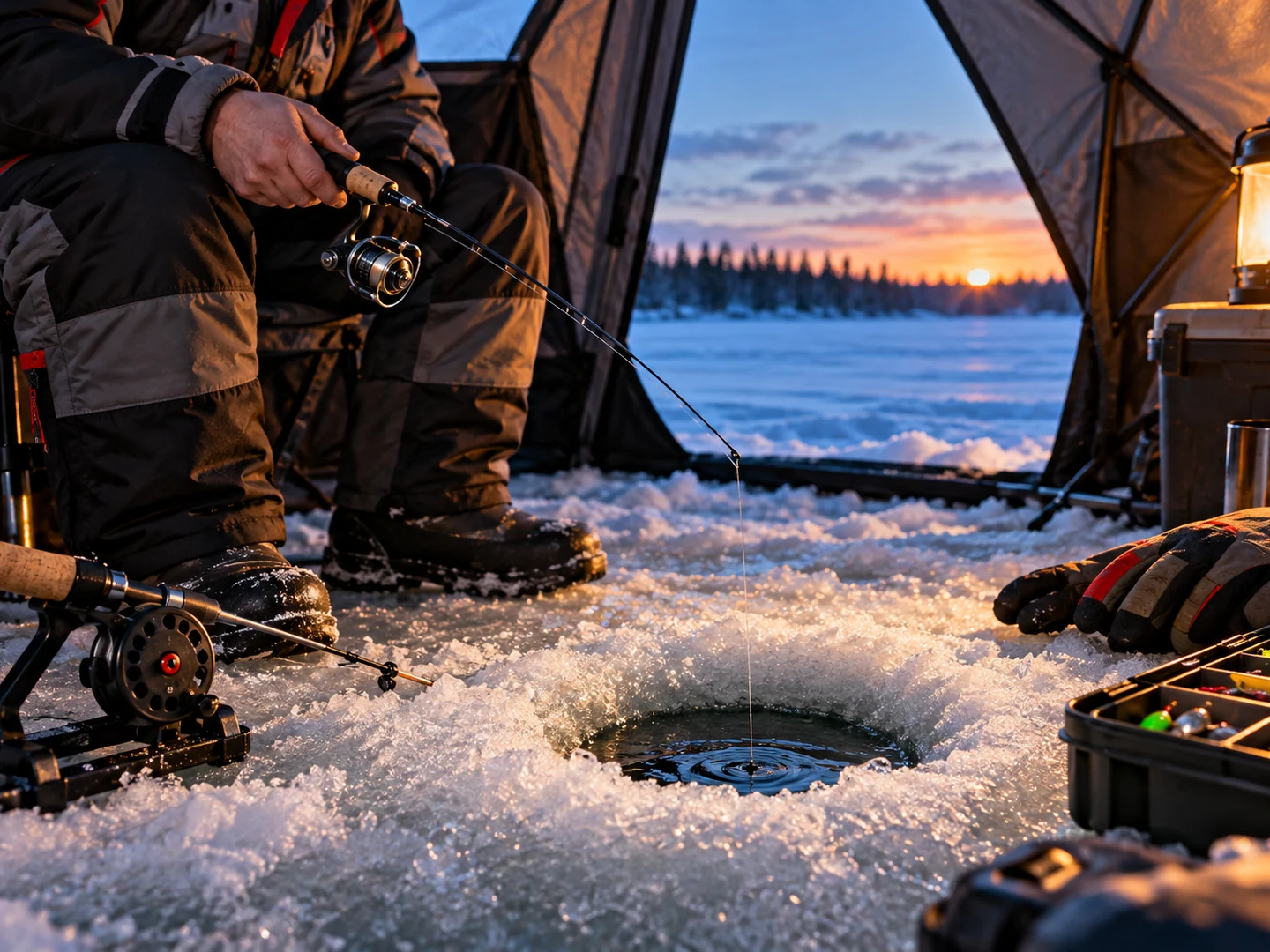
No reel is immune to freeze-up. Avoid laying the reel directly in wet snow, clear slush from the hole, and resist the urge to dunk a frozen reel into lake water. A warm shelter can reduce icing, but moving a wet reel repeatedly between warm air and subfreezing temperatures can also create condensation that later freezes.
How we chose these reels
This roundup is research-based, not a claim of GearAndFish field testing. We checked the current US search results for the main topic and the inline-reel subtopic, then verified current model specifications against manufacturer pages and mapped exact Amazon.com US ASINs. We favored reels that represent distinct buyer use cases rather than filling the list with near-duplicate models.
Selection factors included reel architecture, cold-weather usability, line management, drag, weight, gear ratio, line capacity, control layout and whether the exact model still has a current US product path. Amazon price and availability can change, so the buttons are intentionally labeled to check current availability instead of publishing a fixed price.
Best ice fishing reels FAQ
Are inline reels better than spinning reels for ice fishing?
Inline reels are better for reducing line twist and controlling straight vertical drops. Spinning reels are more familiar, usually more versatile outside winter and often the easier choice for anglers who want one reel for both ice and open water.
What size spinning reel is best for ice fishing?
For most panfish and walleye setups, 500 to 1000-size spinning reels are a practical starting point. Compare actual reel weight, line capacity and drag because size labels are not standardized between brands.
What gear ratio is best for an ice fishing reel?
There is no single ideal ratio. Slower inline reels around 2.5:1 favor controlled vertical work, while faster inline and spinning reels recover line more quickly when you are hole-hopping, checking bait or bringing fish up from deeper water.
Why does line twist matter so much when ice fishing?
Ice fishing often keeps a jig in a narrow vertical column. Twist in light line can make a small jig spin unnaturally instead of hanging cleanly, which can hurt presentation when fish are inactive or inspecting the lure closely.
Can I use a normal spinning reel for ice fishing?
Yes, especially in 500 to 1000 sizes. A compact spinning reel can work very well if its drag is smooth and you keep the reel out of slush, but a dedicated inline reel can reduce line twist and offer faster one-handed drop control.