
GearAndFish is reader-supported. As an Amazon Associate I earn from qualifying purchases. When you buy through links on our site, we may earn an affiliate commission, at no extra cost to you. Learn more.
The best trolling motor is not automatically the one with the most thrust or the longest feature list. For most fishing boats, the decision starts with mount location, water type, battery voltage, shaft length, and whether GPS positioning is worth the added cost and complexity.
This guide focuses on conventional fishing boats rather than kayaks. Kayaks have different weight, shaft, mounting, and battery constraints, so treating a boat-class motor and a kayak motor as interchangeable can lead to a poor setup.
Research-based editorial guide. GearAndFish did not physically test these motors. We compared current manufacturer specifications, current Amazon.com US variant mappings, and current 2026 category coverage. Amazon listings were matched to the exact variants shown below on September 23, 2026.
Minn Kota Terrova 55 is the best fit for the widest group of freshwater boat anglers
The 54-inch, 55-pound-thrust Terrova combines a manageable 12V electrical system with bow mounting, wireless control, Spot-Lock, Drift Mode, and Advanced GPS Navigation. That balance makes it easier to justify than a 24V or 36V premium system for anglers who want real boat-positioning tools without rebuilding the entire battery bank.
Main trade-off: the exact 1358350 variant is freshwater-only and does not include a foot pedal. If you want maximum thrust, a wireless foot pedal, and a more electronics-heavy bow system, the Lowrance Recon 54 is the stronger upgrade. If you simply need quiet low-speed propulsion, an Endura Max or Newport NV can save a large amount of money.
Quick picks
Minn Kota Terrova 55, 54-inch
Best balance of GPS boat control, 12V simplicity, and a proven freshwater bow-mount format.
Lowrance Recon Freshwater 54
For anglers who want 24V or 36V power, wireless foot control, joystick control, GPS anchoring, and Lowrance integration.
Minn Kota Endura Max 55, 42-inch
A straightforward 12V hand-steer motor with variable speed control and no GPS system to configure.
Newport NV-Series 55, 30-inch
A saltwater-ready 12V transom motor for smaller boats that need simple tiller control rather than GPS positioning.

Best trolling motors compared
The most useful comparison is not a single performance score. These four motors solve different problems. The two bow mounts are positioning systems as much as propulsion systems, while the transom motors prioritize simplicity and cost.
| Model | Best for | Mount | Thrust | Voltage | Shaft | Control | GPS hold | Water | Amazon |
|---|---|---|---|---|---|---|---|---|---|
| Minn Kota Terrova 55 | Most freshwater boat anglers | Bow | 55 lb | 12V | 54 in | Wireless remote | Spot-Lock | Freshwater | Check availability |
| Lowrance Recon Freshwater 54 | Premium GPS bow control | Bow | 90 lb at 24V / 115 lb at 36V | 24V / 36V | 54 in | Wireless foot pedal + joystick remote | Anchor Lock | Freshwater | Check availability |
| Minn Kota Endura Max 55 | Simple freshwater transom use | Transom | 55 lb | 12V | 42 in | Telescoping tiller | No | Freshwater | Check availability |
| Newport NV-Series 55 | Saltwater-ready value | Transom | 55 lb | 12V | 30 in | Telescoping tiller, 5 forward / 3 reverse | No | Freshwater + saltwater | Check availability |
Minn Kota Terrova 55
Bow
55 lb, 12V
54 in
Spot-Lock
Lowrance Recon Freshwater 54
Bow
90 / 115 lb
24V / 36V
Anchor Lock
Minn Kota Endura Max 55
Transom
55 lb, 12V
42 in
Variable tiller
Newport NV-Series 55
Transom
55 lb, 12V
30 in
Fresh + salt

Minn Kota Terrova 55, 54-inch
A practical step into GPS bow control without committing to a 24V or 36V battery system.
#1 Pick
Terrova earns the top spot because it adds the feature that most clearly changes how you fish from a boat: repeatable GPS-based positioning. Spot-Lock can hold the boat over a productive area, while Drift Mode and route functions reduce the amount of manual steering needed when wind or current starts moving the boat.
The exact 55-pound, 54-inch version also stays on a single 12V system. That matters. Moving to a premium 24V or 36V motor is not just a motor upgrade; it can mean more battery capacity, more wiring, more charging hardware, more weight, and more installation work. For a smaller or midsize freshwater fishing boat that does not need 90-plus pounds of thrust, the Terrova can be the more balanced system purchase.
The important limitation is control style. Item 1358350 includes the wireless remote but not a foot pedal, and it uses electric steering rather than the direct feel of a cable-steer bass-boat motor. Anglers who want constant foot control should either budget for a compatible control option or choose a motor built around that workflow.
Why it stands out
- GPS Spot-Lock and Drift Mode are meaningful fishing tools, not cosmetic extras.
- 55 lb thrust runs on a comparatively simple 12V system.
- Wireless remote lets you control the motor from different parts of the boat.
- One-Boat Network compatibility is useful for anglers already using compatible Humminbird electronics.
Trade-offs
- Freshwater-only version.
- No foot pedal included with this exact 1358350 package.
- 55 lb thrust is not the right choice for larger, heavier boats in strong wind or current.
Minn Kota Endura Max 55, 42-inch
A good choice when you want efficient variable-speed tiller control, not a GPS positioning platform.
Simple
Endura Max 55 is for a completely different buyer than Terrova or Recon. It clamps to the transom, uses a telescoping tiller, and does not try to be a GPS anchor or integrated electronics hub. That simplicity can be an advantage on smaller freshwater boats, utility boats, or fishing rigs where you want quiet propulsion without permanently building the boat around a bow-mount system.
The Max version is worth choosing over a basic fixed-speed transom motor when fine throttle control and battery management matter. Its variable speed system lets you use only the power needed for the moment instead of jumping between a few fixed speed steps. That is particularly useful when slowly working a shoreline or controlling a drift speed.
The 42-inch shaft is not automatically right for every transom. Measure the mounting height to the waterline and follow the manufacturer shaft-length guidance for your boat. A shaft that is too short can let the prop ventilate in chop; an unnecessarily long shaft can create awkward clearance and depth issues.
Why it stands out
- Simple 12V transom installation.
- Variable speed control instead of fixed speed steps.
- 55 lb thrust covers many small-boat freshwater uses.
- No GPS ecosystem or remote pairing required.
Trade-offs
- No Spot-Lock or automated GPS positioning.
- Freshwater-only.
- Tiller steering keeps the operator near the motor.
Newport NV-Series 55, 30-inch
A practical saltwater-ready transom motor for smaller boats when GPS control is not the priority.
Value
The NV-Series 55 fills the gap left by freshwater-only budget motors. It keeps the simple transom-mount, tiller-steer layout but is sold for both fresh and salt water. That makes it a more logical value pick for skiffs, dinghies, and other smaller fishing boats that regularly see brackish or coastal water.
Its control system is intentionally basic. You get five forward speeds and three reverse speeds rather than continuous variable control, and there is no GPS anchor mode. That can be perfectly adequate when the motor’s job is slow propulsion, maneuvering, or keeping a small boat moving quietly. It is much less suitable when your fishing depends on holding a precise waypoint while both hands stay on the rod.
The 30-inch shaft is another reason to treat the exact variant carefully. It is a useful length on many low-transom small boats, but it is not a universal fit. Deeper-V hulls, high mounting points, and rough water can require a different shaft length or motor class.
Why it stands out
- Freshwater and saltwater compatibility.
- 12V system keeps the electrical setup simple.
- 55 lb thrust in a straightforward transom format.
- Battery meter and included circuit breaker add useful basic system feedback and protection.
Trade-offs
- Stepped speeds rather than variable-speed control.
- No GPS anchoring or remote steering.
- 30-inch shaft is best suited to lower mounting heights.
How to choose a trolling motor without overbuying
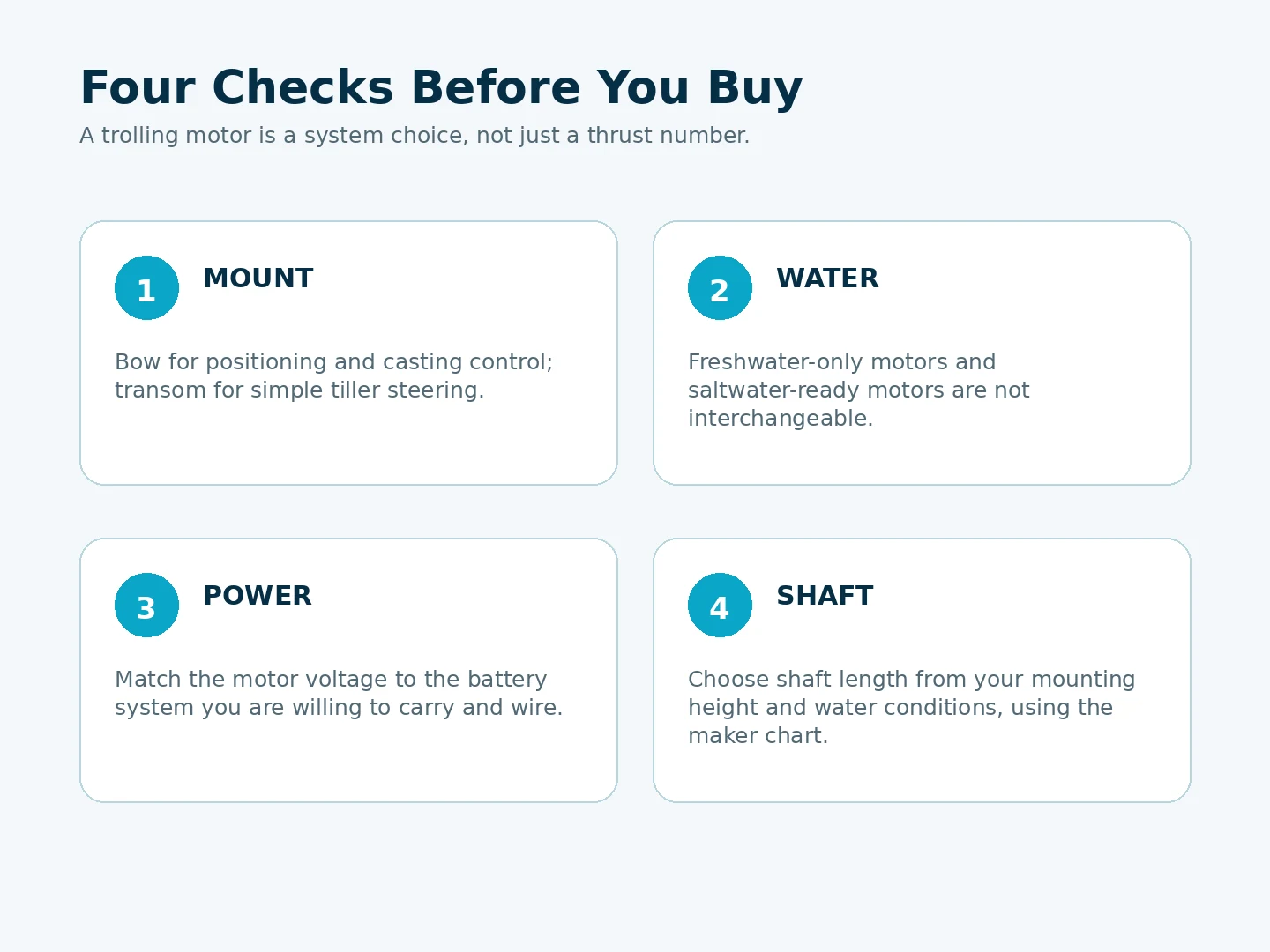
The easiest way to overspend is to shop by thrust alone. A trolling motor is an electrical and control system. The motor has to fit the boat physically, match the water you fish, work with the battery system, and support the way you actually control the boat.
Choose bow mount or transom mount first
A bow-mounted motor pulls the boat from the front and is the better platform for precise fishing-position control. This is where GPS anchor functions, route control, foot pedals, and electronics integration usually matter most. A transom motor pushes from the rear and is simpler to clamp on, remove, steer by tiller, and transfer between compatible small boats.
If you spend most of the day casting while constantly correcting boat position, a bow-mounted GPS motor can change the fishing workflow enough to justify the added cost. If the motor is mainly for slow propulsion or occasional maneuvering, a transom motor may be the more rational purchase.
Do not buy freshwater-only hardware for regular saltwater use
Water rating is a hard filter, not a feature to ignore because two motors have similar thrust. Saltwater-ready models use corrosion-resistant materials and finishing appropriate to that environment. For regular coastal or brackish fishing, start with a model the manufacturer explicitly supports for saltwater use.
Voltage changes the whole boat system
A 12V motor is attractive because the battery and charging setup can stay relatively simple. Moving to 24V or 36V can unlock higher thrust and premium motor platforms, but it also changes the battery bank, wiring, charging, space, and weight requirements. Decide whether the boat needs that level of motor before treating higher voltage as an automatic upgrade.
Shaft length has to match mounting height and conditions
Thrust does not help if the prop cannot stay properly submerged. Measure from the planned mounting point to the waterline, then use the current manufacturer shaft-length guidance for the exact motor family. Bow height, transom height, load, and rough-water use all affect the right choice. Do not copy a shaft length from another boat simply because the hull length looks similar.
GPS positioning is worth paying for only if you will use it
Spot-Lock, Anchor Lock, automated drift control, and route functions can be transformative for anglers who repeatedly hold on structure, fish current seams, work offshore waypoints, or need both hands free. They add much less value to a boat used mostly for simple trolling or short moves along protected shoreline.
Match the motor to the electronics you already own
Premium trolling motors increasingly work as part of a brand ecosystem. Terrova can connect into Minn Kota and compatible Humminbird workflows, while Recon is designed around Lowrance integration. If you already have a modern fish-finder network, that compatibility may matter more than a small difference in headline thrust.
How we chose these trolling motors
GearAndFish built this shortlist around distinct buying scenarios instead of ranking near-identical variants. We first checked the current US search results to confirm that the broad query is a roundup decision page covering bow mounts, transom motors, GPS systems, and value options. Kayak-specific search results are meaningfully different, so purpose-built kayak motors were kept out of this article.
Product specifications can change by thrust, shaft length, sonar package, water rating, and control bundle. Check the exact model and ASIN before ordering, especially when an Amazon page offers multiple style variants.
FAQ
How much thrust do I need for a trolling motor?
There is no single thrust number that fits every boat. Loaded boat weight, hull type, wind, current, mounting style, and the manufacturer’s sizing guidance all matter. A 55 lb motor can be a good small-boat choice, while heavier boats may justify a 24V or 36V high-thrust system.
Is a bow-mount trolling motor better than a transom-mount motor?
For active fishing and precise boat positioning, a bow mount is usually the stronger platform. For simple propulsion, portability, and lower cost, a transom mount can make more sense. The better choice depends on what you need the motor to do.
Is Spot-Lock worth it on a trolling motor?
It can be worth the premium if you regularly hold on offshore structure, current seams, waypoints, or windblown areas. If you mainly use the motor for slow forward propulsion, GPS position hold may not justify the added cost.
Can I use a freshwater trolling motor in saltwater?
For regular saltwater use, choose a motor the manufacturer explicitly rates for saltwater. Saltwater-ready models are built with corrosion resistance appropriate to that environment, while freshwater-only models are not the right default for coastal use.
Do higher-voltage trolling motors always perform better?
Higher voltage can support more thrust and premium motor platforms, but it also increases battery-system complexity, space, weight, wiring, and charging requirements. The best system is the one that provides enough control and thrust for your boat without unnecessary electrical overhead.