
GearAndFish is reader-supported. As an Amazon Associate I earn from qualifying purchases. When you buy through links on our site, we may earn an affiliate commission, at no extra cost to you. Learn more.
The best kayak trolling motor is the one your hull can safely carry and mount, not simply the motor with the biggest thrust number. For a GPS bow-mount setup, the Minn Kota Kayak Terrova is the strongest freshwater fit in this shortlist, while the Riptide Kayak Terrova is the saltwater counterpart. If you want a simpler, lighter transom setup, the Newport Kayak Series 36 and 55 lb models are easier to integrate and much less complex.
Quick answer: which kayak trolling motor should you buy?
Choose the Minn Kota Kayak Terrova if you fish freshwater from a kayak that can accept a substantial bow mount and you specifically want GPS positioning with Spot-Lock. Choose the Riptide Kayak Terrova for the same style of GPS bow control in saltwater. Choose the Newport Kayak Series 36 when keeping motor weight and current draw down matters most, or step up to the Newport Kayak Series 55 when your larger, stable kayak can carry the extra motor and battery load and you want more thrust reserve.
Our kayak trolling motor picks at a glance
Minn Kota Kayak Terrova 55
A kayak-specific 36-inch bow-mount motor with 55 lb of thrust, 12V power, GPS control, and Spot-Lock for anglers who prioritize precise boat positioning.
Minn Kota Riptide Kayak Terrova 55
The saltwater-rated version of the kayak Terrova formula, pairing a 36-inch shaft and 55 lb of thrust with GPS positioning and a Micro Remote.
Newport Kayak Series 36
An 18 lb transom motor with a short 24-inch shaft, 12V power, and freshwater plus saltwater compatibility for smaller or weight-sensitive fishing kayaks.
Newport Kayak Series 55
The same kayak-specific transom format with 55 lb of thrust for anglers who can accept a 23 lb motor and higher maximum current draw.
Best kayak trolling motor comparison
| Product | Best for | Core setup | Main tradeoff | Amazon |
|---|---|---|---|---|
| Minn Kota Kayak Terrova 55 | Freshwater GPS positioning | 55 lb, 12V, 36 in, bow mount, 40 lb 8 oz | Heavy and installation-intensive for a kayak | Check availability |
| Minn Kota Riptide Kayak Terrova 55 | Saltwater GPS positioning | 55 lb, 12V, 36 in, bow mount, 40 lb 8 oz | Heavy and much more complex than a tiller motor | Check availability |
| Newport Kayak Series 36 | Lighter transom setup | 36 lb, 12V, 24 in, transom mount, 18 lb | No GPS anchoring or electric steering | Check availability |
| Newport Kayak Series 55 | More thrust in a simple transom format | 55 lb, 12V, 24 in, transom mount, 23 lb | Higher max draw than the 36 lb version | Check availability |
Minn Kota Kayak Terrova 55
55 lb / 12V / 36 in
Bow
Spot-Lock GPS
Minn Kota Riptide Kayak Terrova 55
55 lb / 12V / 36 in
Bow
Saltwater
Newport Kayak Series 36
36 lb / 12V / 24 in
18 lb
29A
Newport Kayak Series 55
55 lb / 12V / 24 in
23 lb
52A
Minn Kota Kayak Terrova 55
Pick #1
Pick this when precise GPS positioning matters more than low weight and simple rigging, and your kayak has the structure and deck space for a 40 lb plus bow-mount motor.
The important distinction is not the thrust rating by itself. The Kayak Terrova is a complete positioning system. GPS functions can hold a spot, record paths, manage steering, and control speed without requiring you to keep one hand on a tiller. That is a real advantage when you spend long periods casting structure, fishing current seams, or working offshore spots where position control matters more than simply moving from launch to destination.
The cost is weight and installation commitment. Minn Kota lists the motor at 40 lb 8 oz before the battery, wiring, mount hardware, and the rest of your fishing load are counted. That can be reasonable on a large, high-capacity fishing kayak with a proper bow mounting solution, but it is not a casual bolt-on upgrade for every hull. Check the kayak maker’s motorization and mounting guidance, make sure the bow can accept the load and torque, and think through stow space before buying.
Good fit if you want
- GPS Spot-Lock and automatic position control on freshwater.
- A kayak-specific 36-inch bow-mount configuration.
- Variable speed and remote steering instead of a manual tiller.
Skip it if you need
- The lightest possible motor and battery setup.
- A quick clamp-on solution for a small kayak.
- A motor explicitly intended for saltwater use.
Minn Kota Riptide Kayak Terrova 55
Pick #2
Choose the Riptide when you want the kayak Terrova’s GPS positioning architecture but fish coastal or saltwater environments where the freshwater version is the wrong match.
If your fishing means tidal creeks, marsh edges, bays, or coastal flats, the freshwater Terrova should not be treated as an interchangeable substitute. The Riptide version is the model Minn Kota explicitly specifies for saltwater. It also lists the same 40 lb 8 oz motor weight and 50A maximum draw as the freshwater model, so the same hull-capacity and mounting questions apply.
This is the pick for anglers who see GPS position control as part of the fishing system, not just propulsion. If you mainly need a motor to move a short distance or maintain a slow trolling pace, the extra weight, installation work, and electronics may be more than you need. A simple transom motor can be the cleaner choice.
Good fit if you want
- GPS Spot-Lock in a saltwater-rated kayak motor.
- A 12V system rather than moving to a multi-battery 24V setup.
- Remote steering and variable speed for hands-free position management.
Skip it if you need
- A lightweight motor for easy car-top loading.
- A low-complexity clamp-on transom setup.
- A bow area that cannot safely accept the mount and motor load.
Newport Kayak Series 36
Pick #3
The 36 lb Newport is the most sensible choice here when minimizing motor weight and current draw matters more than GPS features or maximum thrust reserve.
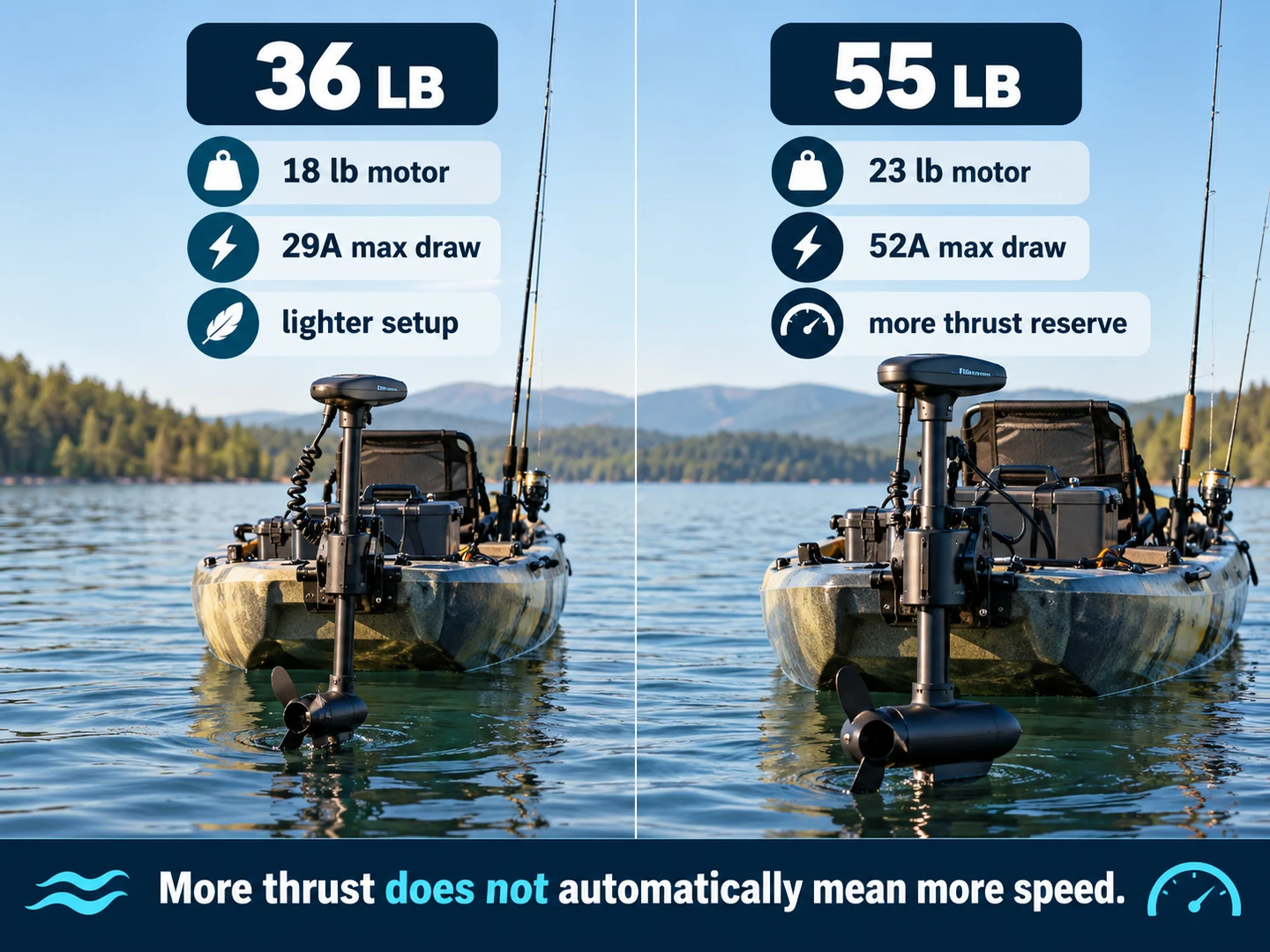
Those numbers matter on a kayak. Compared with the 55 lb Newport, the 36 lb version removes 5 lb from the motor and cuts listed maximum current draw from 52A to 29A. That does not automatically translate into a specific runtime because battery chemistry, capacity, speed setting, wind, current, hull efficiency, and load all matter. It does make the 36 easier to justify when every pound on the stern or motor mount counts.
The tradeoff is simplicity. You steer with the tiller and get fixed forward and reverse speed steps rather than GPS anchoring, automatic heading control, or electric steering. For many anglers that is a feature, not a problem: fewer systems to integrate, a shorter 24-inch shaft made for low kayak freeboard, and a setup that is easier to understand before launch.
Good fit if you want
- An 18 lb motor that keeps stern and carrying weight lower.
- A kayak-specific 24-inch shaft.
- Freshwater and saltwater compatibility without GPS complexity.
Skip it if you need
- GPS anchor or route-following functions.
- Remote or electric steering.
- More thrust reserve for a large, heavily loaded fishing kayak.
Newport Kayak Series 55
Pick #4
Choose the 55 lb version when you want the same simple kayak-specific transom format but have a larger, stable hull and enough electrical capacity for the higher maximum draw.
The 55 lb model is not automatically the better buy. More thrust primarily gives you more force to work with when the kayak is loaded or conditions are demanding; it does not guarantee a proportional increase in top speed. Kayak hull shape imposes its own speed limits, and the larger motor also adds weight and potentially greater battery demand at high power.
Its strongest case is a stable fishing kayak with enough payload margin, a secure transom or motor mount, and an angler who wants a conventional tiller motor rather than a full GPS bow-mount system. It also stays within a single 12V electrical architecture, which can simplify rigging compared with higher-voltage propulsion systems.
Good fit if you want
- More thrust reserve than the 36 lb version.
- A short 24-inch kayak-specific shaft.
- Freshwater and saltwater use with straightforward tiller control.
Skip it if you need
- The lowest possible motor weight or current draw.
- GPS anchor and automatic position control.
- A setup that exceeds your kayak’s approved load or mounting capability.
How to choose the best kayak trolling motor for your setup
Kayak motor shopping gets easier when you stop treating thrust as the first question. The correct order is hull compatibility, mounting location, water type, control system, electrical load, and only then thrust.
1. Confirm that your kayak can safely take a motor
Start with your kayak manufacturer’s guidance. A motor adds more than its published motor weight: you also need to account for the battery, mount, wiring, safety hardware, fishing gear, electronics, tackle, and your own weight. The motor also applies force to a specific part of the hull, so total payload capacity alone does not prove that a bow or stern mounting point is suitable.
This is especially important with the two Terrova picks. A 40 lb 8 oz bow motor is a very different structural and balance problem from an 18 lb clamp-style transom motor. If a kayak does not have an approved or proven motor mounting solution, resolve that first.
2. Decide whether you are buying propulsion or positioning
If your goal is simply to reduce paddling effort, troll at controlled low speeds, or make short powered moves, a basic transom motor can do the job with far less complexity. If your goal is to hold on a waypoint, repeat a path, or keep the bow pointed into wind or current while you fish, GPS positioning can be worth the larger investment and installation burden.
That difference is why the Kayak Terrova and Newport Kayak Series belong in the same roundup even though they solve the problem differently. One is a positioning system with propulsion; the other is primarily simple propulsion and steering.
3. Treat freshwater and saltwater ratings as a hard filter
Do not assume that two otherwise similar models are interchangeable around saltwater. Minn Kota explicitly specifies the black Kayak Terrova for freshwater and the Riptide Kayak Terrova for saltwater. Newport explicitly lists its Kayak Series for both freshwater and saltwater, while also advising freshwater rinsing and appropriate care after saltwater use.
4. Understand what 36 lb versus 55 lb thrust changes
Thrust is force, not a direct speed rating. A 55 lb motor can provide more reserve against load, wind, current, and steering demand, but a displacement-style kayak will not become 53 percent faster just because the thrust number rises from 36 to 55. Hull efficiency, propeller design, voltage, water conditions, and total load all influence actual performance.
Newport’s own Kayak Series specifications make the tradeoff easy to see. The 36 lb version weighs 18 lb and lists a 29A maximum draw. The 55 lb version weighs 23 lb and lists a 52A maximum draw. If the smaller motor provides enough control for your kayak and conditions, lower motor weight and lower peak electrical demand may be more useful than additional thrust.
5. Size the battery and wiring around the motor, not a generic kayak chart
Voltage must match the motor. All four core picks here are 12V models, but their current demand is not identical. Use the manufacturer’s wiring, fuse or circuit breaker, connector, and battery guidance for the exact motor. A battery’s amp-hour rating is only part of the decision; it also needs to safely supply the motor’s required current.
Newport currently specifies a 12V deep-cycle battery for the Kayak Series and its product page references a 12V 50Ah deep-cycle marine battery. Minn Kota publishes a 50A maximum draw for both Kayak Terrova versions. Those figures help size an electrical system, but they should not be converted into a promised runtime without knowing speed setting, battery chemistry, usable capacity, wiring losses, conditions, and load.
6. Do not overlook shaft length and prop depth
Kayaks sit low, which is why kayak-specific motors tend to use shorter shafts than motors intended for larger boats. The Newport Kayak Series uses a 24-inch adjustable shaft. The kayak Terrova models use 36-inch shafts in a bow-mount design. What matters is keeping the propeller submerged enough to avoid ventilation while still being able to run shallow and stow the motor safely.
Bow mount vs transom mount on a fishing kayak
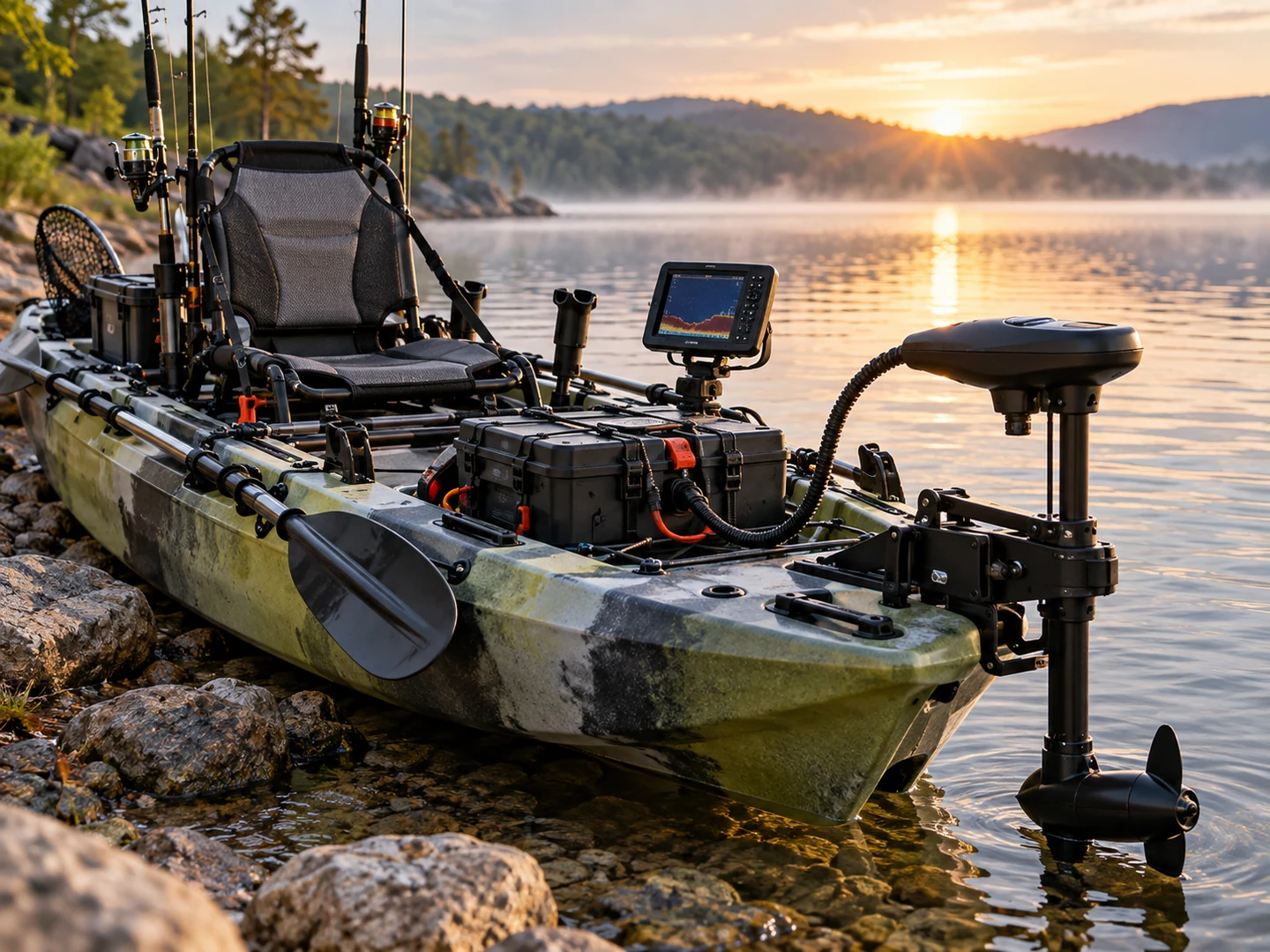
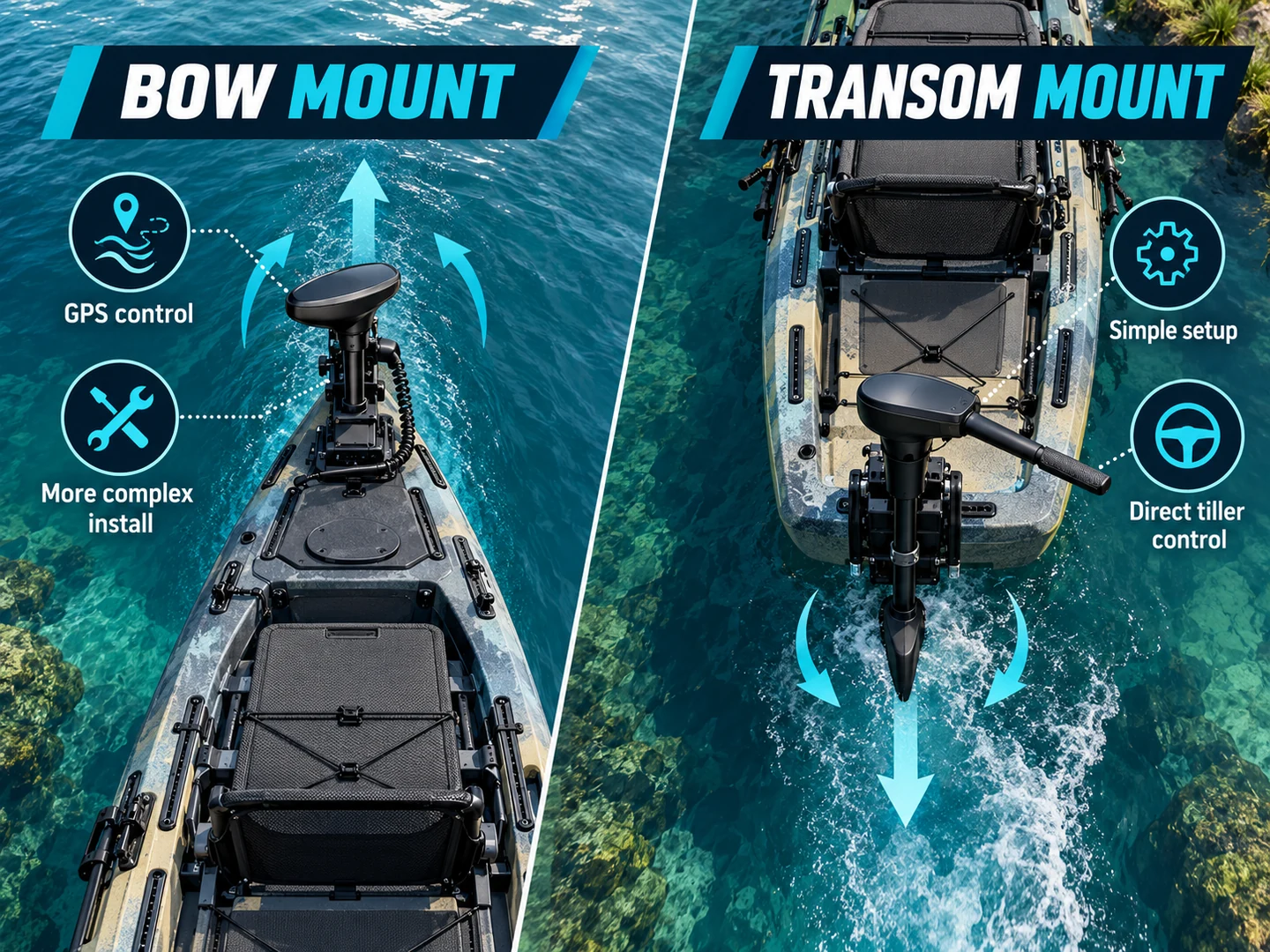
Bow mount: best when precise steering and GPS position control are central to how you fish. It can pull the kayak from the front and integrate advanced navigation features, but usually demands more deck space, a stronger mounting solution, and more careful stow planning.
Transom mount: best when you want lower cost, simple tiller control, and a motor that can be removed with less effort. The tradeoff is that you give up GPS anchoring and remote electric steering unless those features come from a separate system.
What about the Garmin Force Current?
Garmin’s Force Current is one of the most important current kayak motors and deserves a look if wireless foot steering and integrated GPS control are priorities. Garmin specifies 30 lb of thrust on 12V or 50 lb on 24V, plus GPS anchor functions and wireless steering options. We did not place it in the four Amazon-mapped picks because we could not independently confirm a current Amazon.com US ASIN for the exact Force Current configuration during final fact-checking. That is an availability decision, not a negative judgment on the product.
Our research and selection methodology
We checked product identity, thrust, voltage, shaft length, mount type, water rating, control system, motor weight, and current draw against current manufacturer pages where available.
Every core recommendation has an exact 10-character Amazon.com US ASIN mapped in the package. Article buttons use GearAndFish product keys so the Content Manager can inject the final tagged URL.
We weighted hull fit, motor weight, mount complexity, saltwater suitability, control method, and electrical demand ahead of headline thrust.
Current search results contain many pages making extensive first-person evaluation claims. GearAndFish does not repeat those as its own experience. The recommendations here are evidence-based fit judgments.
Primary sources checked: Minn Kota Kayak Terrova specifications, Minn Kota Riptide Kayak Terrova specifications, Newport Kayak Series specifications, and Garmin Force Current product information.
Intent and market cross-check: current US search results were reviewed for dedicated kayak roundups and compared with broader trolling-motor guides, including Wired2Fish’s 2026 trolling motor guide. This confirmed that kayak-specific buying intent is distinct enough to support this page separately from GearAndFish’s broad trolling motor roundup.
Kayak trolling motor FAQ
How much thrust does a kayak trolling motor need?
There is no single correct thrust number for every kayak. Hull size, loaded weight, wind, current, mounting method, and intended use matter more than a simple formula. A lighter 36 lb motor can be a smart match for a small fishing kayak, while a stable, heavily loaded kayak may benefit from 55 lb of thrust reserve if its mount and payload limits support the setup.
Is a 55 lb trolling motor too much for a kayak?
Not necessarily, but 55 lb of thrust does not prove that the motor is appropriate for your hull. Check the kayak manufacturer’s motorization guidance, mounting structure, total payload, weight distribution, and electrical requirements. The motor’s physical weight and torque at the mount can matter as much as the thrust rating.
Should I get the Newport Kayak Series 36 or 55?
The 36 lb version is the better fit when lower weight and lower maximum current draw are priorities. Newport lists it at 18 lb and 29A max draw. The 55 lb version weighs 23 lb and lists a 52A max draw, making it more suitable when your larger kayak can carry the extra load and you want more thrust reserve.
Is Spot-Lock worth it on a fishing kayak?
Spot-Lock can be valuable if you frequently fish structure, current, wind, or offshore spots where holding position takes attention away from casting. If you mainly need short powered moves or slow trolling, a simpler transom motor may be lighter, cheaper, and easier to rig.
Can I use a freshwater trolling motor in saltwater?
Do not assume a freshwater model is saltwater-ready. Use the manufacturer’s stated water compatibility. Minn Kota specifies the standard Kayak Terrova for freshwater and the Riptide Kayak Terrova for saltwater. Newport specifies its Kayak Series for both freshwater and saltwater and provides care guidance for saltwater use.
What battery should I use for a kayak trolling motor?
Match the battery voltage to the exact motor and make sure the battery, wiring, connectors, fuse or circuit breaker, and battery management system can safely support the motor’s current demand. Do not choose a battery only by amp-hour capacity. Follow the motor manufacturer’s electrical guidance for the exact model.