

GearAndFish is reader-supported. As an Amazon Associate I earn from qualifying purchases. When you buy through links on our site, we may earn an affiliate commission, at no extra cost to you. Learn more.
Fishing hook sizes use two numbering systems that run in opposite directions, and the label alone does not tell you the hook’s exact physical dimensions. This guide gives you a fast size chart, then shows how to match hook size to bait profile, hook pattern, and the fish you are targeting.
How fishing hook sizes work
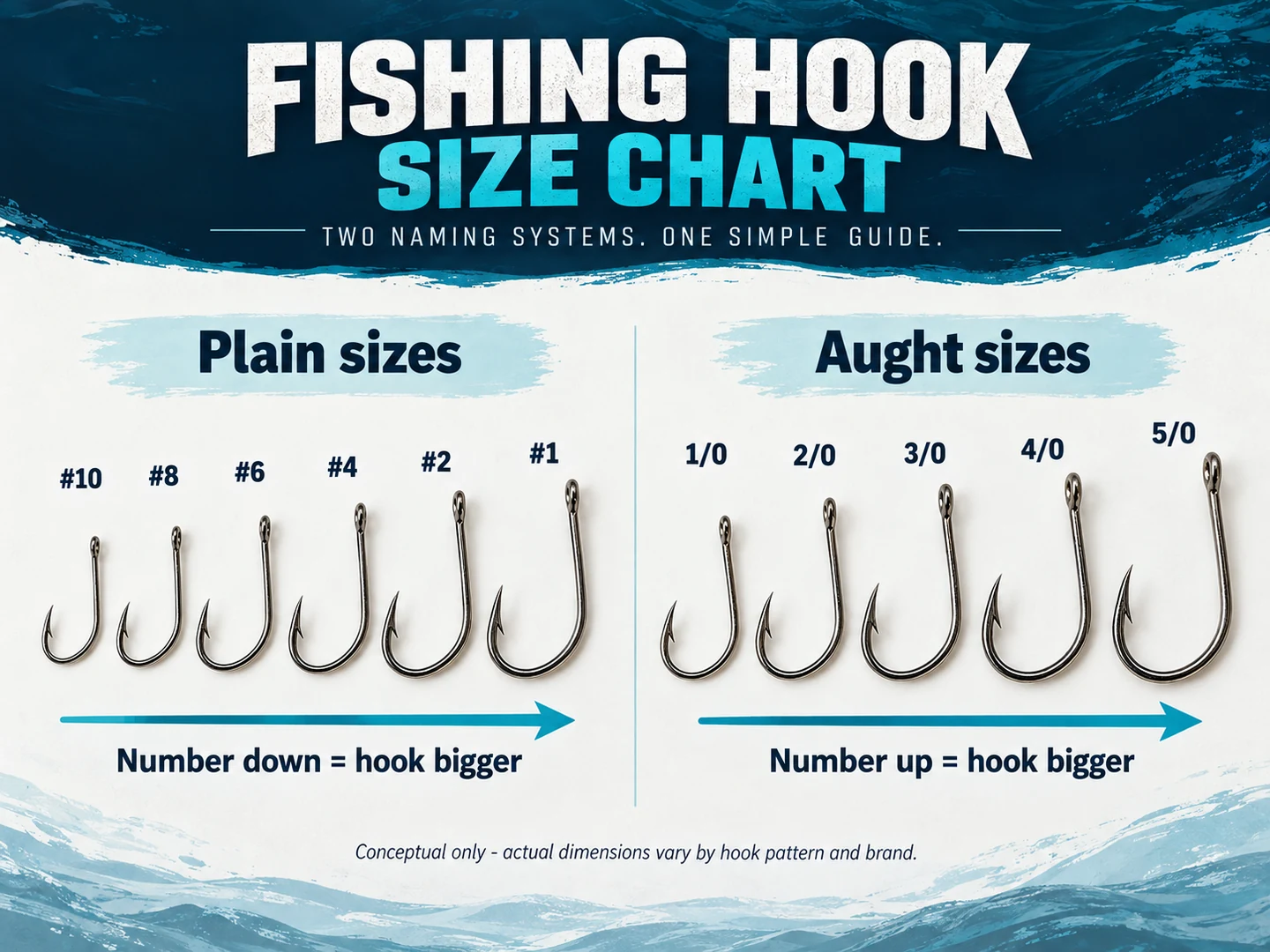
On the plain-number scale, a #10 is smaller than a #6, and a #6 is smaller than a #1. Once you cross into the aught scale, the direction flips: 1/0 is smaller than 3/0, and 3/0 is smaller than 5/0. A useful sequence from smaller to larger is #10, #8, #6, #4, #2, #1, 1/0, 2/0, 3/0, 4/0, 5/0.
The catch is that hook sizing is not standardized across every brand and pattern. Use the number as a starting point, then compare the hook’s actual gap, wire diameter, shank length, and how the bait sits on it.
Fishing hook size chart at a glance
The chart below is a practical starting point, not a universal dimensional standard. The same nominal size can look noticeably different when you compare an EWG worm hook, an octopus hook, a circle hook, or a treble.
| Starting use | Typical starting range | Common hook patterns | What to check before tying on |
|---|---|---|---|
| Small bait for panfish | #10 to #6 | Aberdeen, bait, octopus | Keep the hook small enough that the bait still looks natural and the point stays exposed. |
| Trout or crappie bait rigs | #10 to #4 | Baitholder, Aberdeen, octopus | Match the hook to the bait first. Tiny eggs, worms, and minnows do not need the same gap. |
| Walleye live-bait rigs | #4 to 1/0 | Octopus, live-bait, circle where appropriate | Use enough gap around the minnow or crawler so the point is not buried. |
| Bass soft plastics | #1 to 5/0 | EWG, offset worm, straight-shank | Choose by plastic thickness and body depth. Many common worms and creature baits land around 2/0 to 4/0. |
| Catfish with larger bait | 2/0 to 8/0 | Circle, octopus circle, kahle | Bait chunk size matters more than the fish’s maximum size. Keep enough point and gap clear. |
| Inshore saltwater bait | #1 to 5/0 | Circle, J hook, live-bait | Match bait size and current regulations. Some fisheries specify circle-hook construction. |
| Larger offshore bait rigs | 5/0 and larger | Circle, J hook | Species, bait size, tackle class, and fishery rules can push the required size far beyond general charts. |
#10 to #6
Aberdeen, bait, octopus
Natural bait fit and exposed point
#10 to #4
Baitholder, Aberdeen, octopus
Match hook to the actual bait
#4 to 1/0
Octopus, live-bait, circle
Enough gap around minnow or crawler
#1 to 5/0
EWG, offset worm, straight-shank
Plastic thickness and body depth
2/0 to 8/0
Circle, octopus circle, kahle
Bait chunk size and open gap
#1 to 5/0
Circle, J hook, live-bait
Bait size and current regulations
Important: These are broad starting ranges. Hook labels are relative, not exact inch measurements. If two hooks are from different brands or different patterns, compare the physical hooks rather than assuming identical size labels mean identical dimensions.
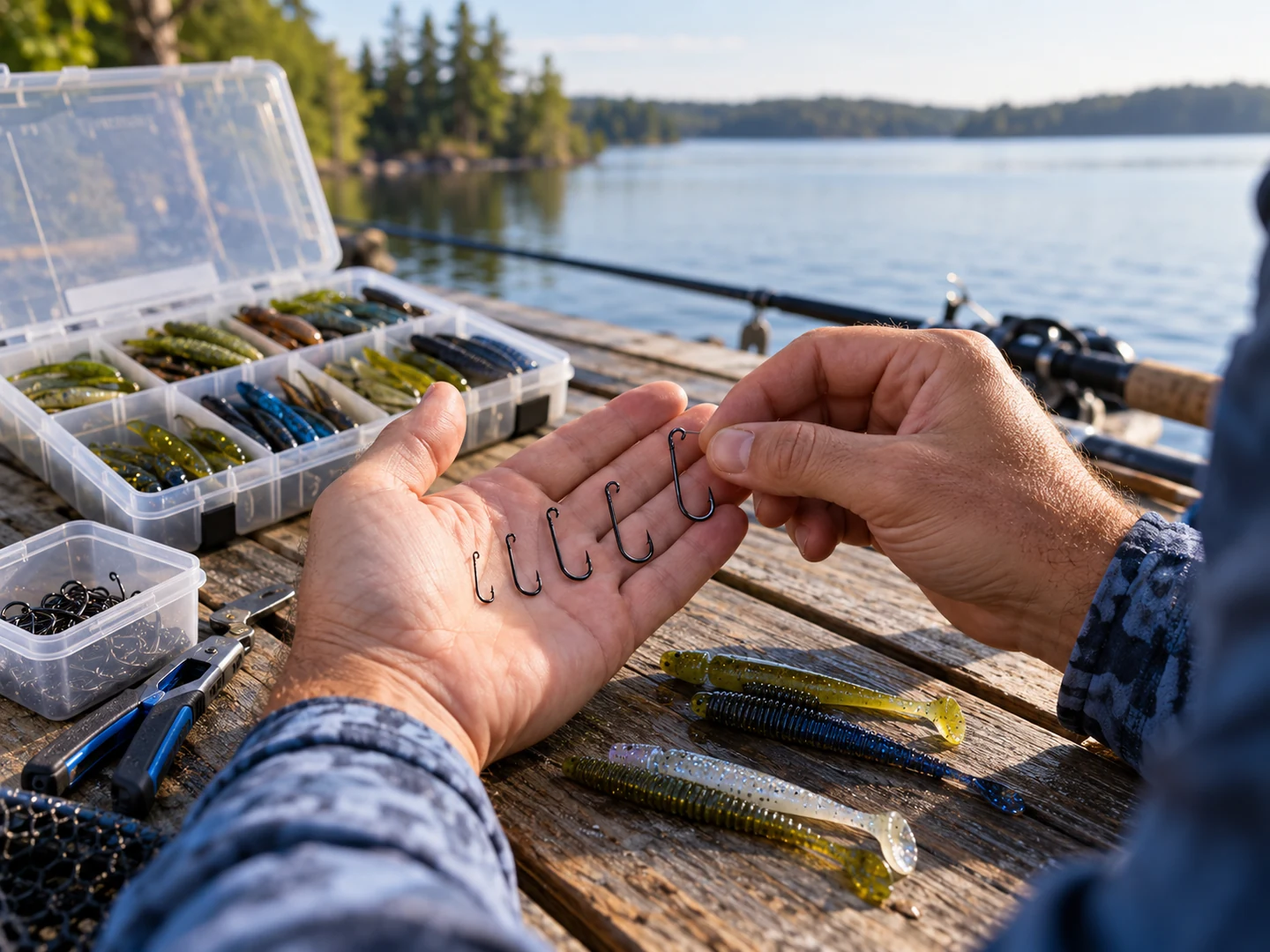
Plain numbers vs aught sizes
The easiest way to remember fishing hook sizes is to treat them as two separate scales.
- Plain numbers: as the number gets smaller, the hook gets larger. A #6 is larger than a #10, and a #1 is larger than a #4.
- Aught sizes: as the number gets larger, the hook gets larger. A 4/0 is larger than a 2/0.
- The crossover: size #1 sits just below 1/0. There is no useful universal physical measurement you can assign to every #1 or every 1/0 across all patterns.
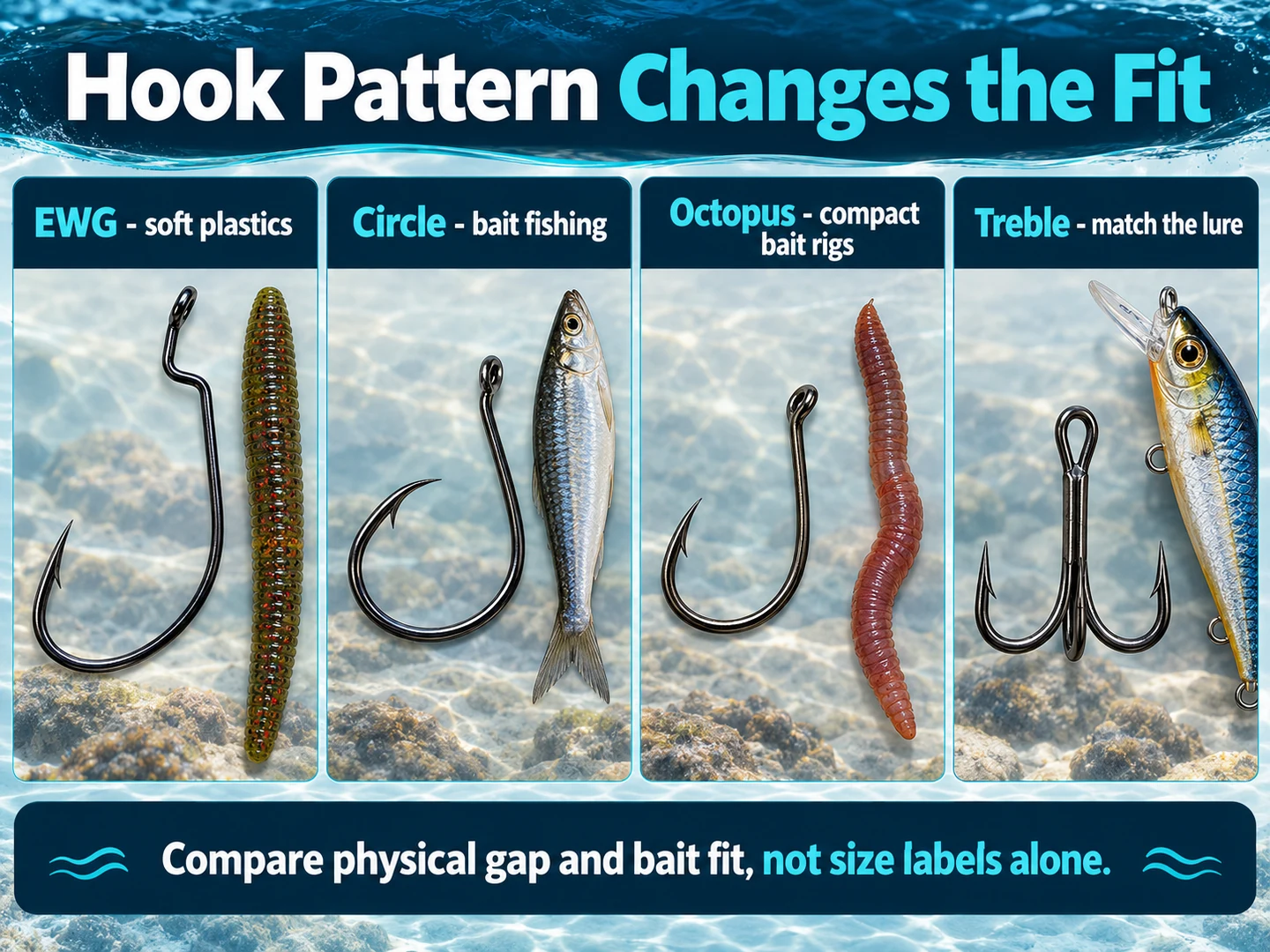
That last point is what makes many online hook charts misleading. A nominal 3/0 EWG worm hook has a different shape and useful gap than a nominal 3/0 circle hook. The number helps you shop within a hook family, but the bait and hook geometry still decide whether the rig fits correctly.
How to choose the right hook size
A species chart is helpful, but it should not be your first decision. Start with the bait or lure, then select the hook pattern, then fine-tune the size.
1. Match the hook to the bait profile
For natural bait, the hook must hold the bait securely without turning it into a stiff, oversized bundle. For soft plastics, the hook needs enough gap to clear the body when a fish bites. A thick creature bait or swimbait usually needs more gap than a slim finesse worm of the same length.
A useful rule is to look at the rigged bait from the side. The hook point should be able to clear the bait body, and the bend should not crush or distort the bait. If the hook dominates the presentation, step down. If the bait crowds the gap or hides the point, step up or choose a wider-gap pattern.
2. Choose the hook pattern before the exact size
Hook style changes the geometry. EWG hooks create extra room for soft plastics. Circle hooks bring the point inward toward the shank and are used differently from a conventional J hook. Octopus hooks are compact, while long-shank bait hooks place more metal behind the bend. Treble hooks are a separate case because they are usually matched to the lure they came on.
3. Check the actual gap and wire
Gap is the usable distance between the point and shank. You need enough room for the bait to move out of the way and for the hook to engage. Wire diameter matters too. Fine-wire hooks can suit delicate presentations and lighter tackle, while heavier wire is commonly chosen for stronger line, heavier cover, or larger fish.
Do not size up just to get thicker wire. Many hook families offer the same nominal size in different wire strengths. When that option exists, pick the pattern and wire class for the technique rather than using an oversized hook to solve a strength problem.
4. Use the target species as a final range check
The fish matters because mouth size, feeding style, and tackle demands set boundaries. But the hook still has to fit the bait. A bass eating a compact finesse bait may need a smaller hook than the same bass eating a bulky 6-inch plastic. A catfish rig with a small piece of cut bait may not need the same circle-hook size as a rig carrying a much larger bait.
Common hook sizes by fishing situation
Use these examples to narrow the aisle, then compare the actual hooks in the pattern you intend to fish.
Panfish, trout, and small natural baits
Small plain-number hooks dominate here. A #10 to #6 is a sensible zone for many small baits, with #4 entering the picture as bait size grows. The main mistake is going too large because a hook looks tiny in your hand. If the target fish can take the bait but the hook is bulky enough to change the presentation, the smaller option often makes more sense.
Bass soft plastics
For common Texas-rigged worms and creature baits, EWG and offset worm hooks often fall between #1 and 5/0, with 2/0, 3/0, and 4/0 covering a large amount of everyday soft-plastic fishing. The exact choice depends on the plastic’s body thickness and where the hook point needs to sit.
Gamakatsu EWG Offset Worm Hook, 3/0, 25-pack is a useful real-world reference for a common mid-range bass soft-plastic size. The Amazon listing is mapped to the exact 3/0, model 58413-25 variant.
Circle hooks for bait fishing
Circle hooks are often sold from small plain sizes into large aught sizes. Instead of choosing from species alone, match the circle hook to the bait and make sure the bait is not packed into the gap. Also check current regulations for the water and species you are fishing, because some fisheries specify circle hooks and may require non-offset designs.
Gamakatsu Octopus Circle Inline Point, 1/0, 25-pack gives you a concrete reference for a compact inline circle hook. The mapped Amazon variant is model 265411-25, size 1/0.
Treble hooks on hard baits
Trebles use the same confusing plain-number convention, but replacing lure trebles is not a good place to apply a generic species chart. A larger treble can add weight, foul against another hook, change how a lure sits, or upset its action. Start with the lure maker’s original size and match both size and wire class unless you have a specific reason to change them.
Why the same size can look different
A hook’s label compresses several design decisions into one rough size class. Manufacturers can change shank length, gap, bend shape, point angle, eye angle, and wire diameter while keeping the same nominal number. That is why a 2/0 in one family can look surprisingly different from a 2/0 in another.
This is also why buying a mixed hook kit solely because it advertises many sizes can be less useful than buying a few well-chosen patterns you understand. The best size label is the one that produces the correct physical fit for the rig in front of you.
Six hook-sizing mistakes to avoid
- Treating the number as a universal measurement. Hook sizes are not standardized enough for that.
- Choosing by fish species before bait size. The hook must physically fit the bait and presentation.
- Burying the gap in a thick bait. A hook can be technically large enough but still have too little usable gap once rigged.
- Ignoring wire diameter. Size and strength are related, but they are not the same specification.
- Upsizing lure trebles at random. Bigger trebles can alter lure balance, action, and hook clearance.
- Ignoring local rules. Hook-type, barb, and circle-hook requirements vary by fishery and can change.
Fast hook-size cheat sheet
When you are standing in front of a tackle wall, use this sequence:
- Pick the hook pattern for the technique. EWG for many soft plastics, circle for appropriate bait applications, compact bait hooks for smaller natural baits, and the lure’s original treble style for replacement.
- Choose a size that fits the bait. The point and usable gap should not be swallowed by the bait body.
- Check the wire strength. Match it to line strength, cover, drag pressure, and target fish rather than blindly jumping to a larger hook.
- Compare physical hooks when brands change. A 3/0 label is a family reference, not an exact cross-brand dimension.
- Confirm regulations. Especially with bait fishing and saltwater species, verify current local or federal hook rules before the trip.
If you remember only one thing, remember this: bait fit first, hook pattern second, printed size third. The number gets you close. The physical fit tells you whether you are actually there.
Fishing hook size FAQ
Is a size 6 fishing hook bigger than a size 8?
Yes. On the plain-number scale, smaller numbers mean larger hooks, so a #6 is larger than a #8.
Is a 1/0 hook bigger than a size 1?
Yes. Size #1 is the largest end of the common plain-number sequence, then 1/0 starts the aught scale. From there, larger aught numbers mean larger hooks.
Are fishing hook sizes the same across brands?
No. Hook sizes are not fully standardized across manufacturers or hook patterns. Use the printed size as a starting point and compare the actual gap, shank, bend, and wire when switching brands or styles.
What size hook should I use for bass?
For many common soft-plastic bass rigs, #1 through 5/0 is a useful starting range, with 2/0 through 4/0 covering many everyday worms and creature baits. The bait’s body thickness and the hook pattern should decide the final size.
What does 3/0 mean on a fishing hook?
It is read as “three aught.” On the aught scale, the hook gets larger as the number increases, so a 3/0 is larger than a 2/0 and smaller than a 4/0 within the same general hook family.


