
GearAndFish is reader-supported. As an Amazon Associate I earn from qualifying purchases. When you buy through links on our site, we may earn an affiliate commission, at no extra cost to you. Learn more.
Fishing rod power vs action describes two different parts of how a rod behaves. Power is how much force it takes to load the blank. Action is where the blank bends. Choose power around lure weight, line, cover, and the amount of force the job requires; choose action around how you want the rod to load, respond, and cushion the presentation.
Research note: This guide uses current manufacturer definitions, current US search intent, current rod specifications, and exact Amazon US listings checked on October 2, 2026. GearAndFish does not claim direct use or testing of the example rods below.
Fishing rod power vs action: remember force versus flex location
Power answers, “How much load does it take to bend this rod?” Action answers, “Where along the blank does that bend happen?” A Medium / Fast rod and a Medium / Moderate Fast rod can have the same power but feel very different because the bend is distributed differently.

Power and action are independent specs
The cleanest way to avoid the usual confusion is to treat power and action as two separate dials. St. Croix defines rod power by the pressure required to flex the rod, while rod action describes where the rod flexes along the blank. That distinction also appears in guidance from the Kentucky Department of Fish and Wildlife Resources.
| Spec | What it describes | Common labels | Use it to decide |
|---|---|---|---|
| Power | How resistant the rod is to bending under load | UL, L, ML, M, MH, H, XH | Lure range, line class, cover, and force requirement |
| Action | Where the blank bends when it is loaded | Extra Fast, Fast, Moderate Fast, Moderate, Slow | Response, loading profile, lure control, and cushioning |
How much force bends the rod
UL through XH
Lure, line, cover
Where the blank bends
Extra Fast through Slow
Response and cushioning
That is why “medium action” is usually the wrong phrase when someone means a general-purpose rod. Medium is normally a power rating. Moderate is an action rating.
Rod power: how much load it takes to bend the blank
Power is commonly labeled from Ultra Light through Extra Heavy. A higher power rating generally takes more force to load and is paired with heavier lure and line ranges. A lower power rod loads more easily with lighter presentations.
The printed lure range on the exact rod is more useful than the power word by itself. Manufacturers do not make every Medium or Medium Heavy blank behave identically, so compare the actual lure and line ratings when you move between brands or series.
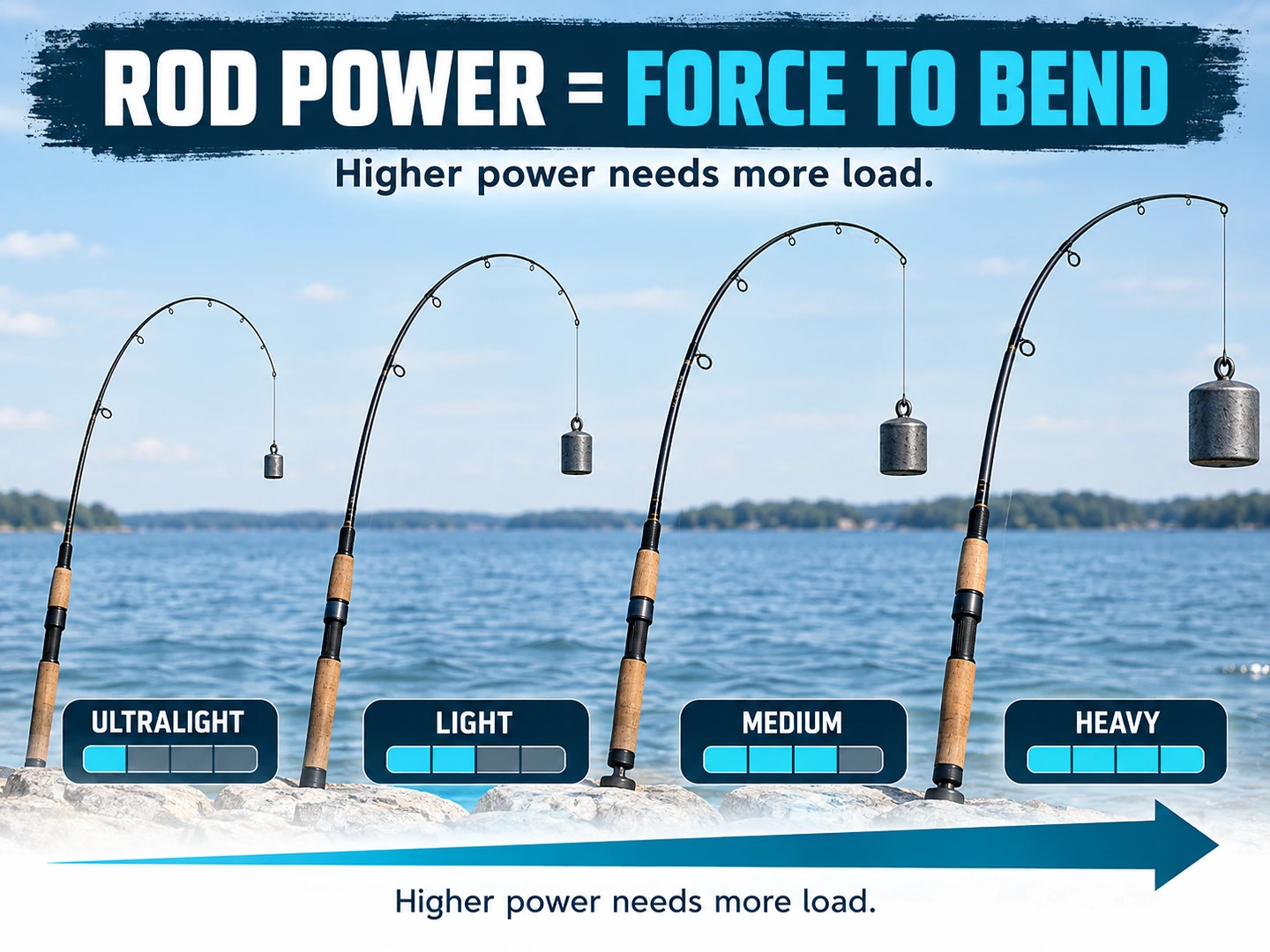
| Power | Typical job | What changes | Watch for |
|---|---|---|---|
| Ultra Light / Light | Small lures, light line, panfish and trout-scale tackle | Loads with less force and light payloads | Limited headroom for heavy cover or large lures |
| Medium Light / Medium | Finesse through general freshwater fishing | Balances light-to-mid lure ranges with broader utility | Exact lure window varies by model |
| Medium Heavy | Bass jigs, Texas rigs, heavier moving baits, moderate cover | More resistance to flex and more force available | Can overpower very light lures and delicate line |
| Heavy / Extra Heavy | Heavy cover, large payloads, and specialized heavy tackle | Requires substantially more load to bend | Not a default choice just because larger fish are possible |
Loads more easily
Lighter lures and line
Less heavy-cover authority
Medium Light to Medium Heavy
Most freshwater techniques
Exact lure rating
Needs more load to flex
Heavier lures and cover
Less useful for light tackle
Rod action: where the blank bends under load
Action changes the shape of the loaded rod. Fast and Extra Fast actions concentrate more of the bend toward the tip. Moderate actions flex farther down the blank. Slow actions bend deeply through much more of the rod.
This affects how quickly the rod transfers movement, how it loads during a cast, and how much cushion the blank provides when a fish surges. It does not tell you how powerful the rod is. A Medium / Extra Fast rod and a Heavy / Moderate rod are both completely possible combinations.
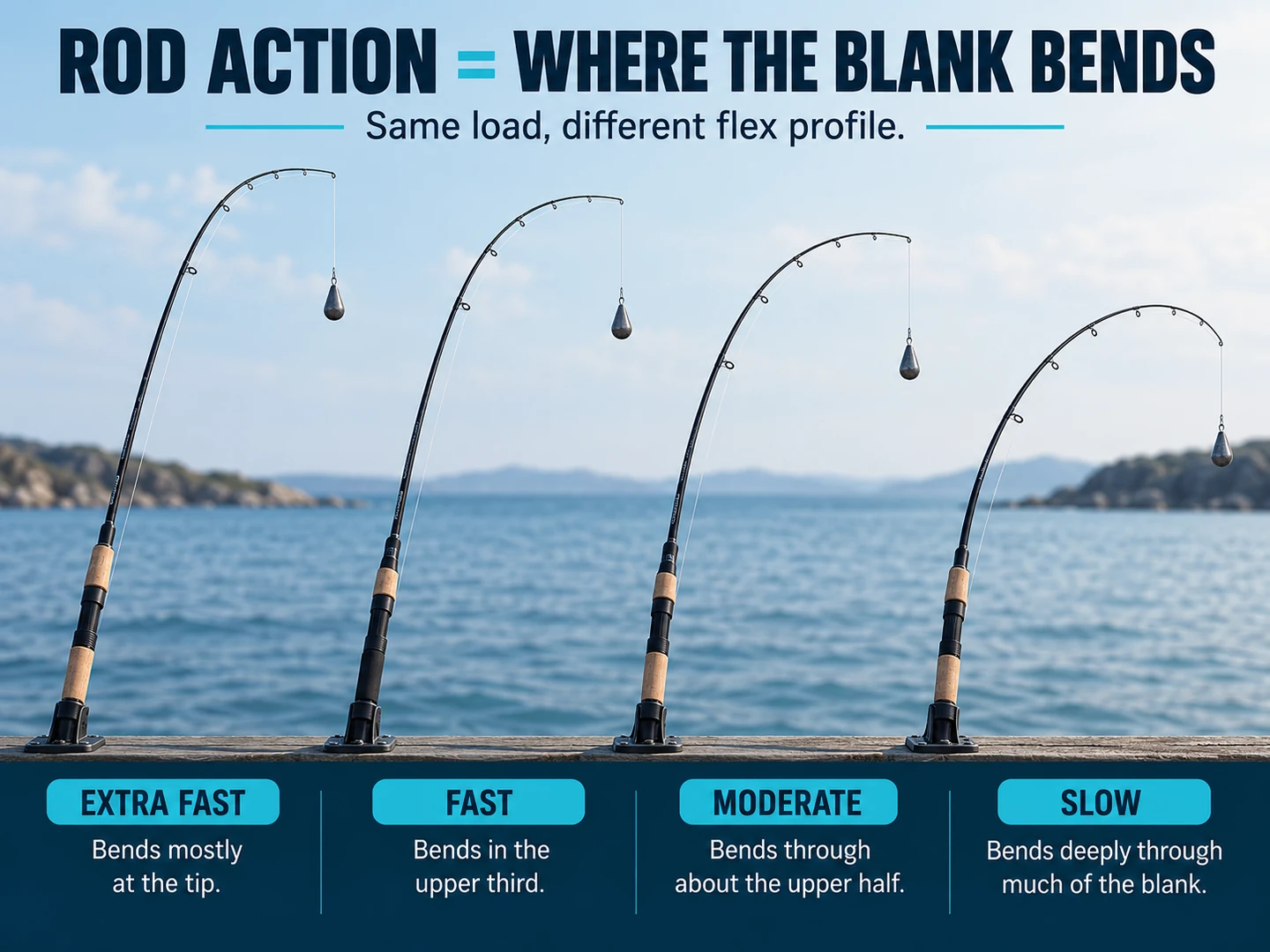
| Action | Bend profile | Often useful for | Main trade-off |
|---|---|---|---|
| Extra Fast | Mostly near the tip | Direct single-hook control, some finesse and cover-oriented techniques | Least forgiving of the common action choices |
| Fast | Upper section of the blank | General lure fishing, jigs, soft plastics, many single-hook techniques | Less cushioning than Moderate action |
| Moderate Fast | Deeper than Fast, shallower than Moderate | Moving baits and anglers who want a compromise between response and give | Not as specialized at either extreme |
| Moderate | Flexes farther toward the middle | Crankbaits and many treble-hook moving baits | Less immediate feel for some bottom-contact work |
| Slow | Deep bend through much of the blank | Specialty light presentations and situations that benefit from maximum cushioning | Slower response and less direct hook-driving feel |
Tip-focused bend
More direct
Single hooks
Deeper-loading bend
More give
Moving baits and trebles
How power and action work together
You choose a rod by combining both specs, not by picking one and ignoring the other. Power determines the load range you are trying to handle. Action determines how the rod distributes that flex.
| Combination | What it tends to prioritize | Example use |
|---|---|---|
| Ultra Light / Moderate | Easy loading plus deep cushioning | Small lures and light line for panfish or trout |
| Medium / Fast | General-purpose load range with a tip-focused response | Mixed freshwater lure fishing |
| Medium / Moderate Fast | Similar power with a deeper, more forgiving bend | Moving baits where extra cushion helps |
| Medium Heavy / Extra Fast | More backbone plus very tip-focused flex | Jigs and Texas rigs around cover |
| Medium Heavy / Moderate | Heavier payload capacity with deeper loading | Larger crankbaits and reaction baits |
Medium / Fast
Middle range
Tip focused
Medium / Moderate Fast
Same class
Deeper bend
Medium Heavy / Extra Fast
More load
Very tip focused
How to choose rod power and action in the right order
1. Start with your real lure weights
List the lures you actually cast most often. The printed lure range on the rod should comfortably cover that working range. Do not buy Heavy power for a hypothetical big fish if your everyday lures are too light to load the blank well.
2. Match power to line, cover, and hook-driving needs
Thicker line, heavier vegetation, wood, large single hooks, and heavier payloads can push you toward more power. Open water, lighter line, and small lures usually push the other way.
3. Choose action around the presentation
Fast and Extra Fast actions are common when the job benefits from direct response and firm single-hook control. Moderate and Moderate Fast actions are common with moving baits and treble hooks because the deeper flex adds cushion. These are decision rules, not absolute laws.
4. Compare exact specifications across brands
Power and action labels are not perfectly standardized across the industry. Compare the exact model’s lure range, line range, length, pieces, material, and intended technique rather than assuming every “M/F” rod feels the same.
Three current rods that make the difference concrete
These are examples, not a second “best rods” roundup. They show how real current models combine power and action. For a broader product shortlist, see our best fishing rods guide and our dedicated spinning rod roundup.
Daiwa Aird X AIRX662MFS
Example 1
A 6’6″ two-piece spinning rod that shows the familiar general-purpose Medium power and Fast action pairing.
This is the baseline many anglers picture when they hear “all-around freshwater spinning rod.” The power is broad enough for common mid-weight lures, while the Fast action keeps most of the flex toward the upper part of the blank.
Berkley Lightning Rod BSLR702M
Example 2
A 7′ two-piece spinning rod with the same Medium power label but a deeper Moderate Fast action.
Put this beside the Daiwa example and the lesson becomes obvious: “Medium” does not tell you the action. The Berkley keeps a similar middle power class while moving to a deeper loading profile.
Abu Garcia Veritas VRPC70-6
Example 3
A 7′ one-piece casting rod that combines more power with a very tip-focused Extra Fast action.
This is a useful contrast with the two Medium examples. Both dials move: the rod is harder to load than a Medium-power generalist, and the flex is concentrated closer to the tip.
What actually changes on the water
Casting and lure loading
A lure needs enough mass to load the rod during the cast. Too little payload on too much power can make the blank feel difficult to load. Too much payload can exceed the rod’s intended range. Start with the printed lure window before debating labels.
Lure control and hook response
Faster actions move less of the blank before the rod begins resisting, which can feel more direct when working a lure or driving a single hook. A deeper Moderate-style bend spreads the load through more of the rod and adds cushion.
Keeping fish pinned
Treble-hook lures are a common reason anglers choose Moderate or Moderate Fast actions. The deeper bend can maintain pressure while reducing abrupt load changes. Single-hook techniques commonly move toward Fast or Extra Fast actions when a more immediate response is useful.
Cover and control
Power matters more as cover gets heavier and the tackle gets stronger. Pulling a fish away from grass or wood with a heavy jig is a different job from protecting light line in open water. Choose the power for the load and environment, then tune the action for the presentation.
Common rod power and action mistakes
- Calling Medium an action. Medium is normally power; Moderate is an action.
- Buying by fish size alone. Lure weight, line, hook style, cover, and technique usually tell you more about the right rod.
- Ignoring the printed lure range. A broad label like Medium cannot replace the exact model’s specification window.
- Assuming one brand’s Medium Heavy equals another brand’s Medium Heavy. Power and action labels are not perfectly standardized.
- Using one “universal” action for every lure. A rod that is excellent for jigs may be less forgiving for small treble-hook baits, and the reverse is also true.
- Confusing spinning and casting decisions with power and action. Reel platform is a separate choice. Our baitcaster vs spinning reel guide explains that trade-off.
How we researched this guide
Primary references: St. Croix Rod Engineering, Kentucky Fish and Wildlife: Power vs Action, Daiwa AIRD-X, and Berkley Lightning Rod Spinning.
Fishing rod power vs action FAQ
Is rod power the same as rod action?
No. Power is how much force it takes to flex the rod. Action is where the rod bends along the blank.
Is Medium an action or a power?
Medium is normally a power rating. Moderate is an action rating. A rod can be Medium power with Fast, Moderate Fast, Moderate, or another action depending on the design.
What power and action should a beginner choose?
For broad freshwater use, a 6’6″ to 7′ Medium-power spinning rod with Fast or Moderate Fast action is a practical starting zone. Check the exact lure and line ratings against the tackle you actually use before buying.
Is Fast action always more sensitive?
Fast action concentrates more flex near the tip and can feel more direct, but sensitivity also depends on blank material, construction, guides, handle design, line, lure weight, and the whole setup. Action alone does not determine sensitivity.
Are fishing rod power ratings standardized?
No. Labels are useful within a product family, but they are not perfectly standardized across manufacturers. Compare the exact model’s lure rating, line rating, length, and intended technique instead of relying on the power word alone.