

GearAndFish is reader-supported. As an Amazon Associate I earn from qualifying purchases. When you buy through links on our site, we may earn an affiliate commission, at no extra cost to you. Learn more.
Learning how to set drag on a fishing reel takes a few minutes and can save a fish when it makes one hard run. Start around 25% of the weakest line or leader rating, check the actual slipping force with a scale if you have one, and make sure line leaves the spool smoothly instead of jerking or locking up.
This is a setup tutorial, not a reel comparison. The drag targets below are conservative starting points, not guarantees for every knot, rod, fish, or style of fishing. GearAndFish did not conduct independent reel or scale testing for this guide.
How to set drag on a fishing reel in five steps
- Find the weakest rated line or leader in your setup, then choose an initial drag target of roughly one-quarter of that rating.
- Rig your rod, close the bail or engage the baitcaster, and locate the drag knob or star.
- Attach the free end of the line securely to a handheld scale. Keep the line routed through the rod guides.
- Pull steadily while holding the rod at a normal fighting angle. Tighten or loosen the drag until the spool starts giving line near your target.
- Repeat the pull several times. The drag should release smoothly without a sudden spike, chatter, or complete lockup.
Without a scale, use a careful hand-pull to check smoothness, but do not confuse that with an accurate pound-force reading.
Know the weakest link before you touch the drag
The number printed on your main line is not always the right number to use. If your reel carries 20 lb braid but the business end is tied to an 8 lb fluorocarbon leader, begin with the weaker 8 lb rating. Knot strength, line wear, rod limitations, and shock loads can reduce the actual safe working margin. The simple rule of thumb is about 25% of the weakest relevant rated line, then adjust for the fishing situation.
At a 25% starting point, 6 lb line suggests about 1.5 lb of drag; 8 lb, 2 lb; 10 lb, 2.5 lb; 12 lb, 3 lb; 15 lb, 3.75 lb; and 20 lb, 5 lb. These numbers are a calibration starting point, not a requirement to hit a decimal perfectly. For light tackle, the scale must be capable of resolving small changes in force.
Do not automatically turn the drag up because your reel advertises a high maximum drag. That specification does not tell you what your line, leader, hook hold, or rod can tolerate.
Step by step: measure the drag with a scale
1. Set up the actual rod and line
Mount the reel, run the line through every guide, and use the same line and leader you intend to fish. Inspect for frays, damaged knots, and line wrapped around a guide. If the connection is suspect, fix it before trying to measure force.
2. Connect the scale safely
Tie a secure loop or suitable connection to the scale’s hook. Remove exposed lures or barbed hooks from the test end. A second person makes the measurement easier: one holds the rod steady, the other pulls on the scale in line with the line path. Keep bystanders out of the possible snap-back path.
3. Load the rod at a practical angle
Hold the rod around a normal fighting angle, often roughly 45 degrees to the direction of pull. Pull the scale in a controlled, steady motion until the reel begins giving line and note the approximate reading. Do not lift the rod into an extreme high-stick angle, and do not exceed the rod’s safe load. With heavier tackle, follow the reel maker’s prescribed drag-setting procedure.
4. Adjust in small increments
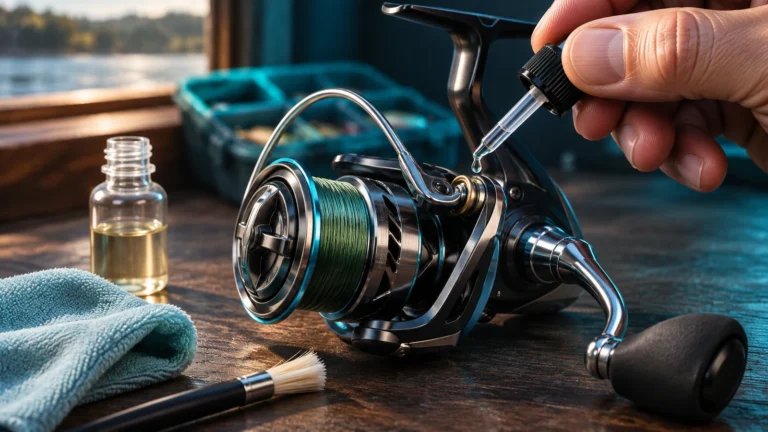
On most front-drag spinning reels, turn the knob on top of the spool clockwise for more drag and counterclockwise for less. On most baitcasters, turn the star beside the handle clockwise for more and counterclockwise for less. Make small changes and measure again rather than guessing by knob position.
5. Confirm smooth release
Try two or three steady pulls, paying attention to the force needed to start the spool and the force needed to keep it moving. The drag should not seize before suddenly dumping line. If it repeatedly sticks, jerks, or changes greatly between pulls, inspect the reel and service it according to the manufacturer’s instructions instead of simply tightening further.
Where to adjust drag on different reels
Spinning reel: front knob or rear control
Most spinning reels place the drag knob on top of the spool. A smaller number have a rear-mounted control. Engage the bail before measuring. The spinning reel’s drag knob is separate from its bail and line roller. For a complete setup overview, see our beginner’s guide to using a spinning reel.
Baitcaster: star drag beside the handle
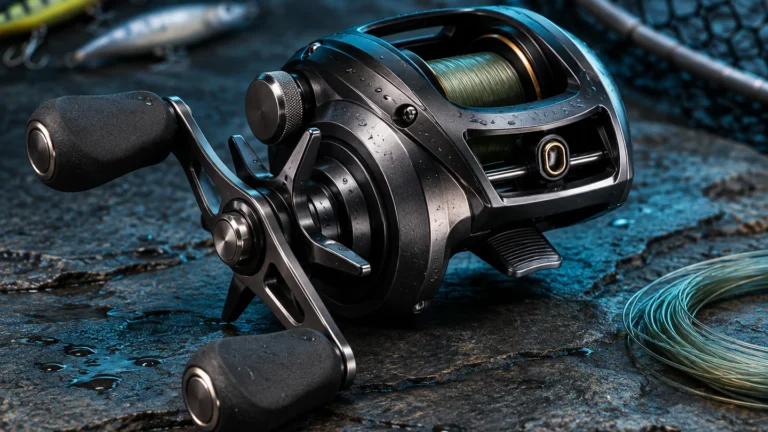
The drag star affects the resistance to line leaving the spool under load. It is not the spool-tension knob, magnetic brake, or centrifugal braking system used to manage casting. Keep the spool engaged while testing. If you are sorting out those controls, our baitcaster controls explainer shows what each does.
Conventional reel: star drag or lever drag
Star-drag conventional reels adjust much like baitcasters. Lever-drag reels are different: many use a preset knob plus a lever with Free, Strike, and Full positions. Follow the exact reel manual when setting the preset, commonly with the lever in Free before changing that preset. Test at the intended Strike position when instructed. Do not treat a lever-drag preset as another star drag.
Can you set reel drag without a scale?
Yes, for a rough, conservative setup. Pull line from the reel through the rod guides with steady tension. You want resistance, but you should still be able to make the spool slip before you are close to snapping the line. Stop if the rod loads excessively or the line cuts into your fingers. Avoid grabbing thin braid barehanded under heavy tension.
That hand test tells you whether the reel slips and whether release feels smooth. It cannot reliably distinguish 2 lb from 4 lb of drag. If you fish light leaders, heavy cover, or expensive fish-of-a-lifetime setups, a scale removes much of the guesswork.
Three scale options for checking drag
You only need one scale, not all three. The examples below are compact hanging scales listed on Amazon US. Look for a readable measurement at your intended drag force. High weight capacity alone does not mean a scale is particularly suitable for tiny 1 to 2 lb adjustments.
- Dr.meter PS01 110 lb digital hanging scale. A simple backlit scale with a hook and built-in tape. Its high overall capacity is more than most drag checks require, so pay attention to how consistently it reads light loads. Check availability on Amazon
- HEETA digital hanging fish scale, 110 lb. Another portable backlit hanging-scale option with a measuring tape. Choose it as an alternative to the Dr.meter rather than a must-have extra. Check availability on Amazon
- KastKing fish scale with ruler, 110 lb. A fishing-oriented digital hanging scale with a handle and retractable tape. The scale is useful for general fishing tasks as well as controlled drag checks; make sure its readout resolution is appropriate for your light-line setup. Check availability on Amazon
A basic mechanical spring scale with a clearly readable low-force range can work just as well. Regardless of brand, make your test with a moving pull, not just a suspended static weight, and repeat it to see whether results are consistent.
When to adjust drag while fishing
Before the first cast: verify the setup after changing leaders, knots, or reel spools. Test again if the reel has been stored with the drag backed off.
When a fish makes a strong run: allow the drag to give line and avoid cranking against a slipping spool. If the line is already under heavy load, do not suddenly lock the drag down to stop the fish. Reduce pressure by adjusting the fighting angle and, when appropriate, carefully easing the drag.
When the spool is nearly empty: be aware that drag can rise as the effective spool diameter shrinks, especially on long runs. This is one reason a conservative starting setting matters.
After an unusual slip or snap: check your knot, leader, spool line lay, and drag smoothness instead of assuming the drag must simply be tighter.
Common drag-setting mistakes
- Using main-line strength when the leader is weaker. Base the first setting on the most vulnerable part of the line system.
- Confusing the baitcaster’s drag star with casting brakes. The drag protects the rig while fighting fish, not against a backlash during a cast.
- Believing a reel’s maximum drag should be the working drag. Maximum rated force is not a recommended everyday setting.
- Judging by the first pull only. Initial start-up resistance can differ from the steady slipping resistance.
- Testing with a sharply bent rod. High-sticking can damage a rod before the reel gives line, particularly with heavy setups.
- Turning the handle while line is slipping off a spinning reel. This can introduce unnecessary line twist. Let the drag do its job during a run.
How this guide was researched
GearAndFish reviewed current US how-to search results, the recreational fishing guidance from Take Me Fishing, drag-setting advice from Salt Water Sportsman, and reel-type explanations from West Marine. The three example scales were matched to their exact Amazon.com US product pages and manufacturer or listing descriptions. This is a research-based setup guide, not a personal fishing test or laboratory measurement.
Fishing reel drag FAQ
How much drag should I use with 10 lb fishing line?
About 2.5 lb is a conservative initial target for 10 lb line, assuming you do not have a weaker leader or other limiting component. Check release with a scale and adjust for your actual rig.
Which way do I turn a spinning reel drag knob?
On most front-drag spinning reels, clockwise tightens the drag and counterclockwise loosens it. Make small changes, then retest. Consult the reel manual if the control works differently.
Should drag make noise when a fish pulls line?
Many reels click or sing as drag releases line. Sound alone does not indicate a good setting. Smooth, controlled slipping without sudden sticking is more important.
Is 25% of line strength always the correct drag setting?
No. It is a practical starting rule. The leader, knots, rod, reel design, fish, and environment can call for a lower or different setting. Lever-drag offshore reels may have more specific manufacturer procedures.