GearAndFish is reader-supported. As an Amazon Associate I earn from qualifying purchases. When you buy through links on our site, we may earn an affiliate commission, at no extra cost to you. Learn more.
Learning how to use a spinning reel is less about casting hard and more about managing the line. Set up the reel below the rod, learn what the bail and drag do, cast with your index finger, close the bail by hand, and retrieve without winding slack loops onto the spool. Those habits matter just as much when you hook your first fish.
This beginner guide covers the entire fishing sequence, from setup to landing a fish. If you only need a detailed line-loading tutorial, see our spinning-reel spooling guide. All equipment examples below are research-based, not claims of personal product testing.
How to use a spinning reel in seven moves
- Secure the reel under a spinning rod and check that the line passes through every guide.
- Set the front drag so line can leave under sustained pressure without slipping freely.
- Hold the line against the rod with your index finger, then flip the bail open.
- Make a smooth forward cast and release the line with your finger.
- After the lure lands, close the bail by hand and remove visible slack.
- Turn the handle to retrieve, changing pace to suit your lure rather than cranking constantly at top speed.
- When a fish pulls hard, keep the rod loaded and let the drag release line instead of forcing the reel handle.
Know the five parts you actually use
A spinning reel has a stationary spool during the cast. Line comes off the front in loops, while the rotor and bail turn around the spool as you retrieve. That is why a spinning reel does not need the thumb-controlled rotating spool used on a baitcaster.
- Bail arm
- The hinged wire you flip open before casting and close before retrieving. When closed, it guides line toward the roller.
- Line roller
- The small rotating guide where line enters the reel during retrieval. The line should settle onto it after you close the bail.
- Spool and lip
- The spool holds line. Its front lip is where line peels off on a cast. An excessively full or underfilled spool can make casting more troublesome.
- Front drag knob
- Usually on the spool face. It sets how much resistance a fish must overcome to pull line off the reel.
- Handle and rotor
- Turning the handle rotates the rotor around the spool and collects line. The spool also moves back and forth to distribute the wraps.
Some models have a reversible handle and some have an anti-reverse switch, but not every current spinning reel includes a visible switch. Check the exact reel’s instructions rather than searching for a control your model may not have.
Before your first cast: set up the reel correctly
1. Mount it the right way and check the line path
Slide the reel foot into the spinning rod’s reel seat, secure the locking ring until the reel no longer shifts, and keep the reel hanging beneath the rod. The rod’s larger first guide should face the reel spool. Route the line through every guide, including the tip, and confirm it is not wrapped around the blank.
If the reel is unspooled, the key ordering rule is to open the bail before tying line to the arbor. Load line with steady, light tension, then stop short of the spool lip according to the reel maker’s instructions. Braid may need monofilament backing on a smooth arbor to prevent the entire line pack from slipping. Our full spooling walkthrough covers direction checks, backing, and fill level in detail.
2. Pick a safe practice rig
For backyard or park casting practice, use a smooth, hookless practice plug only where casting is allowed and people, pets, vehicles, and power lines are clear. When fishing, keep hooks protected until you reach a safe casting area. Choose a lure or sinker inside the weight range printed on your rod, not simply the heaviest weight you own.
3. Set the drag before the cast
Turn the front drag knob clockwise to tighten resistance and counterclockwise to loosen it on most front-drag reels. Start modestly, then pull line through the assembled rod at a controlled angle with a gloved hand or appropriate safe grip. The line should leave smoothly under firm pressure, without the spool giving up line to the lightest pull.
Do not rely on one universal drag setting. The weakest knot, line, leader, hook, rod angle, and fish all affect the appropriate setting. A spring scale can help with measured drag checks, but even a carefully set drag needs adjustment when conditions change. Never wrap line around a finger or pull directly against the rod tip with excessive force.

How to cast a spinning reel without a tangle
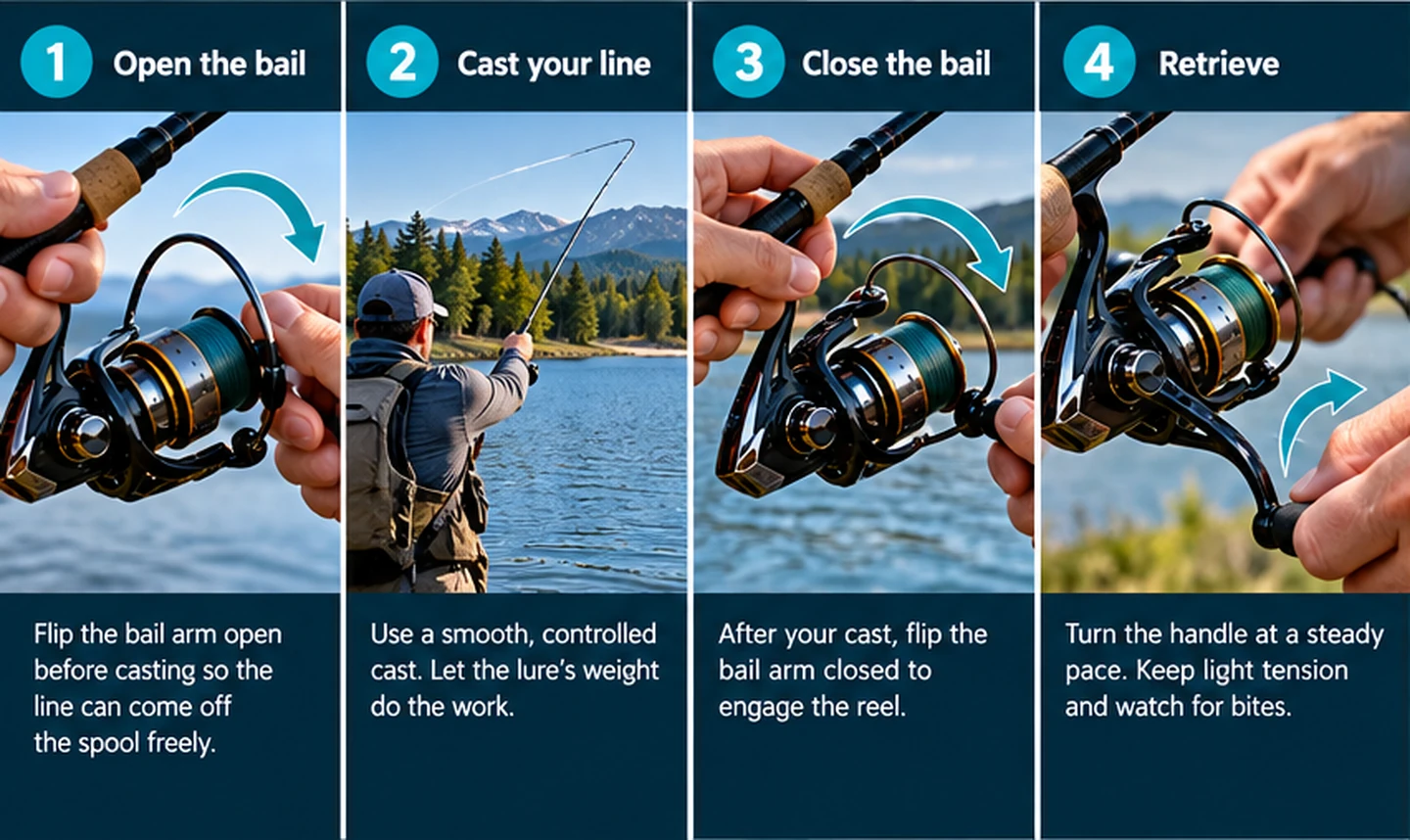
A good first cast has a predictable order: finger, bail, cast, release, close. Beginners often switch the first two actions and watch the lure fall at their feet. Practice this motion slowly before chasing distance.
- Grip the rod. Let the reel hang below the handle. Hold the rod comfortably so your index finger can reach the line ahead of the spool.
- Catch the line. Use that finger to hold the main line gently against the rod, with enough control that the lure will not drop when the bail opens.
- Open the bail with your free hand. The line should now be held by your finger, not by the bail.
- Look behind and above you. Check for people, branches, and especially overhead electrical lines.
- Swing forward smoothly. Let the rod load and release your finger as the rod accelerates toward the target. Do not whip with full force.
- Control the landing. As the lure slows, feather outgoing line lightly if needed, then close the bail manually after the lure lands.
- Remove loose loops. Point the rod toward the lure, lift out slack with the rod or a brief retrieve, and make sure the line sits on the roller before continuing.
Closing the bail by hand is a useful habit because it lets you inspect the line roller and stop loose coils from entering the spool. The handle may trip the bail on many reels, but relying on that every cast can hide sloppy line management.
If casts fly high or land short, adjust finger-release timing before changing gear. If the lure crashes down early, release slightly earlier in the forward motion; if it sails high and beyond your target, try a later, more controlled release. Work on one correction at a time.
Using the reel after the lure lands: three basic retrieves
The handle gathers line. It does not automatically tell the lure what to do. Pay attention to line tension and the lure’s intended action, then use the rod tip and retrieve speed together.
| Retrieve | What you do | Useful for | Watch out for |
|---|---|---|---|
| Steady | Turn the handle at a consistent, moderate pace. | Spinners, many swimbaits, and other moving lures | Moving too fast for the lure to run correctly |
| Pause and go | Retrieve a few turns, pause briefly, repeat. | Soft plastics, small hard baits, and exploring depth changes | Allowing loose loops to pile onto the spool during the pause |
| Lift and take up slack | Move the lure with the rod, then turn the handle to collect the slack. | Bottom-contact jigs and some finesse presentations | Reeling so fast that the lure never settles |
Steady
Pause and go
Lift and take up slack
A high-speed reel is not an instruction to fish every lure quickly. As you learn, try a steady retrieve first, then introduce intentional pauses and rod movements. If you use a spinner or other lure that can twist line, a suitable swivel or adjusted retrieve can help, but there is no universal cure for twist except correcting the underlying cause.
When a fish bites: use the rod and drag together
Keep tension without locking everything down. A loaded rod cushions sudden movement, and the drag lets line leave when pressure becomes excessive. Aim to guide the fish, not win a tug-of-war with a stationary handle.
- Recognize the strike. Watch for an unexpected line movement, a load on the tip, or a firm tick through the rod.
- Set the hook appropriately. Use a controlled sweep or lift that matches the hook and species. Not every presentation needs a dramatic overhead jerk.
- Keep the rod bent and pressure steady. Avoid raising a heavily loaded rod close to vertical, especially near the boat or bank.
- Let the drag work during a run. If line is leaving under steady tension, do not keep cranking hard against a slipping drag.
- Recover line when pressure eases. Lower the rod slightly as you turn the handle, then lift in a controlled motion if needed.
- Land the fish safely. Use an appropriate net, avoid lifting fish by the rod, and keep hands clear of hooks and sharp spines.
If the drag jerks instead of slipping smoothly, stop and inspect the system before forcing the fight. Also check the line and knot after a snag or abrasion. An old or damaged line can break below its printed rating.

Two useful pieces of gear for learning
You do not need premium tackle to practice the steps above. A compatible freshwater spinning reel and manageable line will take you further than complicated settings. The examples below are specific Amazon US variants, not a ranked roundup or a substitute for checking your rod’s line rating.
Daiwa Regal LT 2500D-XH-B spinning reel
This is a current 2500-class freshwater option with a front drag and a fast 6.2:1 ratio. Daiwa documents its Regal LT construction and drag system; the RGLT2500D-XH-B variant is the one associated with this Amazon listing. The faster line pickup is useful for collecting slack, but it can make it easy to retrieve a slow lure too quickly. Choose it only if its line capacity and balance suit your rod.
Check Daiwa Regal LT availability on Amazon
Berkley Trilene XL Clear, 8 lb, 330 yd
An 8-pound clear monofilament is a reasonable learning line when your rod and reel allow it. Mono is generally forgiving when tying knots and absorbing sudden loads, although it still develops memory and twist if loaded incorrectly. The exact XLFS8-15 clear 330-yard variant is the mapped Amazon product. It is not a universal choice for ultralight or heavier saltwater tackle.
Check Berkley Trilene XL availability on Amazon
Already own a reel? You may not need to buy anything. Spend your first practice session on bail handling, drag behavior, and line tension. If you are pairing a new rod, see our spinning rod guide; reel size labels are explained in our reel size guide.
Quick fixes for the most common spinning-reel mistakes
Loose loops collect at the top of the spool
Stop winding immediately. Open the bail, pull out enough line to remove the loose wraps, inspect the line path, then close the bail manually and wind back on under light tension. Reeling over the loop usually makes the next cast worse.
Line jumps off as soon as the bail opens
Check overfill, stiff line, and preexisting twist. The reel may be carrying too much line or the diameter may be awkward for its spool. Fix the spooling problem rather than tightening the drag; drag does not stop line coming off an open spool.
The reel spins but the line does not wind in
Confirm the bail is closed and the line is actually seated on the line roller. If you use braid and the spool’s entire line load turns around the arbor, the braid may be slipping because it lacks a compatible grip surface or backing.
The handle turns but the drag clicks and the fish stays put
You may be reeling against drag that is already slipping. Maintain control with the rod, let the fish’s run slow, and regain line when pressure decreases. Do not solve the problem by immediately locking down the drag.
One retrieve creates more twist than another
Inspect the lure for rolling, and check whether the line was already loaded with twist. Some presentations naturally twist line more than others. Letting slack coils wind onto the spool magnifies the problem.
A ten-minute practice routine
- Two minutes: with a hookless practice plug and a safe area, practice line-in-finger, bail-open, bail-closed without casting.
- Three minutes: cast gently toward a close target. Focus on releasing the line smoothly and closing the bail by hand.
- Two minutes: alternate a steady retrieve and a pause-and-go retrieve while keeping slack off the spool.
- Three minutes: check drag with a controlled pull, inspect the line roller, and review any unexpected loops before your next session.
When you can repeat these motions without looking down at the reel each time, add accuracy and different lure presentations. Fishing skill improves faster through controlled repetitions than a series of maximum-distance casts.
How this guide was researched
GearAndFish compared the current US search intent for using a spinning reel with reel-maker instructions, educational fishing resources, the site’s existing spooling coverage, and current product listings. The article deliberately stays broad: bail control, drag, retrieve, fighting fish, and error prevention. Detailed spooling and casting technique remain separate tasks. No first-person fishing sessions or product performance measurements are claimed.
For equipment reference, see Daiwa’s Regal LT manufacturer page, Berkley’s Trilene XL line information, and the Take Me Fishing beginner guide. Exact Amazon variants were checked October 9, 2026. Online selection and stock can change.
How to use a spinning reel: FAQ
Do I open the bail before or after holding the line?
Hold the line against the rod with your index finger first, then open the bail. Your finger keeps the lure from dropping until you release the line during the cast.
Should I close the bail with my hand or the handle?
Closing it by hand is a useful routine. It helps you check the line roller and clear loose loops before winding. Some reels can trip the bail with the handle, but that should not replace checking line tension.
What drag setting should a beginner use?
Start with controlled resistance that protects the weakest part of your rig and allows line to leave smoothly under a firm pull. A fixed rule is less useful than checking the complete rod, line, leader, and knot system.
Why does my spinning reel keep making loops?
Common causes include loose line after a cast, too much line on the spool, excessive twist, or line that is too stiff for the reel. Stop and remove loose wraps before retrieving again.
Can I reel while a fish is pulling drag?
It is usually better to let the drag release line during a strong run and retrieve when the load eases. Reeling hard against slipping drag can add twist without gaining line.
Is a spinning reel good for beginners?
Yes. Spinning reels are a practical first choice for many freshwater setups because the spool does not rotate during a cast. You still need to learn bail sequence, drag control, and line management.