
GearAndFish is reader-supported. As an Amazon Associate I earn from qualifying purchases. When you buy through links on our site, we may earn an affiliate commission, at no extra cost to you. Learn more.
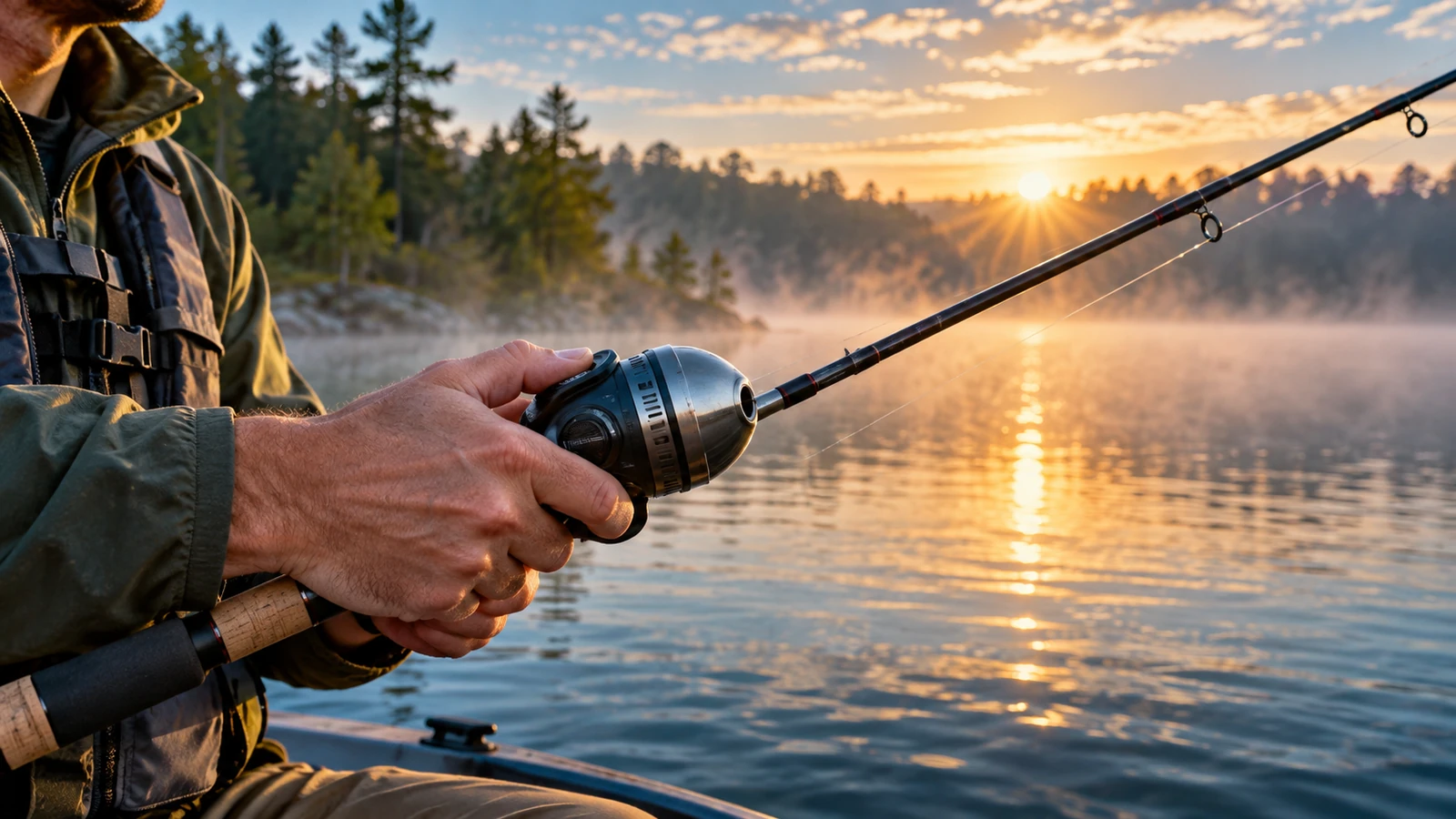
Learning how to use a spincast reel comes down to one skill: hold the thumb button as you bring the rod back, then release it during the forward cast so the line can flow through the enclosed nose cone. Once your bait lands, turn the handle to engage the pickup and reel in. The simple button makes spincast reels approachable, but accurate casts still depend on timing, a properly rigged rod, and sensible drag.
This is a technique-first guide for conventional push-button, closed-face spincast reels mounted above the rod. It is not a baitcaster tutorial, a product roundup, or a full line-spooling guide.
How to use a spincast reel in 5 steps
- Put the reel on top of a casting rod, thread the line through every guide, and attach a suitable practice plug or fishing rig.
- Leave roughly 6 to 12 inches between the rod tip and the plug or lure, and check that the area behind you is clear.
- Press and hold the reel’s thumb button, then bring the rod back smoothly over your shoulder.
- Move the rod forward and release the button as the rod tip travels toward your target. Follow through without snapping your wrist.
- When the plug or lure lands, turn the handle forward to engage line pickup and begin your retrieve.
Practice with a hookless casting plug in an open area before using a hook or lure near people. Move the button release slightly earlier or later to correct the flight path.

First, know what the button, handle, and drag do
A spincast reel has a fixed internal spool hidden behind a front cone. The button at the back controls the line-holding mechanism for casting; once released during the forward stroke, line can leave through the small hole in the cone. Turning the reel handle picks line back up and winds it onto the spool. You do not open a bail, and you do not thumb a rotating casting spool as you would on a baitcaster.
- Thumb button: Your casting trigger. Hold it while loading the rod and release it to let the line leave the reel.
- Handle: Re-engages pickup after the cast and retrieves line. Crank in the reel’s normal forward direction.
- Drag dial or knob: Controls how readily a fish can pull line out under tension. It is not a casting-distance adjustment.
- Front cone: Covers the spool and directs line through the nose opening. Do not crank hard if line becomes caught inside.
Spincast reels usually sit above the rod on a casting-style reel seat. If your reel sits under the rod and has an exposed spool and bail, you are holding a spinning reel instead.
Set up the rod before your first cast
1. Check the line path and mounting
Secure the reel foot in the rod’s reel seat. Lead the line from the nose opening through each guide, starting nearest the reel and ending at the tip. Check the small guides carefully: missing one or wrapping line around the blank makes casting erratic. Never pull the line through the guides by yanking on a lure with exposed hooks.
2. Use manageable line and a lure the rod can load
Many general-purpose spincast reels are supplied with monofilament around the 8 to 10-pound class, but you should follow the capacity and line recommendations on your exact reel. Fresh, appropriately sized mono is a safe beginner default. Heavy or stiff line can bind inside the closed face, while a lure far below the rod’s rated casting weight may fail to load the rod. Do not assume braid is compatible with every spincast model.
3. Test the drag before fishing
With the line properly routed through the rod, pull steadily on the line beyond the tip while keeping the rod pointed safely away from people. The reel should release line under firm, controlled tension rather than staying completely locked. A setting around one-quarter to one-third of the line’s breaking strength is a common starting reference, not a substitute for checking the actual knot, line condition, rod rating, and hook size. Begin on the lighter side; adjust as you fish.
4. Make a safe first rig
For yard practice, tie on a dedicated hookless casting plug of a weight appropriate for the rod. At the pond, a basic float, small hook, and appropriately placed split shot will work for panfish; a modest inline spinner or small jig can teach controlled retrieves. Inspect overhead branches, people, pets, and your backcast area before every cast.
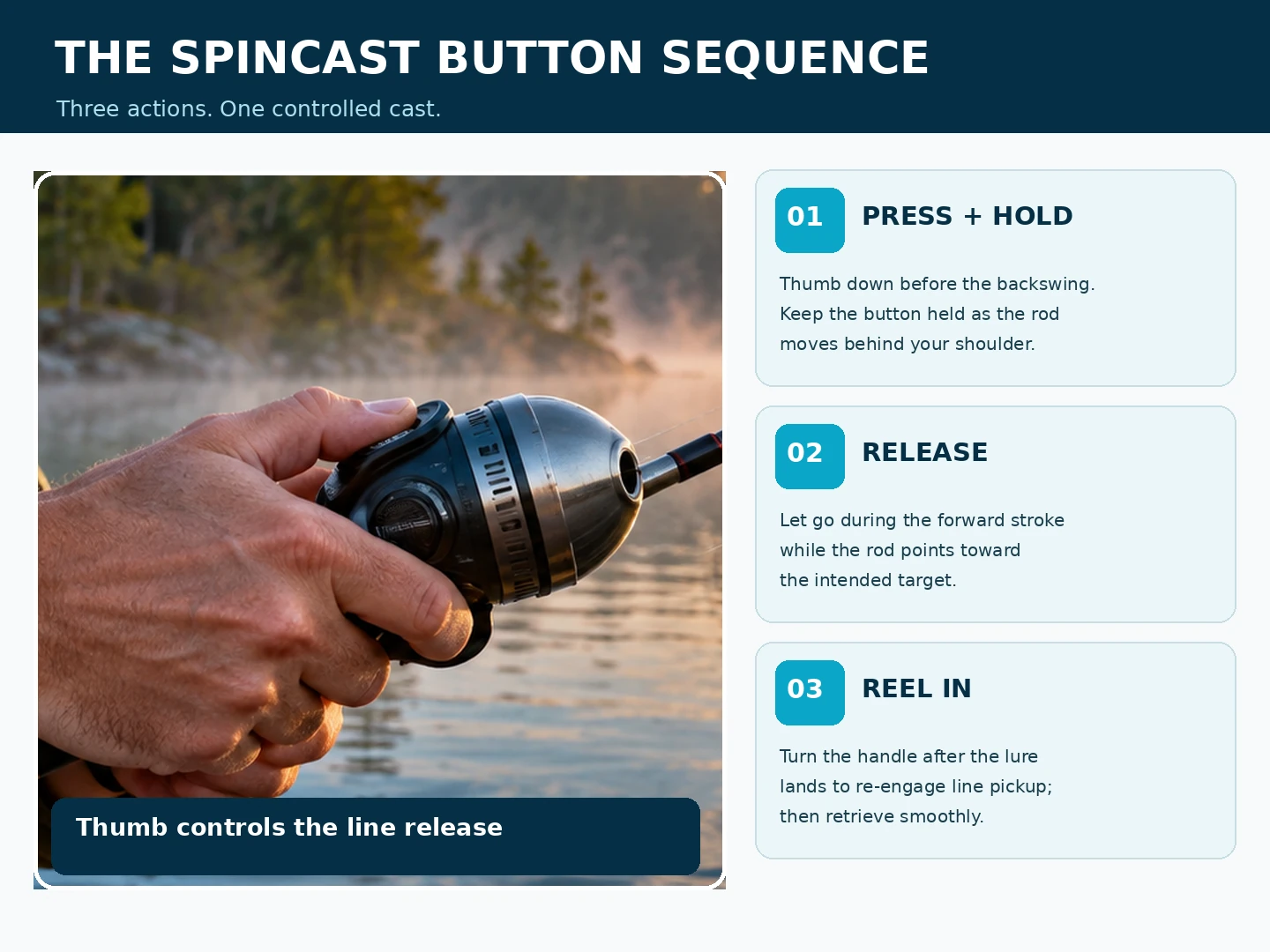
How to cast a spincast reel without fighting the button
Use a short overhead cast first. Distance comes later. The release is easier to learn when your rod motion stays relaxed and repeatable.
Step 1: Set the drop
Reel up until the lure or practice plug hangs about 6 to 12 inches beneath the rod tip. Enough line should remain to let the lure swing and load the tip; do not reel the lure into the top guide.
Step 2: Grip the rod and press the button
Place your thumb on the rear button while holding the rod handle comfortably. Press and keep the button depressed. The button holds the line during your backswing. The reel belongs on top of the rod, and your thumb should be able to reach the button without an awkward wrist position.
Step 3: Bring the rod back smoothly
Check behind you, then raise the rod to roughly the position it would reach when making an easy overhand throw. Stop before the tip travels into the ground or a branch. An exaggerated whip is unnecessary, particularly with a moderate-action beginner rod.
Step 4: Cast forward and let go
Accelerate the rod toward your target and release the thumb button during the forward stroke, near the point where the rod tip begins aiming at the target. The exact release point changes with rod length, lure weight, wind, and casting angle. Keep the motion fluid and point the rod along the cast’s direction.
Step 5: Engage the pickup and retrieve
Let the lure land, then turn the handle forward. You may hear or feel a small pickup click as the mechanism engages. Start reeling steadily, keeping light tension so slack does not form loose loops inside the cone. If the handle turns but does not bring line in, stop and troubleshoot instead of cranking harder.
Read the cast: high, on target, or too short
Your first casts provide better feedback than trying to memorize a perfect clock-face position. Watch where the lure goes, then change only the thumb release timing.
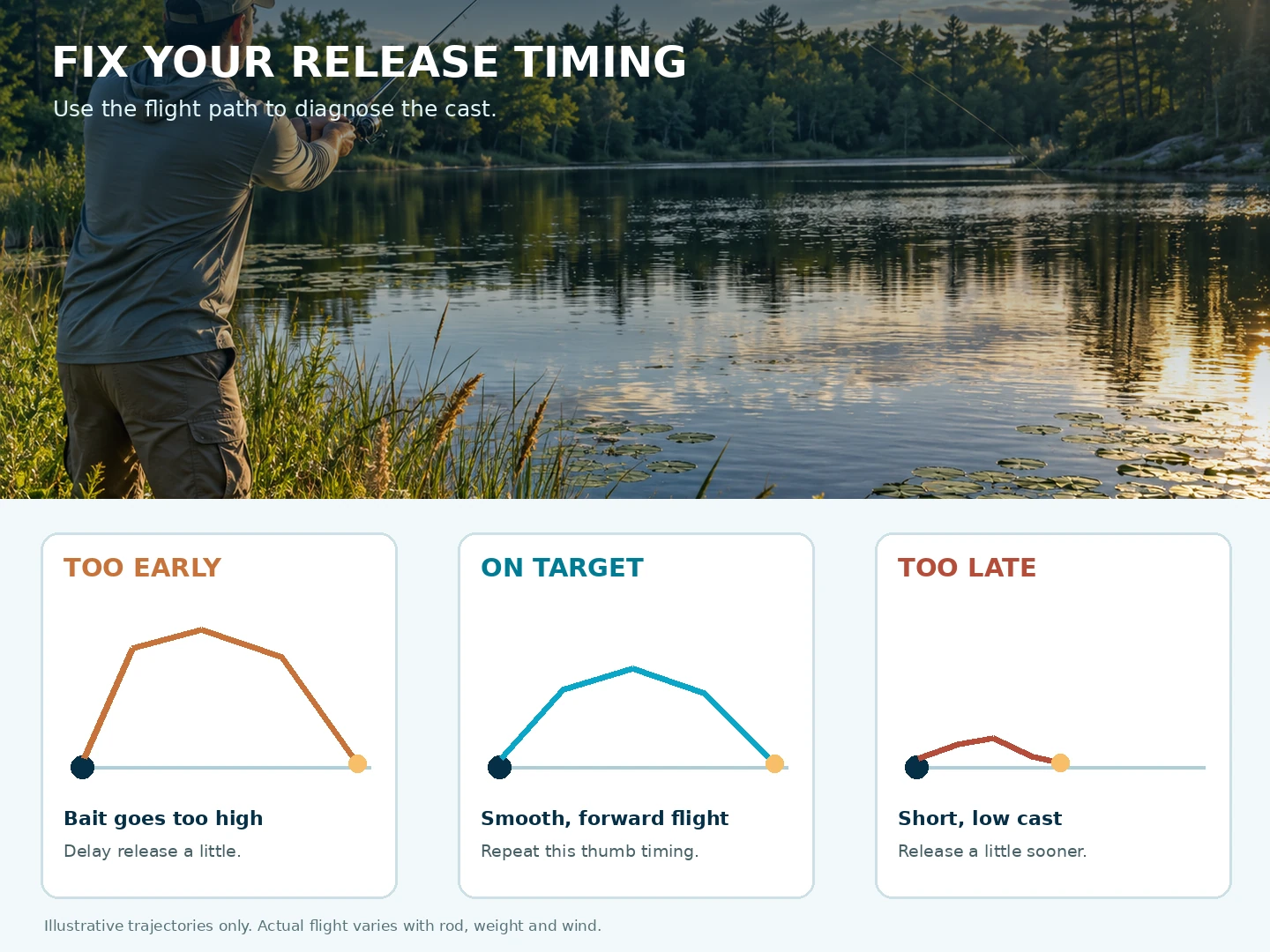
- It shoots high and drops short: You probably let go of the button too early. Keep it depressed slightly longer into the forward stroke.
- It dives into the water or ground in front of you: You probably released too late. Let go a little earlier.
- It travels toward the target in a smooth arc: Maintain the same swing and release point before trying for more distance.
If the lure comes out poorly in every direction, check for a line tangle, a loose or overly tight spool fill, an unsuitable lure weight, or a rod guide the line missed. Wind, especially a strong headwind, can also change the trajectory.
Retrieve a lure and handle a fish
Once the pickup engages, a spincast reel works like other basic reels: you can use steady turns for a small spinner, a slower retrieve for some soft plastics, or very little movement when a float is holding bait in place. Keep the rod at a comfortable angle and maintain just enough line tension to feel what is happening without dragging the lure unnaturally.
When a fish takes, lift the rod to set the hook according to the hook and bait you are using, then let the bent rod and drag absorb surges. If a fish is pulling line against the drag, avoid grinding the handle in place. Maintain steady pressure, and reel as you lower the rod when the fish stops pulling. For small panfish, a controlled retrieve is usually better than a dramatic hookset.
A ten-minute practice routine that actually helps
- Two minutes: Check the reel mount, line guides, drag, practice plug, and clear casting lane.
- Three minutes: Make short, easy casts with the same drop length and deliberate button release.
- Three minutes: Set one target on the ground and adjust only your release point to correct high or low casts.
- Two minutes: Rehearse handle engagement and an even retrieve. Finish with one accurate cast rather than your longest cast.
A smaller controlled motion is easier to repeat than a full-power throw. Children should be supervised and practice with a hookless plug. Never practice into a street, near power lines, or where another person could enter the casting lane unnoticed.
Spincast reel troubleshooting: 6 common problems
| Problem | Likely reason | First fix |
|---|---|---|
| No line comes out | Not enough line, line behind the spinnerhead, or line too heavy | Stop, inspect the nose cone, and check the recommended line size |
| Cast is consistently short | Old line, low spool fill, line friction, or mismatched lure | Check line condition and fill before increasing force |
| Lure goes nearly straight up | Button released too soon | Release slightly later in the forward stroke |
| Lure hits close to your feet | Button released too late | Release slightly earlier |
| Handle turns without retrieving | Pickup mechanism not engaging or line snagged | Stop winding, check engagement and the line path |
| Line breaks or feels locked | Drag too tight, damaged line, or snag | Check the line and reset drag under controlled tension |
If the front cover needs to come off, follow your model’s manual; many conventional Zebco models unscrew counterclockwise, but not every reel uses the same fitting. Remove damaged line instead of winding a hidden knot back inside the mechanism. Do not dismantle springs or internal assemblies just to solve an ordinary bird’s nest.
When is fresh line worth more than more practice?
If your spincast reel has old, tightly coiled line, visible abrasion, or very little line remaining, timing corrections will not restore normal casting distance. Check the line through the nose opening and inspect the spool if the manufacturer’s procedure permits it. Use the labeled line class and spool-fill guidance for your reel; Zebco’s general troubleshooting guidance describes filling to roughly 1/8 inch below the spool rim on compatible models.
Replacing line is its own task because threading the front cover before tying to the spool, controlling fill and tension, and avoiding line trapped behind the pickup are important. This page stays focused on operating and casting the reel rather than repeating a full respooling tutorial.
Two spincast reels that fit this learning process
You do not need to buy a new reel to learn the technique. If your current button reel is mechanically sound, practice with it first. For an initial purchase or replacement, these are two current, identifiable examples rather than a full product ranking:
Zebco 202 Size 30: simple first reel
The Size 30 Zebco 202 is a basic right-hand-retrieve model with a 2.8:1 gear ratio and pre-spooled 10-pound monofilament. That makes it sensible for practicing push-button casts and slow bait retrieves. Do not pick it if you need left-hand cranking: this 202 version is right-hand only.
KastKing Brutus Size 30: easier to share
The Brutus Size 30 has a reversible handle and a 4.0:1 gear ratio. Those features can make it a more practical shared-family setup when one person prefers left-hand cranking or wants quicker line pickup than a basic 202. It remains a push-button spincast reel, not a replacement for a spinning setup when fine line and very light lures matter most.
For a broader model-by-model buying comparison, use our best spincast reels guide. That page covers retrieve speed, handle orientation, capacity, and other reel options in more detail.
How this guide was prepared
GearAndFish reviewed manufacturer operating guidance and public fishing-education material to separate the repeatable casting procedure from product-specific details. The primary references were Zebco’s spincast setup guide, Zebco’s spincast troubleshooting resource, and the Utah Division of Wildlife Resources casting instructions. Product examples were checked against currently identifiable Amazon.com US listings and manufacturer or category specifications. This is research-based advice, not a claim of first-party field use of either listed reel.
Spincast reel FAQ
Do you hold the button while casting a spincast reel?
Hold the button through the backswing, then release it during the forward stroke so the line can leave the reel. Keeping it held for the entire forward swing prevents a normal cast.
Do you reel before or after the lure hits the water?
Turn the handle after the lure reaches the target to engage the pickup and begin retrieving. You can control excessive line travel with the button as appropriate for your particular model.
Why does my spincast reel cast only a few feet?
Common causes are releasing the button too late, old or insufficient line, a lure that does not load the rod, and line caught inside the nose cone. Check timing first, then inspect the rig and line condition.
Does a spincast reel need a special rod?
A traditional push-button spincast reel belongs above a casting-style rod with a suitable reel seat and guide layout. Follow the rod’s line and lure ratings, and make sure your thumb can comfortably operate the button.
Is a spincast reel the same as a baitcaster?
No. A spincast reel feeds line from a fixed spool inside a closed nose cone. A baitcaster uses a rotating spool and different casting controls. Do not use baitcaster spool-tension or braking instructions on a conventional push-button spincaster.