
GearAndFish is reader-supported. As an Amazon Associate I earn from qualifying purchases. When you buy through links on our site, we may earn an affiliate commission, at no extra cost to you. Learn more.
How much line should you put on a spinning reel? Enough to bring the line close to the spool lip, but not so much that loose coils spill over it. The number of yards that takes depends on your exact reel and the diameter of the line, not just the reel’s size number or the pound-test printed on the package.
This is a line-capacity and fill-level guide, not a second tutorial on tying the arbor knot or controlling line twist. It draws on reel-maker capacity conventions, fishing-line specifications and published spooling guidance. No personal equipment testing is claimed.
How much line to put on a spinning reel
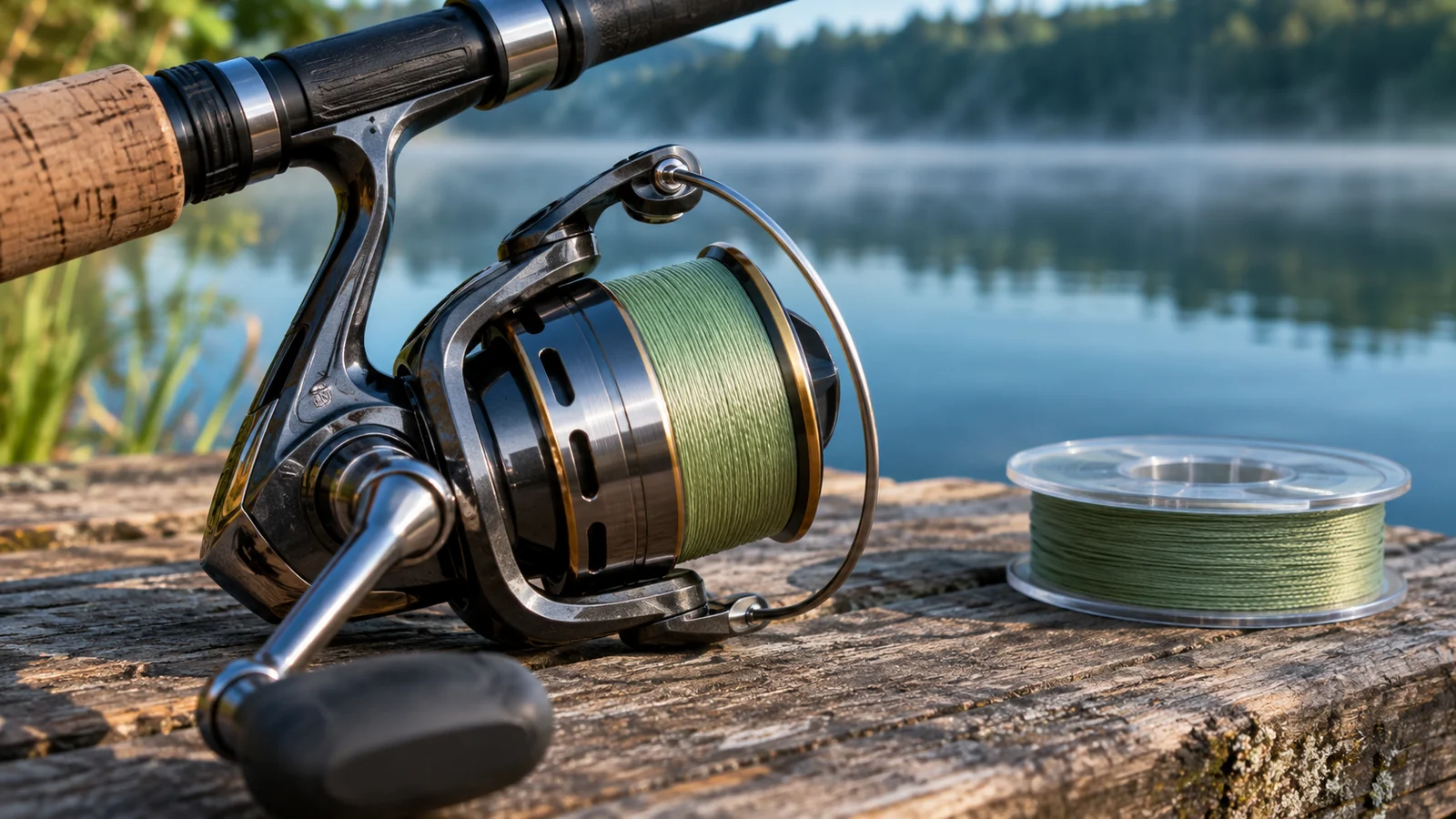
For a typical spinning reel, stop at roughly 1/8 inch below the outer spool lip, unless the reel maker specifies a different fill mark. To estimate the yardage you’ll need, start with the line-capacity rating on your particular spool and compare the diameter of the line you actually plan to use. A 150-yard filler spool is not automatically a perfect match for a 2500-size reel.
First, separate fill level from line capacity
These are two different questions. Fill level means how close the outermost wraps sit to the front lip. You can see it while winding line onto the reel. Capacity means the length of a particular diameter of line that fits between the spool arbor and that fill level.
That’s why a fixed answer such as “put 150 yards on any 2500 reel” is unreliable. A 2500 label is a size family, not a shared industry specification. Even two reels from the same manufacturer can have different spool depths or capacities. The spool itself or the official specifications for your exact model are a better starting point.
The visible fill level is the final check. If you’ve loaded the recommended number of yards but the wraps end well below the lip, check whether the line is thinner than the reference line or whether you have a deeper spool than expected.
How to read the line capacity printed on a spinning reel
Look for a marking on the spool skirt, the box, or the reel maker’s specification sheet. It might show mono in pounds and yards, braid in pounds and yards, or a line diameter in millimeters paired with meters. The units matter.
If a spool says 8 lb / 150 yd, the manufacturer is indicating an approximate capacity for its reference 8-pound line. It is not promising that every brand of 8-pound mono, every 8-pound fluorocarbon, or 8-pound braid will take exactly 150 yards.
Why diameter beats pound-test for estimating yards
Breaking-strength labels tell you something about the line’s rated strength, but they don’t define its thickness. A thin braid and a relatively thick mono can share a pound-test while occupying very different volumes on the spool. Read the diameter on the filler-spool label whenever it is supplied, and compare it with the diameter in the reel manufacturer’s capacity chart.
For two lines of different diameters, a rough volume-only estimate is:
Estimated new capacity = stated capacity × (reference diameter ÷ new diameter)².
Suppose an illustrative reel rating is 150 yards at 0.25 mm. A 0.20 mm line gives a theoretical estimate of about 234 yards, calculated as 150 × (0.25 ÷ 0.20)². That is planning math, not a guaranteed fill amount. Spool geometry, packing tension, braid construction and the reel maker’s assumptions all change the real result. Stop by the visible fill level, not a calculator alone.
How many yards should you buy?
Read the exact reel rating first, then choose a filler-spool length that covers the line you want on top. A smaller package can be enough when you use backing, while a larger package gives you flexibility if you’re loading more than one reel.
A 150-yard spool can be enough, but not for every reel
If the reel’s actual capacity for your chosen line is near 150 yards, a 150-yard package may be a convenient fit. If the reel can hold substantially more thin braid, 150 yards will not reach the intended fill level on an empty deep spool. You can either buy more main line or fill the deeper portion with compatible backing.
Before purchasing an expensive braid, check whether you need all of that line to be braid. For many general freshwater applications, a practical length of braid over mono backing makes better use of a 150-yard filler spool. Your fishing location, potential fish runs and likelihood of losing line determine whether that amount is suitable. Do not assume that 150 yards is adequate for every saltwater or long-running-fish situation.
A 300-yard spool is inventory, not a target
A 300-yard package doesn’t mean the reel should hold 300 yards. It may supply two smaller reels, one deeper reel, or a main-line fill with some line left over. The goal is the correct fill level and appropriate working length, not emptying the package.
When to use backing instead of adding more expensive main line
Backing is lower-cost line wound beneath your fishing line. It takes up space on a deep spool and can help thin braid grip a smooth arbor. Some braid-ready reels use a grippy spool surface that allows the braid to be attached directly, so follow your reel’s instructions rather than treating backing as mandatory on every model.
- Choose your usable main-line length. Consider the actual fishing application. Do not short a reel intended for long runs just to save line.
- Check the reel’s capacity for that line diameter. If the main-line length will leave the spool obviously underfilled, backing can occupy the unused depth.
- Load backing, then connect the main line. A compact, well-tied connection matters because it may pass under later wraps. Wind with consistent tension.
- Stop at the fill mark or roughly 1/8 inch below the lip. The right backing length is the amount that gives this final fill with the chosen main-line length.
There is no dependable universal rule such as “add 30 yards of mono under 150 yards of braid.” The backing amount varies with spool depth and both line diameters. If you want to measure it accurately, you can reverse-load the reel: wind the desired main line onto an empty spare spool, add backing until full, then transfer it in reverse order to the fishing spool. This requires a suitable spare spool or an intermediate transfer arrangement.
For the step-by-step winding technique, bail order, tension and line-twist check, use our guide to spooling a spinning reel. This page is concerned with deciding how much to put on it.
How mono, braid and fluorocarbon change the calculation
Monofilament: compare its diameter with the reel’s mono rating
Monofilament is a straightforward backing choice and an accessible main line for general freshwater spinning. As a concrete US product example, Berkley Trilene XL in clear 8 lb / 330 yd is listed at 0.010 inch (0.25 mm) diameter. That 330-yard figure describes the filler package, not what one reel should hold. Match the actual diameter to your spool capacity and use only the amount the reel takes.
Braid: expect diameter and spool depth to matter more
A thin braid often allows more yards of line than a thicker monofilament at a comparable strength rating. For example, KastKing SuperPower Silky8 braid is offered in multiple pound-tests and filler lengths, including a 150-yard package. Check the selected size and the diameter listed for that exact variant before estimating your reel’s usable capacity. On a smooth arbor, use mono backing or an approved grip system to keep the entire line pack from slipping.
Fluorocarbon: capacity alone does not tell the whole story
A 100% fluorocarbon main line can fit a stated capacity yet still behave poorly if its memory or stiffness is unsuitable for a small spinning spool. The 8 lb / 200 yd Seaguar InvizX variant is an example of a fluorocarbon sold for main-line use. Compare actual diameter and line handling rather than buying solely by spool yardage. If the line jumps into coils, a thinner line or a braid-main-line-and-fluorocarbon-leader arrangement may be easier to manage.
Check the fill level before the first cast
Once you’ve loaded the line, look straight across the face of the spool. The outermost wraps should form an even pack with a small, visible gap below the front lip. Around 1/8 inch is a useful general reference; Zebco’s published reel guidance uses that spacing for spinning reels. Always prefer any line-fill mark or model-specific instruction from your own reel maker.
- Too low: a large, exposed lip forces outgoing line to climb over more of the spool edge. Check whether more line or backing is needed.
- About right: the pack is level, controlled and slightly below the lip. No precise number of handle turns is needed.
- Too high: line sits nearly flush with or above the lip, making loose coils more likely to spring off when the bail opens. Remove some line before fishing.
Do not confuse a loose, uneven pile of wraps with full capacity. Pack line under controlled tension and check that it is laying evenly. If the reel piles line at one end of the spool, consult its specific manual before adjusting spool-height washers.
Four common ways to get the amount wrong
- Using reel size as a yardage chart. Size 1000, 2500 and 4000 labels are not standardized capacities. Check the exact model.
- Reading “8 lb / 150 yd” as a universal line quantity. The maker’s reference diameter may not match your filler spool.
- Trying to fit the entire new line package. A 300-yard package may be more than the reel needs, even if it was sold as a single spool.
- Calculating backing from a fixed percentage. The amount of backing depends on the spool’s actual dimensions and the thickness of both lines. Stop by fill level.
If your casts produce loops or wind knots even though the spool is correctly filled, line twist or slack winding may be the cause rather than the number of yards. Our spinning-reel casting guide covers closing the bail and controlling slack after a cast.
The practical rule
Buy line by the reel’s printed capacity and your line’s diameter; fill by the visible spool lip. A package marked 150 yards is a supply quantity, not an instruction. With braid on a deep reel, backing can bring a shorter main-line fill up to the correct level. For most everyday spinning reels, a small margin below the lip is safer than chasing the last possible yard.
Spinning reel line capacity FAQ
Is 150 yards of line enough for a spinning reel?
Sometimes. It can be appropriate for many freshwater setups, particularly with backing, but there is no universal rule. Check your actual reel’s capacity and the kind of fish and water you plan to fish. A reel used for long runs may need more usable line.
Should I fill a spinning reel all the way to the edge?
No. A common starting target is roughly 1/8 inch below the front spool lip, unless your manufacturer gives a different mark or instruction. Line packed flush with the lip is more likely to spill in loose loops.
How much braid fits compared with mono?
It depends primarily on the actual diameters, not equal pound-test labels. Thinner braid can take substantially more yards, but published braid capacities and the visible fill level are more reliable than a generic conversion chart.
How much backing do I need under 150 yards of braid?
Use enough to bring the chosen 150 yards of braid to the proper finished fill level. There is no fixed backing yardage for all reels. Deep spool capacity, braid diameter and backing diameter all matter.
Can I put 300 yards of line on a 2500 spinning reel?
Only if the exact reel has that capacity for your chosen diameter. A 300-yard filler spool does not mean 300 yards will fit, and a 2500-size label alone cannot answer the question.