
GearAndFish is reader-supported. As an Amazon Associate I earn from qualifying purchases. When you buy through links on our site, we may earn an affiliate commission, at no extra cost to you. Learn more.
The best crankbait for bass is not one universal lure. A squarebill that is right for a stump in 4 feet of water is a poor match for a school holding on a ledge near 18 feet, while a sinking lipless bait gives you a completely different way to cover grass and open water.
For this guide, we narrowed the field to five crankbaits that cover genuinely different jobs: shallow cover, cold-water finesse, grass and search fishing, deep structure, and ultra-shallow flats. The goal is to help you choose by depth and cover first, then refine by action, sound, and color.
Start with the Bill Lewis SB-57 if you fish typical shallow bass cover
The Bill Lewis SB-57 is our best overall starting point because its 3 to 6 foot running range covers a lot of productive bank, stump, laydown, and riprap water. Its compact 2.25 inch body and square circuit-board lip make it a practical cover-contact crankbait rather than a generic open-water plug.
If your water is deeper or your cover changes, skip the one-size-fits-all approach: use the Rapala Shad Rap 05 for a tighter finesse presentation, the Rat-L-Trap for grass and variable depth, the Strike King 6XD for deep structure, or the KVD 1.5 Shallow when you need to stay around 3 feet or less.
Quick picks
Bill Lewis SB-57
Compact squarebill for 3 to 6 foot cover, with a thin circuit-board lip and slow rise on the pause.
Rapala Shad Rap 05
A 2 inch balsa crankbait with a tight, natural profile for slower or more pressured fish.
Bill Lewis Rat-L-Trap
A 1/2 ounce sinking bait that can be burned over grass, ripped free, or counted down deeper.
Strike King Pro Model 6XD
A 1 ounce deep crank rated to reach about 19 feet for offshore ledges, points, and deep hard cover.
Strike King KVD 1.5 Shallow
A silent 3/8 ounce squarebill designed to stay in the upper few feet over shallow rock, wood, and grass.
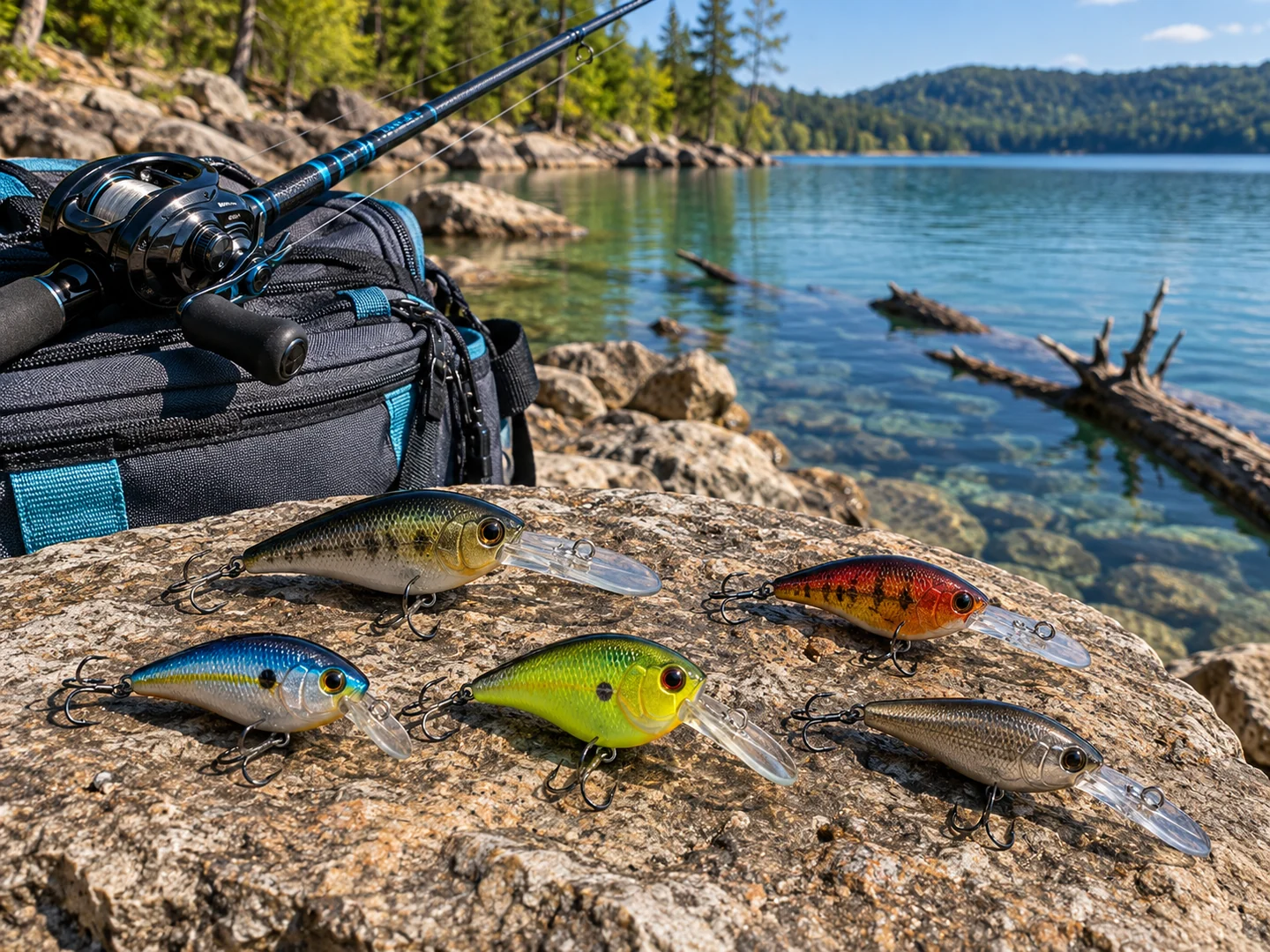
Best crankbaits for bass compared
Published diving depths are useful starting points, not promises. Line diameter, cast length, retrieve speed, and rod position can change where a floating crank actually tracks. Lipless baits are different because you control depth largely with sink time and retrieve speed.
| Crankbait | Best for | Type | Size / weight | Depth | Key trade-off | Amazon |
|---|---|---|---|---|---|---|
| Bill Lewis SB-57 | Shallow cover | Squarebill | 2.25 in / 3/8 oz | 3 to 6 ft | Not a deep-water tool | Check Amazon |
| Rapala Shad Rap 05 | Finesse and cold water | Floating balsa diver | 2 in / 3/16 oz | 4 to 9 ft | Light weight is harder in wind | Check Amazon |
| Bill Lewis Rat-L-Trap | Grass and covering water | Lipless, sinking | 3 in / 1/2 oz | Variable | Two exposed trebles collect vegetation | Check Amazon |
| Strike King 6XD | Deep structure | Deep diver | 1 oz | Rated to 19 ft | Pulls harder and needs appropriate tackle | Check Amazon |
| KVD 1.5 Shallow | Skinny water | Silent squarebill | 2.5 in / 3/8 oz | Up to about 3 ft | Too shallow once fish move down | Check Amazon |
Rapala Shad Rap 05
KVD 1.5 Shallow
Bill Lewis SB-57
The most useful first crankbait here if your bass fishing centers on banks, stumps, laydowns, riprap, and other shallow cover.
Top pick
Verified model: Amazon ASIN B09P4F42JS is the 3/8 ounce SB-57 MDJ Series in Lavendar Shad. Current product information lists a 2.25 inch body, 3 to 6 foot dive range, circuit-board lip, Mustad Triple Grip hooks, and a slow rise on the pause.
Why it made the shortlist: squarebills earn their keep when they can contact cover without immediately becoming a liability. The SB-57 sits in a useful middle ground. It is compact enough for ordinary bass forage, heavy enough to cast comfortably on common baitcasting tackle, and its published depth range fits the water many anglers actually work from the bank or front deck.
What makes it different from the KVD Shallow below is depth. The SB-57 is the better choice when you want the lure to get down and touch a 3 to 6 foot target instead of simply staying above very shallow cover.
Why it works
- Useful 3 to 6 foot range for shallow cover
- Compact body with a cover-oriented squarebill
- Slow rise can help it back away from some snags on a pause
Trade-offs
- Does not replace a medium or deep diver
- Treble hooks still demand care around soft grass
- Very shallow flats may call for a shallower runner
Rapala Shad Rap 05
A small balsa diver for anglers who want a tighter, less bulky presentation in cold water or around pressured bass.
Finesse
Verified model: Amazon ASIN B001NXD0QE is the Rapala Shad Rap 05 in Crawdad. Rapala lists the SR05 at 2 inches, 3/16 ounce, floating, with a 4 to 9 foot running range and two No. 8 VMC black nickel trebles.
The Shad Rap 05 earns a separate role because it is not trying to be a loud, bulky power-fishing crank. Its small balsa body and classic baitfish profile give you a more restrained option when fish are following without committing or when cooler water favors a tighter presentation.
The main compromise is casting. At 3/16 ounce, it is much lighter than the other picks here, so wind and heavy baitcasting gear can make distance and accuracy harder. Light baitcasting tackle can work, but many anglers will find a spinning setup easier for this size.
Why it works
- Small 2 inch profile for pressured or less aggressive bass
- 4 to 9 foot range overlaps useful transition water
- Floating balsa body can rise when paused
Trade-offs
- 3/16 ounce weight is not ideal for windy long casts
- Small trebles call for a controlled drag and rod load
- Not the fastest way to cover a huge flat

Bill Lewis Rat-L-Trap 1/2 oz
The pick when you want a sinking crankbait that can cover water fast, run over vegetation, or be counted down below the surface.
Grass
Verified model: Amazon ASIN B0000AUYVO is the 1/2 ounce Rat-L-Trap in Chrome Blue Back. Bill Lewis lists the 1/2 ounce model at 3 inches, with a sinking profile, premium Mustad hooks, and its distressed-baitfish sound system.
A lipless crankbait solves a different problem from a billed diver. Instead of relying on a fixed bill to reach a nominal zone, you can start the lure high, let it sink, or change retrieve speed to work different parts of the water column. That makes the Rat-L-Trap especially useful on broad flats and around submerged grass.
Its weakness is the same thing that makes it aggressive: two exposed trebles and a sinking body can bury into soft vegetation if you let the bait fall too far. It is often most useful when you can keep it ticking the tops of grass and rip it free rather than dragging it through thick stems.
Why it works
- Sinking design gives you flexible depth control
- 1/2 ounce weight casts well and covers water efficiently
- Good fit for grass edges, flats, and active fish
Trade-offs
- Exposed trebles can foul in heavy vegetation
- Easy to fish below the productive zone if you over-count the sink
- Louder profile is not always ideal for pressured fish
Strike King Pro Model 6XD
A purpose-built deep crank for reaching offshore bass where a squarebill or mid-depth crank simply cannot stay in contact with the target zone.
Deep
Verified model: Amazon ASIN B003L3E6BC is the Strike King Pro Model 6XD in Gizzard Shad, 1 ounce. The current Amazon listing specifies a unique curved bill, free-floating rattle chambers, size 1 treble hooks, and a dive rating to 19 feet.
The 6XD is the specialist in this group. It makes sense when the fish are on offshore points, channel swings, ledges, or deep hard spots and you want a billed crankbait repeatedly working through that depth band. The 1 ounce body also gives you the mass needed for long casts, which matters because a deep diver needs distance to reach and hold its running depth.
Do not buy it as your first crankbait if most of your water is shallow. Deep divers create more retrieve resistance, and the 6XD is much more comfortable with tackle built for deep cranking than with a short, stiff all-purpose rod.
Why it works
- Purpose-built for bass holding well below shallow crank range
- 1 ounce weight supports long casts
- Rattle chambers add sound for an aggressive presentation
Trade-offs
- High retrieve resistance compared with shallow cranks
- Overkill for banks and skinny water
- Best with a rod, reel, and line setup suited to deep cranking
Strike King KVD 1.5 Shallow Square Bill
A silent shallow runner for keeping a crankbait in the strike zone over very shallow rock, wood, or grass without digging too hard.
Skinny
Verified model: Amazon ASIN B00N4OD7RC is the KVD 1.5 Shallow Square Bill in Chartreuse Sexy Shad, 3/8 ounce. Current retailer specifications for the HCKVDS1.5SH family put it at about 2.5 inches, 3/8 ounce, and up to roughly 3 feet, with a silent design.
This is the crankbait to reach for when a normal squarebill is simply digging too deep. Keeping a bait above a shallow grass line or bouncing it through less than 3 feet of water is a distinct job, and the shallow KVD lets you do that without switching to a topwater lure.
The trade-off is obvious: the shallower the runner, the faster it becomes irrelevant when bass pull off the bank. Treat it as a specialist that complements a 3 to 6 foot squarebill, not as a replacement for one.
Why it works
- Stays higher than a standard shallow squarebill
- 3/8 ounce weight is easier to cast than tiny finesse plugs
- Silent approach can be useful around pressured shallow fish
Trade-offs
- Narrow depth role
- Not useful for mid-depth or deep targets
- Chartreuse Sexy Shad is more visible than subtle in very clear water
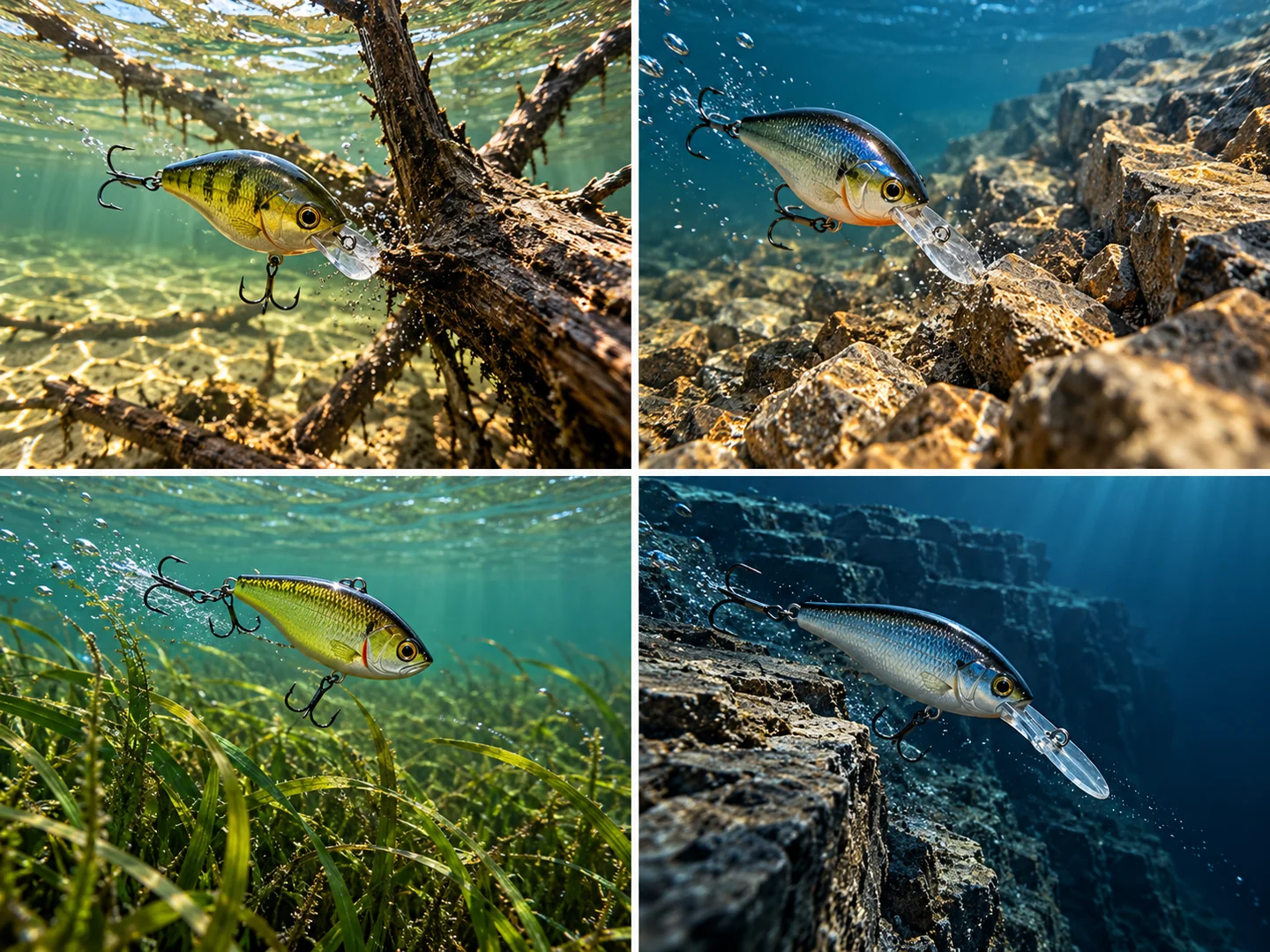
How to choose a crankbait for bass
1. Pick running depth before color
The first question is not shad versus craw. It is whether the bait can spend enough of the retrieve near the cover, bottom, or fish you are targeting. A squarebill that tops out around 5 feet cannot replace a deep diver on an offshore ledge, and a 19 foot diver is cumbersome when you are throwing at flooded bushes.
For floating billed crankbaits, choose a published range that lets the bait reach the target with some margin. If the bottom is 5 feet deep and you want regular bottom contact, a lure rated only to 4 feet is less useful than one designed to reach 5 or 6 feet under your actual line and casting conditions.
2. Match bill style to cover
Square bills are useful around shallow hard cover because their shape is built to deflect. Longer diving bills make more sense when depth becomes the priority. Lipless crankbaits trade the protective bill for a compact sinking body, which is why they are so effective for grass and broad open-water searches but can be less forgiving in snaggy wood.
3. Decide whether you want sound
Rattling crankbaits can help you make a more aggressive presentation in stained water, wind, or active feeding conditions. Silent or subtler options can be useful when bass see the same noisy baits repeatedly. There is no universal winner, so sound is best treated as a second-stage adjustment after depth and cover.
4. Use color to solve visibility and forage
Start with the food bass are actually seeing. Shad and silver patterns are logical around baitfish, while craw colors make sense around rock and bottom-oriented forage. In clear water, natural and translucent patterns reduce visual excess. In stained water, chartreuse, red, or stronger contrast can make the bait easier to locate.
5. Remember that line changes crankbait behavior
Published diving numbers are produced under specific assumptions. Thicker line generally keeps a billed crank shallower, while thinner line can help it reach deeper. Long casts also give a deep diver more distance to descend and spend time near maximum depth. Use manufacturer depth ratings as a comparison tool, then watch what the bait is actually contacting on your water.
How we chose these crankbaits
GearAndFish did not physically evaluate these products on the water for this guide. We built this shortlist from current manufacturer specifications, current US retail listings, Amazon.com US product mappings, and the decision patterns that dominate the current US search results for bass crankbaits.
FAQ
What type of crankbait is best for shallow bass?
A squarebill is the most useful starting point around shallow wood, rock, and other hard cover because it is designed to deflect. For extremely shallow water around 3 feet or less, a shallow-running squarebill can stay above cover that a standard 3 to 6 foot bait would dig into too aggressively.
When should I use a lipless crankbait for bass?
Use a lipless crankbait when you want to cover water quickly, fish submerged grass, or control depth with sink time and retrieve speed. Because it sinks and has exposed trebles, it takes more attention around thick vegetation and snaggy wood than a floating squarebill.
What crankbait depth should I choose?
Choose a bait that can reach the level of the fish or make contact with the cover or bottom you want to work. For billed crankbaits, line diameter, cast length, retrieve speed, and rod position can all change real running depth, so treat the package rating as a starting range rather than an exact promise.
Are silent crankbaits better than rattling crankbaits?
Neither is always better. Rattles can be useful for an aggressive presentation in stained water, wind, or active feeding conditions. Silent and subtler baits give you another look when bass are pressured or repeatedly exposed to noisy lures.
What crankbait color should I start with for bass?
Start with forage and visibility. Shad-style colors are a sensible default around baitfish, craw patterns fit rock and bottom-oriented forage, natural colors suit clear water, and stronger contrast or chartreuse can help in stained water. Depth and cover still matter more than having the perfect color.