
GearAndFish is reader-supported. As an Amazon Associate I earn from qualifying purchases. When you buy through links on our site, we may earn an affiliate commission, at no extra cost to you. Learn more.
The best fish finder is not the one with the longest feature list. It is the unit whose sonar, mapping, screen size, transducer bundle, and upgrade path match the way you actually fish. For most freshwater boat anglers, that means choosing between a compact 7-inch all-rounder, a more readable 9-inch system, or a specialized setup built around side imaging or live sonar.
Scope: This guide covers current mounted open-water fish finders and chartplotter-fishfinder combos for U.S. boat anglers. Portable and castable units, kayak-specific setups, and ice-fishing systems are separate buying decisions. GearAndFish compared current manufacturer specifications, included transducers, mapping packages, upgrade compatibility, current Amazon.com US listings, and recurring owner feedback. GearAndFish did not physically test these units for this article.
Best fish finder for most anglers
Garmin ECHOMAP UHD2 73sv with GT54 is the strongest all-around starting point for most freshwater boat anglers who want traditional CHIRP, ClearVu, SideVu, built-in U.S. inland mapping, touchscreen control with physical keys, and a realistic path to LiveScope later. If you routinely run map plus sonar in split view, the ECHOMAP UHD2 93sv with GT56 earns its extra dash space with a larger 9-inch display and the more capable GT56 transducer. If forward-facing live sonar is the priority right now rather than a future upgrade, the Lowrance Eagle Eye 9 packages focused Live Forward and Live Down views into a simpler single-transducer system.
Quick picks
Garmin ECHOMAP UHD2 73sv
Balanced 7-inch package with SideVu, ClearVu, Navionics+ inland mapping, and LiveScope compatibility.
Garmin ECHOMAP UHD2 93sv
More split-screen room plus the GT56 transducer for anglers who want to stay in Garmin’s ecosystem.
Lowrance Elite FS 9
Active Imaging 3-in-1, full networking, and support for ActiveTarget 2 live sonar.
Humminbird HELIX 7 MSI GPS G4
Sharp 1024 x 600 display and MEGA Side Imaging without paying for a networked flagship.
Lowrance Eagle Eye 9
Live Forward and Live Down without a separate sonar module, plus CHIRP and DownScan.
Garmin STRIKER Vivid 7sv
SideVu, ClearVu, CHIRP, GPS, and Quickdraw mapping for anglers who do not need preloaded charts.
Fish finder comparison
| Model | Screen | Included transducer | Core sonar | Mapping | Upgrade path | Best for | Amazon |
|---|---|---|---|---|---|---|---|
| Garmin ECHOMAP UHD2 73sv | 7 in, 800 x 480, touch + keys | GT54UHD-TM | CHIRP, ClearVu, SideVu | Garmin Navionics+ U.S. Inland | LiveScope compatible | Most freshwater boat anglers | Check availability on Amazon |
| Garmin ECHOMAP UHD2 93sv | 9 in, 1024 x 600, touch + keys | GT56UHD-TM | CHIRP, ClearVu, SideVu | Garmin Navionics+ U.S. Inland | LiveScope compatible | Split-screen sonar + mapping | Check availability on Amazon |
| Lowrance Elite FS 9 | 9 in, 800 x 480, multi-touch | Active Imaging 3-in-1 | CHIRP, DownScan, SideScan, FishReveal | C-MAP Contour+ | ActiveTarget 2, Ethernet, NMEA 2000 | Expandable Lowrance systems | Check availability on Amazon |
| Humminbird HELIX 7 MSI GPS G4 | 7 in, 1024 x 600, keypad | XNT 9 HW MSI 150 T | Dual Spectrum CHIRP, MEGA Down Imaging, MEGA Side Imaging | Humminbird Basemap, AutoChart Live | Premium chart cards, limited networking | Detailed side imaging on a 7-inch unit | Check availability on Amazon |
| Lowrance Eagle Eye 9 | 9 in, 1024 x 600, keypad | Eagle Eye live transducer | Live Forward, Live Down, CHIRP, DownScan, FishReveal | C-MAP U.S. Inland, Genesis Live | Purpose-built live sonar system | Forward-facing sonar without a module | Check availability on Amazon |
| Garmin STRIKER Vivid 7sv | 7 in, 800 x 480, keypad | GT52HW-TM | CHIRP, ClearVu, SideVu | GPS + Quickdraw Contours | Sonar-first, not a chartplotter ecosystem | Value-focused sonar and self-mapping | Check availability on Amazon |
What actually separates a good fish finder from the wrong one
Fish finder marketing tends to collapse very different technologies into one feature list. A better way to shop is to decide what you need the transducer and display to do before you choose a brand.
Traditional CHIRP, down imaging, side imaging, and live sonar do different jobs
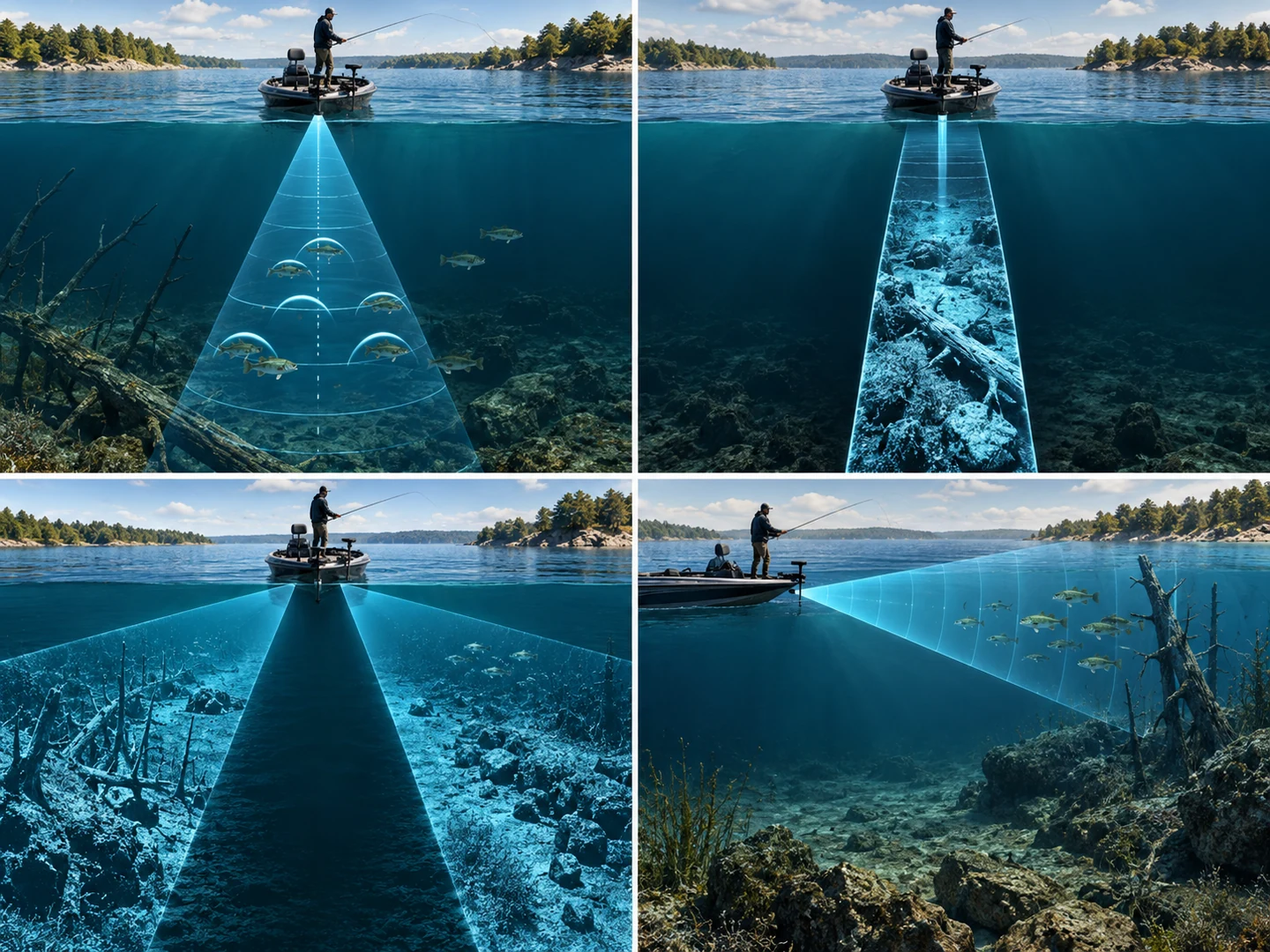
Traditional CHIRP is still the foundation. It is useful for depth, bottom hardness, bait, and fish directly under the boat, especially while moving. Down imaging trades the familiar fish-arch look for a more structure-like picture beneath the boat. Side imaging is the biggest search tool in this roundup because it lets you scan water and structure off both sides instead of driving directly over every target. Forward-facing live sonar is different again: it is built around seeing fish, structure, and lure movement in real time in a focused direction.
If you fish new water and spend time looking for points, brush, rock, grass edges, docks, or isolated cover, side imaging usually gives you more search value than jumping straight to live sonar. If your fishing is already target-oriented and you want to watch fish react to a presentation, live sonar can matter more.
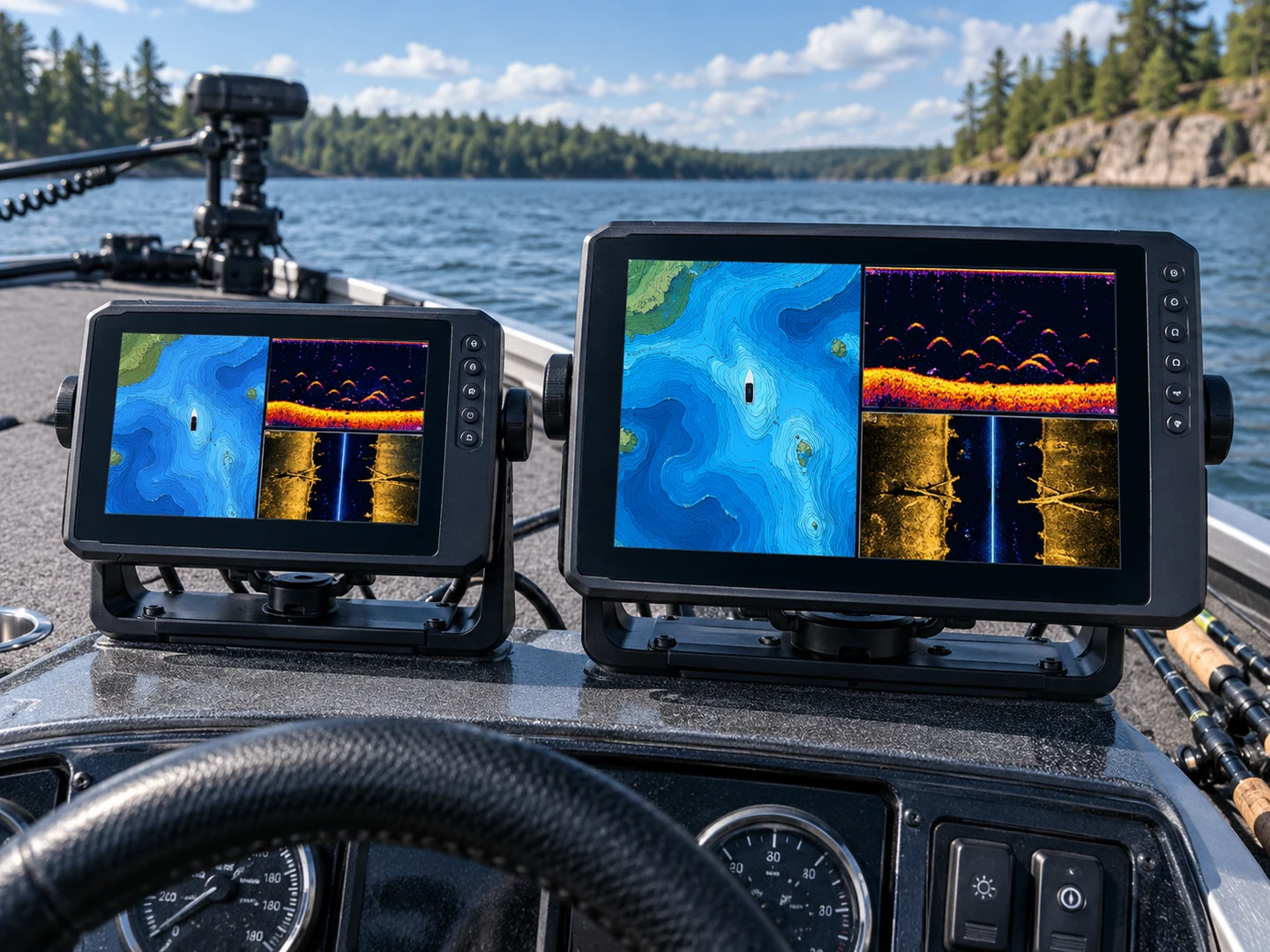
Seven inches is workable. Nine inches changes split-screen use.
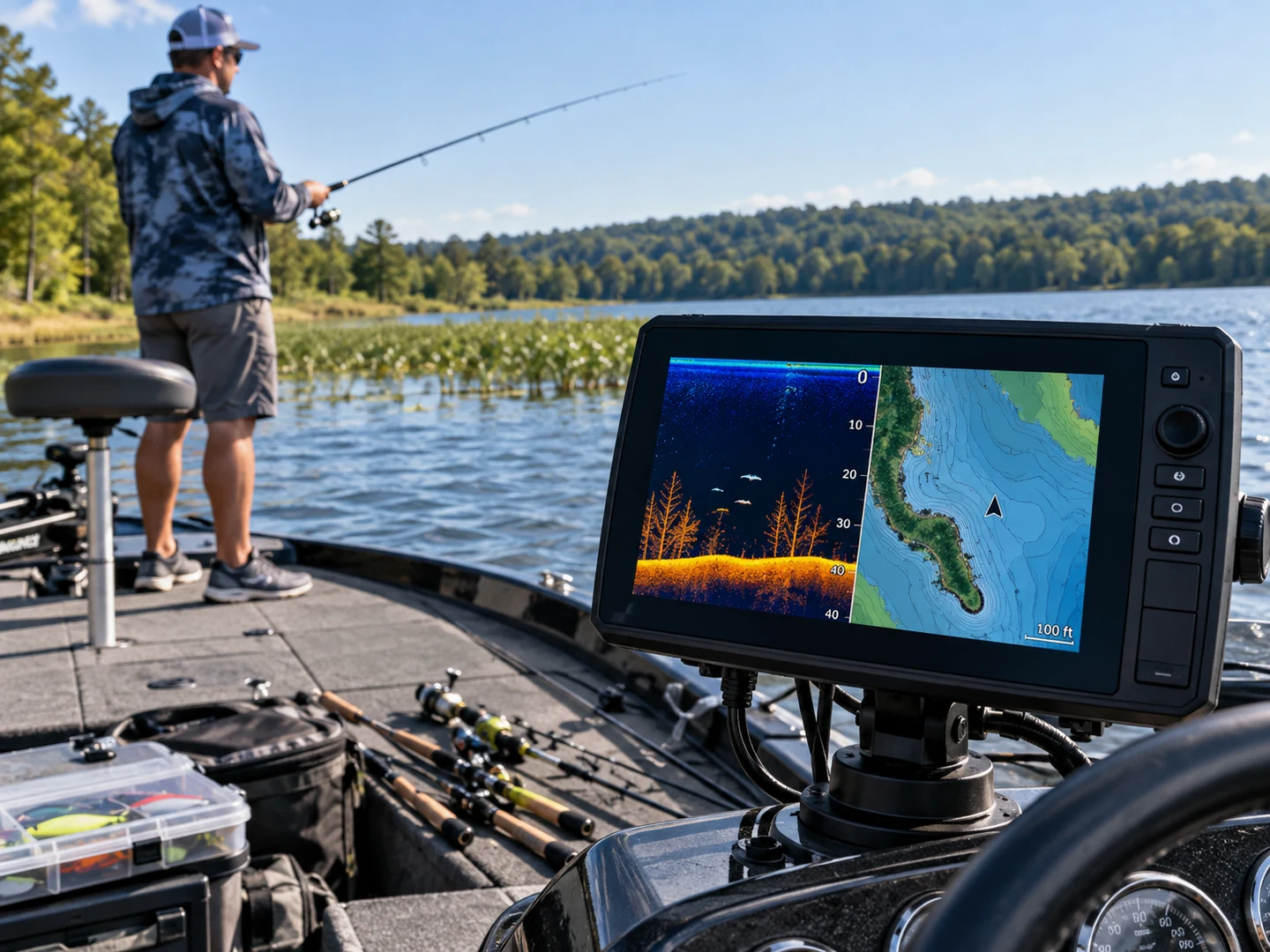
A 7-inch display is enough for a single sonar view, a full map, or a simple two-way split. It also fits smaller consoles and costs less. The compromise appears when you want map, SideScan, and traditional sonar visible at the same time. Each pane gets small quickly.
A 9-inch unit does not automatically find more fish, but it gives mapping contours, side-imaging shadows, waypoint icons, and sonar targets more room to breathe. That is why the ECHOMAP UHD2 93sv is a meaningful upgrade over the 73sv even though they share the same basic Garmin ecosystem.
Buy the transducer bundle, not just the display name
Two listings with the same display can be very different purchases. Garmin sells ECHOMAP units with and without transducers, and the 73sv and 93sv bundles in this guide use different transducers. Humminbird also sells control-head-only versions of some products. Lowrance families can be configured with different sonar packages and chart options.
Before checkout, match the exact model number and included transducer to the listing. A lower price is not a bargain if the transducer you expected is missing.
Mapping matters more if you travel
Preloaded mapping is valuable if you fish multiple lakes, navigate unfamiliar water, or use contours to plan routes and locate offshore structure. Garmin’s 73sv and 93sv U.S. inland bundles include Garmin Navionics+ mapping. Lowrance’s U.S. inland Eagle Eye package includes C-MAP inland charts. The Elite FS 9 bundle mapped here includes C-MAP Contour+. The HELIX 7 includes Humminbird Basemap and supports optional premium chart cards.
The STRIKER Vivid 7sv is the exception. It has high-sensitivity GPS and Quickdraw Contours, so it can mark waypoints, follow routes, and create contour maps from your own sonar data, but it is not the same thing as buying a chartplotter with detailed preloaded inland charts.
Think about the next upgrade before the first install
Electronics ecosystems get expensive when you change brands after adding live sonar, multiple displays, trolling-motor integration, or network accessories. The Garmin ECHOMAP UHD2 picks make sense if LiveScope is a likely future purchase. Elite FS 9 is stronger if you want a networked Lowrance build and ActiveTarget 2 later. The HELIX 7 MSI GPS G4 in this guide is intentionally simpler: its official compatibility list does not include NMEA 2000, Ethernet switching, MEGA Live, or MEGA 360. Buy it for the sonar and mapping it provides now, not for a large future network.
Garmin ECHOMAP UHD2 73sv with GT54
The most balanced choice here for a typical freshwater boat that needs real mapping, side imaging, easy controls, and room to grow.
The 73sv lands in the useful middle ground between inexpensive sonar-only units and larger network-focused systems. The 7-inch touchscreen is backed up by physical keys, which is a practical combination when spray, gloves, or a bouncing deck make touch-only control less appealing. Garmin’s current documentation lists an 800 x 480 display, GPS, Navionics+ inland mapping, and support for traditional CHIRP, ClearVu, and SideVu.
The included GT54 is capable enough for a first serious side-imaging setup. More important, the display does not box you into that transducer forever. If forward-facing sonar becomes part of your fishing later, the ECHOMAP UHD2 family supports LiveScope. That makes the initial install easier to justify than a cheaper unit that would need to be replaced rather than expanded.
Pros
- Strong mix of sonar, mapping, and controls
- Detailed U.S. inland charts in this exact bundle
- SideVu and ClearVu included
- LiveScope-compatible upgrade path
Cons
- 7-inch screen gets crowded with three-way splits
- GT54 is not the same transducer as the higher-tier GT56
- LiveScope hardware costs extra
Garmin ECHOMAP UHD2 93sv with GT56
The better Garmin buy when split-screen readability and the stronger GT56 transducer matter more than compact size.
The 93sv is not just a stretched 73sv. The larger screen changes how practical it is to keep charting, SideVu, and traditional sonar visible at once. Garmin’s current UHD2 manual lists the 9-inch models at 1024 x 600, compared with 800 x 480 on the 7-inch model. That extra screen area matters when you are trying to read contour labels and side-imaging returns without constantly switching pages.
The included GT56 is also a step up from the GT54 bundle used with our 73sv pick. For anglers who actively search offshore structure with SideVu and still want Garmin’s mapping and LiveScope upgrade path, this is the more complete starting package.
Pros
- More usable space for split views
- GT56 transducer included in this exact bundle
- Garmin Navionics+ U.S. inland mapping
- LiveScope-compatible
Cons
- Needs more console or bow space
- Costs more than the 73sv for the same basic ecosystem
- Live sonar still requires separate hardware
Lowrance Elite FS 9 with Active Imaging 3-in-1
A better fit than Eagle Eye if you want SideScan now and a broader networked Lowrance system later.
Elite FS 9 is the most system-oriented Lowrance choice in this list. The included transducer handles the core search work, especially SideScan and DownScan, while the display can later become part of a larger setup with ActiveTarget 2 live sonar, Ethernet-connected displays, NMEA 2000 data, or compatible trolling-motor integration.
The tradeoff is visible on the spec sheet: the 9-inch screen uses 800 x 480 resolution. It is still a large, bright, touch-driven display, but buyers comparing pixel counts will notice that both the Garmin 93sv and Humminbird HELIX 7 in this guide pack more pixels into their screens. Buy the Elite FS because you want its sonar and ecosystem, not because it wins a resolution contest.
Pros
- CHIRP, SideScan, DownScan, and FishReveal in one included transducer
- ActiveTarget 2 compatible
- Ethernet and NMEA 2000 support
- 9-inch touch display is comfortable for multiple views
Cons
- 800 x 480 resolution is modest for a 9-inch display
- Live sonar hardware is a separate purchase
- More capability than a simple one-display boat may need
Humminbird HELIX 7 MSI GPS G4
A sharp 7-inch MEGA Side Imaging package for anglers who care more about seeing structure clearly than building a networked electronics stack.
HELIX 7 MSI GPS G4 is a very focused proposition. You get a high-resolution 7-inch display and Humminbird’s MEGA imaging without paying for the networking stack built into higher lines. Side imaging can show structure to either side of the boat, while AutoChart Live lets you create your own mapping for water you fish repeatedly.
The limitation is equally clear. Humminbird’s own compatibility table says this model does not support NMEA 2000, MEGA Live, MEGA 360, i-Pilot Link, or the 5-port Ethernet switch. That is not a hidden flaw if you are buying a stand-alone graph. It is a major reason to step up to a network-capable Humminbird if those upgrades are part of the plan.
Pros
- 1024 x 600 resolution on a 7-inch display
- MEGA Side and Down Imaging included
- Humminbird Basemap plus AutoChart Live
- Physical keypad works well in wet conditions
Cons
- No MEGA Live or MEGA 360 compatibility
- No NMEA 2000 or Ethernet networking
- 7-inch screen is still small for complex multi-pane layouts
Lowrance Eagle Eye 9 with C-MAP U.S. Inland
The simplest route here to forward-facing live sonar when you want the live view in the box instead of planning a separate module purchase.
Eagle Eye 9 solves a specific buying problem: forward-facing sonar systems usually become a display-plus-module-plus-transducer project. Here, the live transducer connects directly to the display and provides focused forward and down live views alongside traditional CHIRP and DownScan. For anglers who want to learn live sonar without immediately building a multi-box system, that simplicity is the point.
But do not read “four sonar views” and assume it replaces every other unit here. The official feature set does not include SideScan. If you spend your day idling flats and points while scanning wide areas off both sides of the boat, the Eagle Eye is a poor substitute for a side-imaging unit. It is better treated as a live-sonar-first system.
Pros
- Live Forward and Live Down included
- No separate live-sonar module
- 9-inch 1024 x 600 IPS display
- U.S. inland C-MAP charts and Genesis Live
Cons
- No SideScan
- Focused live views are less flexible than a larger modular system
- Keypad-only interface may feel slower than touch for map work
Garmin STRIKER Vivid 7sv
A capable side-imaging fish finder for anglers who want sonar, GPS, waypoints, and self-made contours without paying for preloaded premium charts.
STRIKER Vivid 7sv makes the most sense when “fish finder” matters more to you than “chartplotter.” The sonar package is substantial for the tier: traditional CHIRP plus ClearVu and SideVu, all on a 7-inch 800 x 480 display. High-sensitivity GPS handles waypoints, routes, tracks, and boat speed, while Quickdraw can build 1-foot contour maps from the water you survey yourself.
The catch is mapping. Quickdraw is useful, but it does not turn the STRIKER into an ECHOMAP with preloaded detailed inland charts. If you regularly travel to new lakes and want contour data ready before the first pass, the ECHOMAP 73sv is worth the step up.
Pros
- SideVu, ClearVu, and traditional CHIRP included
- GT52 transducer in the mapped Amazon bundle
- GPS, waypoint navigation, and Quickdraw Contours
- Simple physical-key interface
Cons
- No detailed preloaded inland chart package
- Not the best base for a future live-sonar network
- 7-inch 800 x 480 screen is functional rather than luxurious
Which fish finder should you buy?
Choose Lowrance Elite FS 9 if you want an expandable Lowrance system with SideScan today and ActiveTarget 2 later. Choose Eagle Eye 9 if forward-facing sonar is the immediate goal and you are willing to give up SideScan for a simpler live-sonar package.
Choose Humminbird HELIX 7 MSI GPS G4 if side-imaging detail is the priority and you are comfortable with a stand-alone, non-networked 7-inch unit. Choose STRIKER Vivid 7sv if you fish familiar water and would rather spend on sonar than on preloaded charting.
One display or two?
A single 9-inch display is often more useful than two tiny screens if you are starting from scratch. Two displays become more compelling when the jobs are split: for example, mapping and side imaging at the console, then live sonar or 2D sonar at the bow. If a second display is likely, networking and ecosystem compatibility should move higher on your priority list.
Console or bow?
Side imaging is commonly most useful while searching from the console at controlled speed, where the transducer can scan broad water as you drive. Live sonar is often most useful at the bow, where an angler can aim the transducer relative to the cast. Traditional CHIRP and mapping work in either position. Your mounting plan should follow the fishing job, not just the easiest place to drill holes.
Do not ignore installation
A premium fish finder cannot compensate for a transducer sitting in aerated or turbulent water, blocked side-imaging beams, weak power connections, or a display mounted where glare and viewing angle make it hard to read. Before buying, confirm transducer clearance, cable routing, power requirements, and whether your console has enough physical space for the display and bracket.
How we chose these fish finders
This is a research-synthesis buying guide based on documented specifications and current market checks, not a physical product test by GearAndFish. We prioritized exact current U.S. product variants that could be mapped to a current Amazon.com US ASIN, then checked the specs that materially change the buying decision.
Fish finder FAQ
What is the best fish finder for a beginner?
For a beginner who wants mapping as well as sonar, the Garmin ECHOMAP UHD2 73sv is the most balanced pick in this guide. It combines touch and physical controls, preloaded U.S. inland mapping, CHIRP, ClearVu, and SideVu. If detailed preloaded charts are not important, the STRIKER Vivid 7sv is a simpler sonar-first alternative.
Is side imaging worth it on a fish finder?
Side imaging is especially useful when you need to search water efficiently. It can reveal structure, cover, and targets off both sides of the boat instead of only beneath it. For anglers who fish new water or offshore structure, that search advantage is often more useful than adding a more advanced feature that only looks in a narrow direction.
Do I need live sonar to find fish?
No. Traditional CHIRP, down imaging, side imaging, mapping, and good boat positioning can cover a large amount of fishing. Live sonar becomes most valuable when you want to see fish and lure movement in real time and adjust a presentation to specific targets.
Is a 9-inch fish finder worth it over a 7-inch model?
A 9-inch screen is most valuable when you use split views. A 7-inch unit is fine for one full-screen view or a simple two-way split, but maps, side imaging, and sonar become easier to read together on a larger screen. Console space and budget still matter.
Which is better: Garmin, Lowrance, or Humminbird?
There is no universal winner. Garmin is attractive for ECHOMAP and LiveScope expansion, Lowrance for Active Imaging and ActiveTarget systems, and Humminbird for MEGA imaging and its broader Minn Kota ecosystem on compatible models. The right brand is the one whose sonar, mapping, trolling-motor integration, and future accessories match your boat.
Do fish finders always include a transducer?
No. The same display may be sold with different transducers or as a control-head-only package. Always check the exact manufacturer part number and the included transducer before buying. Every Amazon listing mapped in this guide was selected as a specific bundle, not just by display family name.
Bottom line
For a broad all-around freshwater setup, the Garmin ECHOMAP UHD2 73sv with GT54 is the easiest recommendation to start from. The 93sv with GT56 is the better buy when a 9-inch screen fits the boat. Lowrance Elite FS 9 makes more sense for a networked Lowrance build, while Eagle Eye 9 is the shortcut to live sonar without a separate module. The HELIX 7 MSI GPS G4 is the side-imaging specialist, and the STRIKER Vivid 7sv is the value pick when you do not need preloaded charts.
The deciding question is not “Which fish finder has the most features?” It is “Which views will I actually use, where will the display be mounted, and what am I likely to add next?” Answer those three questions and the shortlist gets much smaller.