

GearAndFish is reader-supported. As an Amazon Associate I earn from qualifying purchases. When you buy through links on our site, we may earn an affiliate commission, at no extra cost to you. Learn more.
The best trout lure is less about finding one magic bait and more about matching a compact presentation to current, depth, forage, and how much room you have to cast. For a first tackle box, a small inline spinner is the safest place to start, then add a spoon for reach, a finesse jig for pressured fish, and a minnow plug for pools and larger water.
GearAndFish built this shortlist from current US search intent, current manufacturer specifications, exact Amazon.com US child listings, and established trout-lure coverage. This guide does not claim direct product testing by GearAndFish.
Best trout lure for most anglers: Panther Martin Classic Holographic
The Panther Martin Classic Holographic #2 in Brown Trout, 1/16 oz is the most balanced starting point here for stream and river trout. Its compact weighted body helps it cast well for its size, while the shaft-through-blade design is built to start spinning quickly in moving water. The trade-off is the same one shared by most small treble-hook spinners: it is not the best choice around heavy wood, grass, or places where snag resistance matters more than flash and vibration.
Quick picks
Panther Martin Classic Holographic
Compact spinner for streams, runs, and everyday trout fishing.
Worden’s Original Rooster Tail
Simple steady-retrieve option with a highly visible white profile.
ACME Kastmaster with Bucktail
Dense 1/4 oz spoon for lakes, deeper pools, and longer casts.
Trout Magnet Neon Kit
Micro presentation for pressured trout and slower water.
Rapala Original Floating F07
Floating balsa minnow for pools, lake edges, and baitfish-focused trout.
Rebel Hellgrammite S72
Sinking insect profile for rocky runs and bottom-oriented fish.
Best trout lures compared
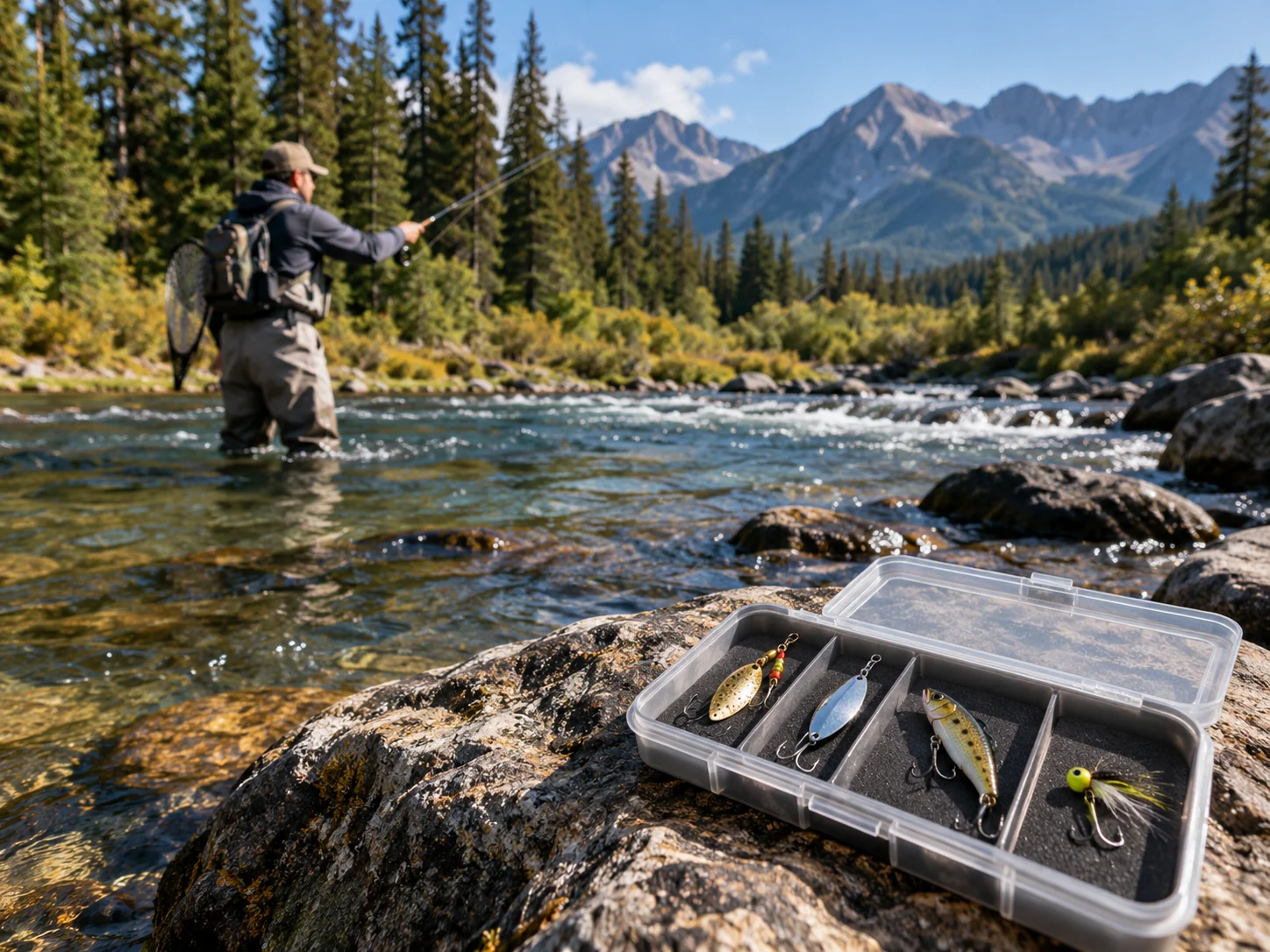
| Lure | Type | Exact variant | Best fit | Main trade-off | Amazon |
|---|---|---|---|---|---|
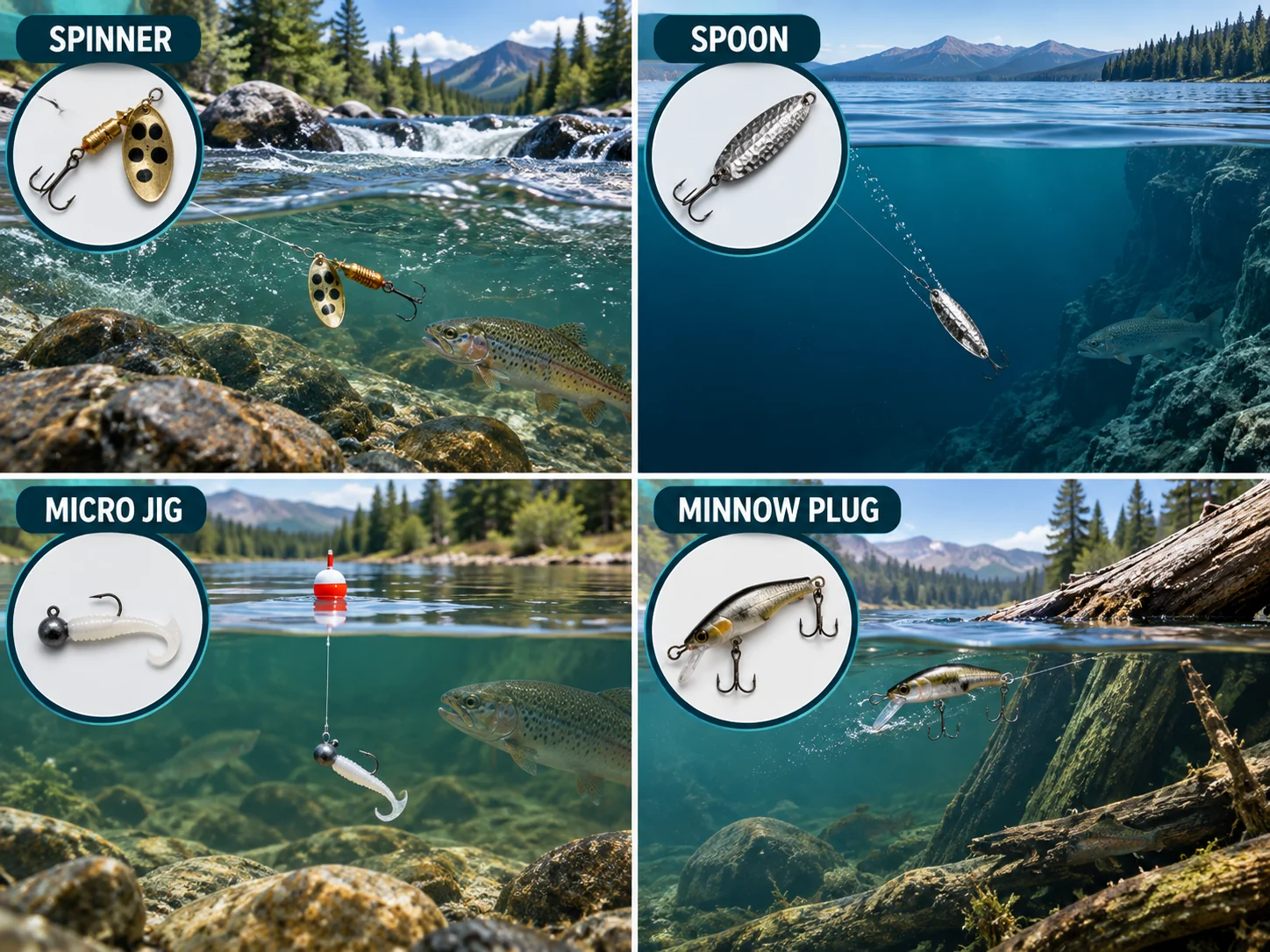
| Panther Martin Classic Holographic | Inline spinner | #2, 1/16 oz, Brown Trout Holographic | Streams and moving water | Treble hook can snag around cover | Check Amazon |
| Worden’s Original Rooster Tail | Inline spinner | 2 in, 1/16 oz, White, model 206-WH | Beginners and steady retrieves | Light weight limits deep-water reach | Check Amazon |
| ACME Kastmaster with Bucktail | Spoon | 1/4 oz, Gold | Lakes, deeper pools, long casts | Fast sink can be too much for skinny water | Check Amazon |
| Trout Magnet Neon Kit | Micro jig system | 82-piece kit, 70 bodies and 12 size 8 jig hooks | Pressured trout and finesse | Needs light tackle or a float for practical casting | Check Amazon |
| Rapala Original Floating F07 | Floating minnow plug | 2-3/4 in, 1/8 oz, Brown Trout | Pools, lake edges, baitfish patterns | Two trebles are less friendly around weeds and wood | Check Amazon |
| Rebel Hellgrammite S72 | Sinking ultralight crankbait | 1-3/4 in, 3/32 oz, Immature | Rocky runs and insect-focused trout | Bottom-searching action raises snag risk | Check Amazon |
Detailed picks
Panther Martin Classic Holographic
A compact inline spinner that covers the widest range of everyday stream-trout situations in this shortlist.
#1
Manufacturer data lists a shaft-through-blade design, convex-concave blade, weighted body, and trout suitability across the Classic Holographic line. Amazon currently maps ASIN B00AU5W14S to Brown Trout Holographic in size #2, 1/16 oz.
Small inline spinners remain the easiest lure category to recommend when the water is moving and the goal is to cover likely holding water without overcomplicating the retrieve. This exact Panther Martin variant is light enough for small trout water but carries more body weight than its tiny profile suggests.
The main reason it gets the top spot is balance. It can be cast across a run, swung through current, or retrieved through a pool with very little setup. The blade creates both flash and vibration, while the compact trout-pattern body keeps the presentation from looking oversized in small water.
Why it works
- Compact size fits typical stream trout
- Weighted body helps casting for a 1/16 oz lure
- Quick-spinning blade suits moving water
What to know
- Treble hook is not ideal around wood or weeds
- 1/16 oz is not the best option for very deep still water
- Fast retrieves can ride too high in strong current
Worden’s Original Rooster Tail
A straightforward 1/16 oz white spinner that makes sense for beginners who want a cast-and-retrieve lure with a little extra tail movement.
#2
Amazon identifies this child listing as model 206-WH, a 2 in, 1/16 oz Rooster Tail in White. Published retailer information describes the lure’s flashing blade and pulsating hackle tail.
The Rooster Tail is the other classic answer for anglers who want a simple spinner rather than a technique-heavy presentation. The white body is easy to track in clear to moderately stained water, and the hackle tail gives the lure a fuller profile than a bare metal spinner.
Compared with the Panther Martin, the appeal here is less about compact density and more about an obvious, easy-to-see presentation. It is a good choice for new anglers learning how fast a spinner needs to move before the blade works cleanly.
Why it works
- Very simple steady retrieve
- White profile is easy for the angler to track
- Hackle tail adds movement behind the blade
What to know
- Light weight limits deep-water reach
- Exposed treble can catch grass and debris
- Spinners can add line twist if rigged or retrieved poorly
ACME Kastmaster with Bucktail Teaser
The best pick here when the fish are farther out, the water is deeper, or a small stream spinner simply cannot reach the zone.
#3
Amazon maps ASIN B0000AV0HA to the 1/4 oz Gold Kastmaster with Buck Tail Teaser. ACME describes the Kastmaster as a dense, precision-machined spoon designed for distance casting and lists 1/8 oz and 1/4 oz sizes for light spinning and trout use.
A spoon solves a different problem than the two spinners above. When trout are holding off the bank, below the top few feet, or along a lake ledge, the lure has to carry farther and sink more efficiently. The 1/4 oz Kastmaster is built for that job.
The bucktail teaser adds a small amount of visual bulk behind the metal body, but the reason to buy this version is still the spoon itself: compact mass, flash, and a controlled sink. It can be counted down before the retrieve to search deeper water.
Why it works
- Strong casting distance for a compact lure
- Reaches deeper water faster than micro spinners
- Useful from shore on lakes and larger pools
What to know
- Can sink too quickly in shallow creeks
- Treble and bucktail can collect weeds
- Needs retrieve-speed control to avoid fishing below the target zone
Trout Magnet Neon Kit
A small-jig system for pressured trout, soft drifts, and days when a flashing metal lure is getting ignored.
#4
The current Amazon listing is an 82-piece kit with 70 grub bodies and 12 size 8 hooks. Trout Magnet’s product page specifies 70 bodies across seven colors plus 12 shad-dart heads in gold, black, and silver at 1/64 oz.
This is the opposite end of the presentation spectrum from the Kastmaster. Instead of covering lots of water with flash, the Trout Magnet is designed to stay small and subtle. That makes it especially useful when trout are visible but reluctant to chase, or when the water is clear enough that a larger lure feels excessive.
The biggest practical limitation is casting. A 1/64 oz jig is extremely light. An ultralight rod and fine line help, but many anglers will find a small float is the simpler way to control the drift and keep the tiny presentation in the strike zone.
Why it works
- Very small profile for pressured fish
- Seven body colors cover natural and bright looks
- Kit supplies multiple bodies and jighead finishes
What to know
- Very light jigheads are difficult to cast alone
- Tiny hooks are not designed for heavy tackle
- Requires more drift control than a simple spinner retrieve
Rapala Original Floating F07
A floating balsa minnow for anglers who want a baitfish profile that can be twitched, paused, or retrieved through pools and lake edges.
#5
Rapala lists the F07 at 2-3/4 in, 1/8 oz, floating, with a published running depth of 3 to 5 ft and two No. 8 hooks. The Amazon child listing is the Brown Trout color under ASIN B00019NKF2.
The F07 fills the gap between tiny metal lures and larger trout hard baits. It has enough profile to imitate a small baitfish, but it is still light enough for trout-oriented spinning gear. Because it floats, pauses can let the lure rise away from rocks before the next pull.
This is a particularly sensible choice in pools with a defined mid-depth zone, along lake edges, or anywhere larger brown trout are keying on minnows instead of insects. It is less forgiving around submerged branches because two trebles provide more snag points than a single-hook jig.
Why it works
- Natural minnow profile and floating body
- Published 3 to 5 ft running depth fits many pools and shorelines
- Can be retrieved steadily or worked with pauses
What to know
- Two trebles increase snag risk
- Costs more than a simple spinner or spoon
- Less practical in tiny brush-choked creeks
Rebel Hellgrammite S72
A compact sinking insect imitation for rocky water where trout are feeding closer to the bottom than a spinner naturally runs.
#6
Rebel’s current product information describes the Hellgrammite as a sinking, bottom-searching ultralight crankbait. The S72 is 1-3/4 in and 3/32 oz; Amazon maps ASIN B00019NN72 to the Immature color.
Most trout roundups lean heavily on flash. The Hellgrammite earns a place because it approaches the problem from the opposite direction. It resembles a large aquatic insect and is designed to work near the bottom, where natural nymphs and larvae are often available to trout.
That bottom orientation is also the downside. Rocks, roots, and submerged debris can eat sinking lures. It makes the most sense when the bottom is readable and the angler can control contact rather than dragging blindly through every crevice.
Why it works
- Distinct insect profile instead of another baitfish imitation
- Sinking design reaches bottom-oriented trout
- Compact 3/32 oz size suits light tackle
What to know
- Bottom-searching action increases snag potential
- Not a distance-casting choice for big lakes
- Requires more depth awareness than a high-running spinner
How to choose a trout lure
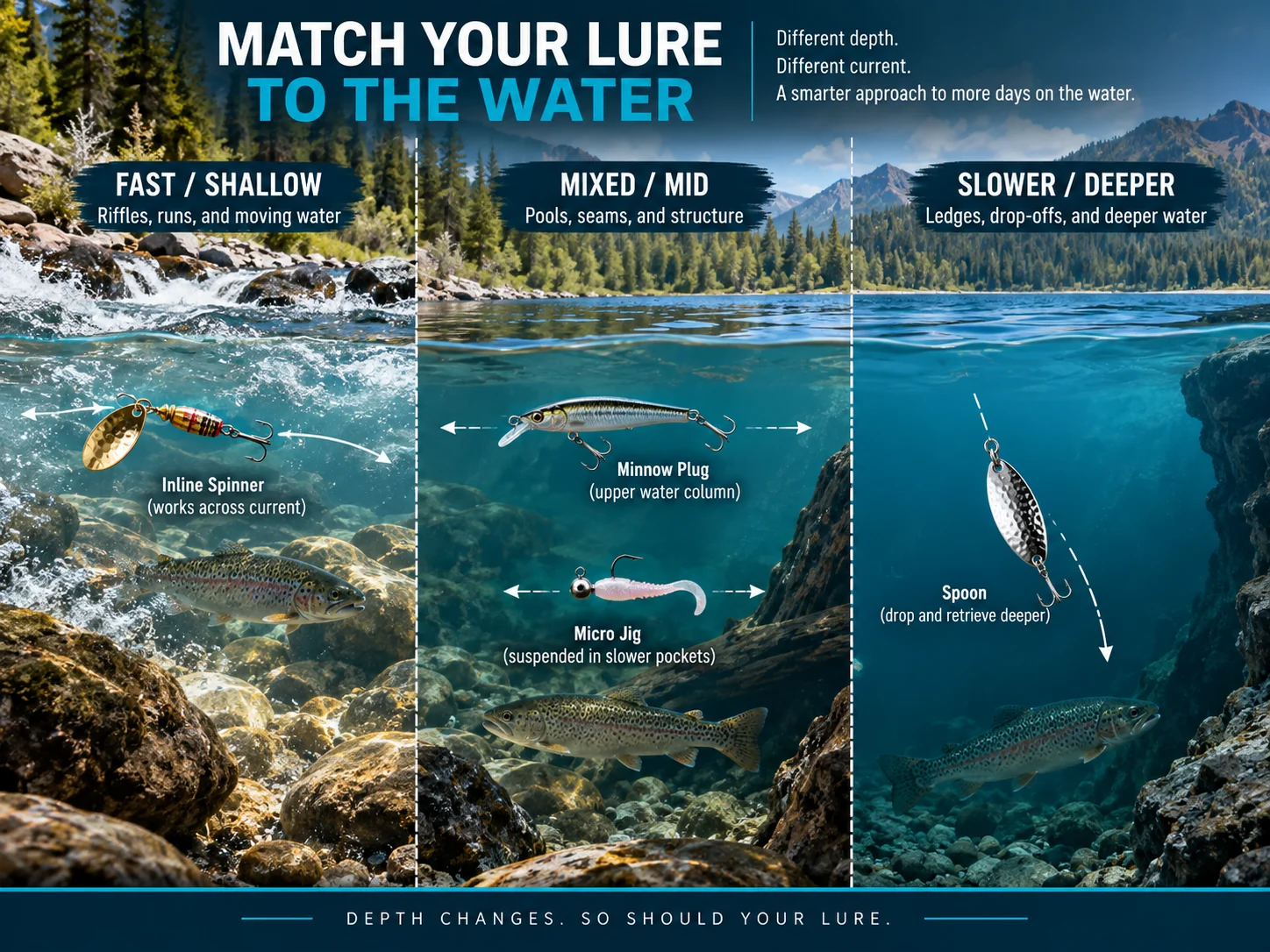
The fastest way to choose is to start with the water, not the color chart. Current, depth, and available casting space usually narrow the category before pattern details matter.
Fast, shallow streams: start with an inline spinner
A small spinner is easy to keep moving through riffles, runs, and pocket water. Cast slightly upstream or across the flow, then retrieve just fast enough to keep the blade working. The Panther Martin and Rooster Tail are the simplest choices in this guide for that job.
Still water or distant fish: move to a spoon
If trout are holding beyond the comfortable range of a 1/16 oz spinner, a denser spoon makes sense. A 1/4 oz Kastmaster carries farther and sinks faster, which helps from lake banks and around deeper drop-offs. The trade-off is control in shallow water: more weight means less room for mistakes before the lure reaches the bottom.
Pressured trout: reduce size and speed
When trout follow but refuse hardware, a tiny jig can change the look completely. The Trout Magnet uses a 1/64 oz shad-dart head and a small soft-plastic body, making it better suited to controlled drifts and suspended presentations than fast prospecting.
Baitfish-focused trout: use a minnow plug
Small floating plugs make sense in pools, lake edges, and larger streams where trout have room to chase. The F07 Rapala is a 2-3/4 in floating minnow with a published running depth of 3 to 5 ft, so it covers a different zone than a surface-skimming spinner or bottom-oriented jig.
Rocky bottom and insect forage: consider a sinking bug imitation
When trout are holding low around rock, a sinking insect profile can be more natural than another flashing baitfish shape. The Hellgrammite S72 is built for this role, but it should be fished with enough line control to avoid dragging it through every snag.
Color is a secondary choice
Natural trout, silver, gold, white, and bright neon all have a place. A useful starting rule is simple: natural or subdued patterns are easier to justify in clear water, while extra flash or contrast can help when visibility is reduced. Local forage, light, and water color still matter more than any universal color rule.
How this guide was researched
This roundup is research-based. GearAndFish does not claim that these six exact products were personally fished for this article.
FAQ
What is the best all-around lure for trout?
A small inline spinner is the easiest all-around starting point because it works in many streams, rivers, and stocked waters with a simple cast-and-retrieve presentation. In this shortlist, the Panther Martin Classic Holographic #2 gets the top spot for that role.
Are spinners or spoons better for trout?
Spinners are usually easier in moving water and at short to medium range. Spoons become more useful when casting distance and depth matter. Carrying one of each covers more situations than trying to force either category everywhere.
What lure should I use for stocked trout?
Small spinners work well for covering water, while a Trout Magnet gives a much smaller option when fish are pressured or unwilling to chase. The better choice depends on whether the fish are roaming and aggressive or holding in a smaller zone.
What lure size is good for trout?
There is no single correct size. This guide intentionally spans tiny 1/64 oz jigheads, 1/16 oz spinners, a 3/32 oz insect lure, 1/8 oz minnow plug, and a 1/4 oz spoon. The right size is the lightest lure that still reaches the fish and can be controlled in the current or depth you are fishing.
Do I need different lures for lakes and streams?
Not always, but the weighting matters. Small spinners are easier to control in stream current, while denser spoons and minnow plugs become more useful on lakes where fish can be farther from shore or holding deeper.