GearAndFish is reader-supported. As an Amazon Associate I earn from qualifying purchases. When you buy through links on our site, we may earn an affiliate commission, at no extra cost to you. Learn more.
The best fishing net is the one that lets you reach the fish without overextending, gives the fish enough hoop and bag depth, and does not turn every treble hook into a ten-minute untangling job. For most freshwater anglers, the KastKing Pontus is the best all-around balance. Kayak anglers should look hard at the YakAttack Leverage, while boat and pier anglers may need the extra reach of the 75-inch KastKing Brutus.
How we chose: We compared current manufacturer specifications, current Amazon US mappings, fish-handling guidance, storage needs, mesh construction, hoop size, and handle reach. GearAndFish did not claim physical use of these nets. Product variants can change, so confirm the selected Amazon option before checkout.
Quick answer: which fishing net should you buy?
Start with the KastKing Pontus if you want one foldable freshwater net for a boat, kayak, or shoreline. Choose the YakAttack Leverage for seated kayak control, the KastKing Brutus 75-inch when reach is the priority, the PLUSINNO Floating Net for a compact wading setup, or the RESTCLOUD 50-inch when you want basic telescoping reach at a lower cost.
Best fishing nets at a glance
KastKing Pontus Fishing Net
Foldable, floating, compact, and long enough for most freshwater setups without becoming awkward to store.
YakAttack Leverage Landing Net
The forearm grip and folding 12 x 20-inch rubber hoop are built around one-handed control from a seated position.
KastKing Brutus with Boat Hook
The mapped 75-inch version gives you substantially more reach from a deck, dock, or raised bank.
PLUSINNO Floating Fishing Net
A 12.5-ounce fixed-handle net with a small hoop and foam flotation for wading and low platforms.
RESTCLOUD Telescoping Landing Net
A simple 50-inch full-length option for ponds, banks, and light-duty fishing.

Fishing net comparison
The biggest buying mistake is comparing landing nets only by price. Reach, hoop size, mesh, and storage change how usable a net is on your actual platform.
| Product | Best for | Key difference | Trade-off | Amazon |
|---|---|---|---|---|
| KastKing Pontus Fishing Net | Freshwater all-around use | Foldable, floating EVA foam, built-in length scale | 36-inch reach is not ideal from a tall pier | Check availability |
| YakAttack Leverage Landing Net | One-handed kayak control | 12 x 20-inch rubber hoop, forearm grip, folds flat | Premium price and bulky versus tiny wading nets | Check availability |
| KastKing Brutus with Boat Hook | Boat decks and extra reach | Extends to 75 inches, folds, built-in boat hook | Longer and heavier than compact nets | Check availability |
| PLUSINNO Floating Fishing Net | Wading and compact kayak setups | 15.8 x 11.8-inch hoop, floats, rubber-coated mesh | Fixed handle limits reach | Check availability |
| RESTCLOUD Telescoping Landing Net | Light-duty bank and family fishing | 50-inch full length, folds and retracts | Soft mesh and small hoop are not our pick for big treble-hook fish | Check availability |
KastKing Pontus Fishing Net
Freshwater all-around use
Foldable, floating EVA foam, built-in length scale
36-inch reach is not ideal from a tall pier
YakAttack Leverage Landing Net
One-handed kayak control
12 x 20-inch rubber hoop, forearm grip, folds flat
Premium price and bulky versus tiny wading nets
KastKing Brutus with Boat Hook
Boat decks and extra reach
Extends to 75 inches, folds, built-in boat hook
Longer and heavier than compact nets
PLUSINNO Floating Fishing Net
Wading and compact kayak setups
15.8 x 11.8-inch hoop, floats, rubber-coated mesh
Fixed handle limits reach
RESTCLOUD Telescoping Landing Net
Light-duty bank and family fishing
50-inch full length, folds and retracts
Soft mesh and small hoop are not our pick for big treble-hook fish
Our 5 fishing net picks
These picks cover different jobs rather than five near-identical products. The mapped ASINs are for the exact variants described in each section.
KastKing Pontus Fishing Net
Pick #1
The Pontus is the easiest recommendation for anglers who want one compact net for bass, trout, panfish, and general freshwater use without paying for a specialty system.
The design solves the two everyday problems that make landing nets annoying: storage and retrieval. The hoop folds, the handle retracts, and flotation around the frame gives you a better chance of recovering the net if it goes overboard.
Its 36-inch full length is enough for most low-sided boats, kayaks, and shoreline spots where you can get close to the water. The built-in measurement markings are useful for quick legal-size checks, but they should not replace a proper bump board where regulations require one.
The compromise is reach. Anglers on high docks, deep-V boats, or steep banks will be happier with a longer handle. For a one-net freshwater setup, however, the Pontus balances compact storage, fish-friendly coated mesh, and usable reach better than the more specialized picks below.
Good fit if you want
- One foldable net for several freshwater situations
- A net that floats and stores compactly
- Coated mesh rather than bare knotted nylon
Skip it if you need
- More than 36 inches of total reach
- A large hoop for oversized salmon, muskie, or trophy catfish
- A premium full-rubber bag
YakAttack Leverage Landing Net
Pick #2
For kayak anglers, the Leverage is less about maximum hoop size and more about controlling the net with one hand while seated.
The forearm cradle is the defining feature. Instead of trying to manage a long conventional handle from a seated position, you brace the net along your arm. That gives you more leverage while the other hand controls the rod.
The hoop folds beside the handle for stowage, and the foam-covered extension is designed to sit in tube-style or flush-mount rod holders. That matters on a kayak because a good net is only useful if it is reachable without standing up or digging through gear.
Full rubber netting also makes sense around treble hooks and release-focused fishing. The trade-off is bulk and cost. This is a purpose-built kayak tool, not the lightest thing to clip to a wading pack.
Good fit if you want
- One-handed control from a seated position
- Full rubber mesh for easier hook management
- A folding design that works with kayak storage
Skip it if you need
- The cheapest workable landing net
- A tiny packable net for walking streams
- A very large hoop for oversized fish
KastKing Brutus Folding Landing Net with Boat Hook
Pick #3
The 75-inch Brutus is the strongest fit here when the fish is below the deck and extra reach matters more than ultralight portability.
A longer handle changes the landing angle. From a boat deck, dock, or raised bank, you can meet the fish at the surface instead of leaning down and pulling it toward you on a short line. The Brutus extends far beyond the Pontus while still folding for storage.
The integrated boat hook is not a reason to buy the net by itself, but it can be useful for grabbing a dock line or retrieving light objects without adding another long-handled tool to the boat.
The drawback is obvious once you compare it with a compact kayak or wading net: there is more handle, more mechanism, and more weight to manage. Choose it for reach, not because the longest net is automatically the best net.
Good fit if you want
- Long reach from a boat, dock, or raised bank
- A folding net that still stores smaller than a rigid long-handle net
- A built-in boat hook as a secondary function
Skip it if you need
- Minimal weight for all-day wading
- A compact net that stays clipped to a vest
- A full-rubber bag instead of the mapped PVC-net style
PLUSINNO Floating Fishing Net
Pick #4
The fixed-handle PLUSINNO is a light, simple net for wading and low-to-the-water platforms where flotation and compact storage matter more than reach.
This pick makes sense when you can bring the fish close to your body. The small hoop is easy to move through current, the net is light enough to carry, and foam around the hoop helps prevent a dropped net from disappearing.
Rubber-coated mesh is a useful middle ground between heavy molded rubber and basic nylon. It absorbs less water than untreated mesh and tends to be friendlier to hooks and fish than coarse knotted nylon.
Do not buy this exact ASIN expecting a telescoping pole. Its short fixed handle is the feature that makes it compact, and it is also the reason it is a poor fit for tall banks or high-sided boats.
Good fit if you want
- A floating net for wading or kayak fishing
- Low weight and compact storage
- A smaller hoop for trout, bass, and panfish
Skip it if you need
- Long reach
- A big-fish hoop
- A telescoping handle on this exact mapped variant
RESTCLOUD Telescoping Fishing Landing Net
Pick #5
RESTCLOUD is the budget way to get a folding net with more reach, but its light-duty mesh and smaller hoop make it a better fit for modest fish than trophy work.
For casual bank fishing, family trips, or ponds where a short fixed handle forces you to crouch at the waterline, the extra reach can be useful. The frame folds and the handle retracts, so it does not demand as much storage space as a rigid 50-inch net.
The low price comes with real limitations. The hoop is small, and the soft mesh is not as attractive as rubber or quality coated mesh when you routinely throw crankbaits and other treble-hook lures.
Treat it as a light-duty telescoping option, not a substitute for a large deep bag when you target heavy fish. If release care and hook management are top priorities, the Pontus, YakAttack, or PLUSINNO picks are better aligned with that job.
Good fit if you want
- An inexpensive telescoping net
- More reach than a compact fixed-handle model
- Light-duty pond, bank, or family fishing
Skip it if you need
- Large fish or heavy boat use
- Frequent treble-hook fishing
- The most release-focused mesh option
How to choose the best fishing net for your setup
1. Choose handle length around where you stand or sit
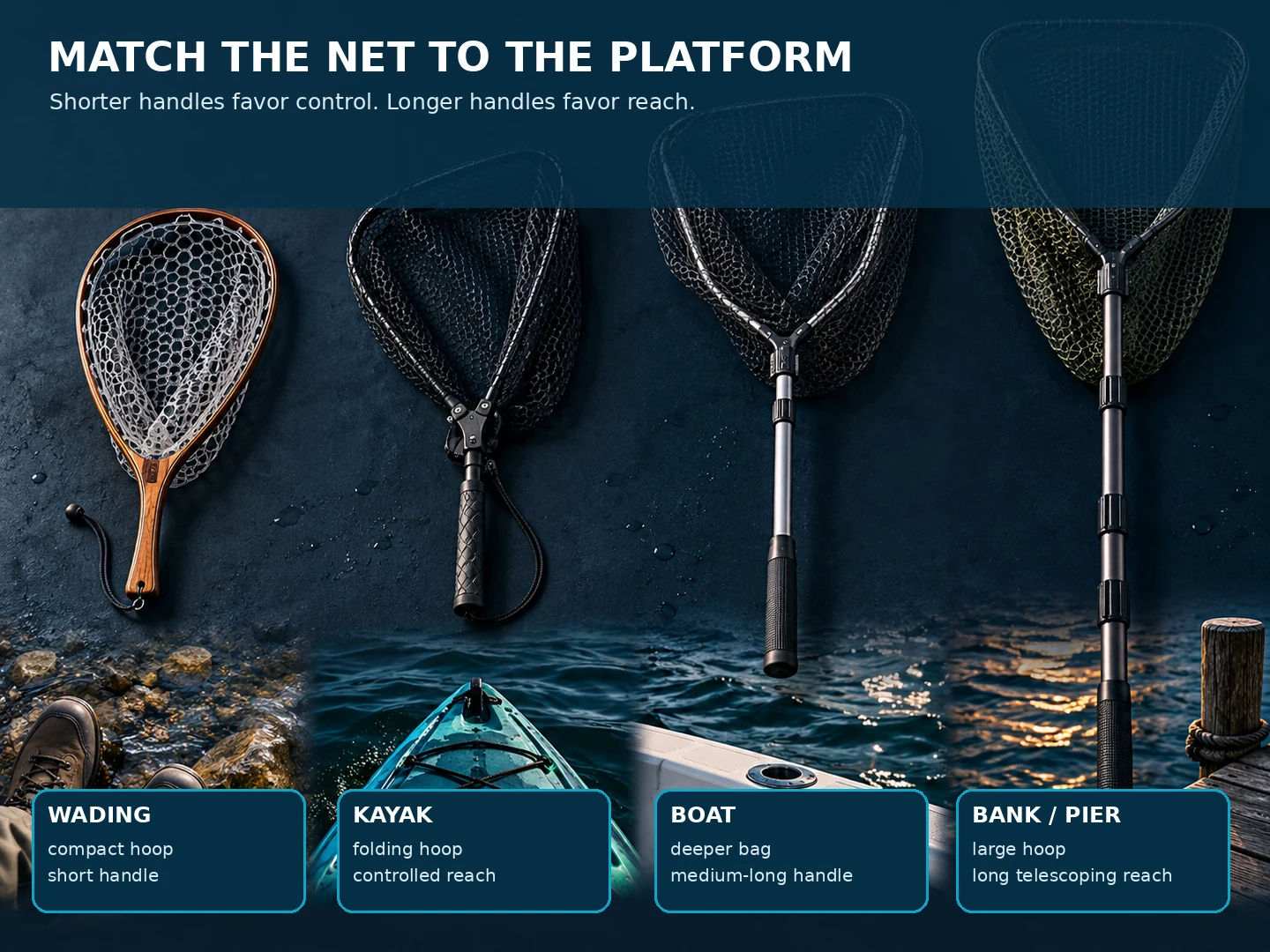
A short handle is easier to control when wading because the fish is already close to you. A kayak needs enough reach to get around the bow or gunwale without becoming a long lever in a small cockpit. From a high-sided boat, dock, seawall, or steep bank, longer reach becomes more valuable because you want to meet the fish at the surface rather than lift it on the line.
That is why there is no universal “best” handle length. A 30 to 40-inch net can feel perfect in a kayak and frustrating from a pier. A 60 to 75-inch telescoping net can be excellent on a boat and annoying on a small stream.
2. Size the hoop for the fish, not the marketing photo
For trout, panfish, and ordinary bass, a compact hoop is easier to maneuver and store. If you regularly target salmon, large catfish, pike, muskie, or other long-bodied fish, step up to a genuinely larger hoop and deeper bag. Do not assume a longer handle means a bigger basket. Those are separate dimensions.
When you are between sizes, think about the fish you would regret being under-netted for. A hoop only needs to be oversized on the day the biggest fish of your season reaches the boat.
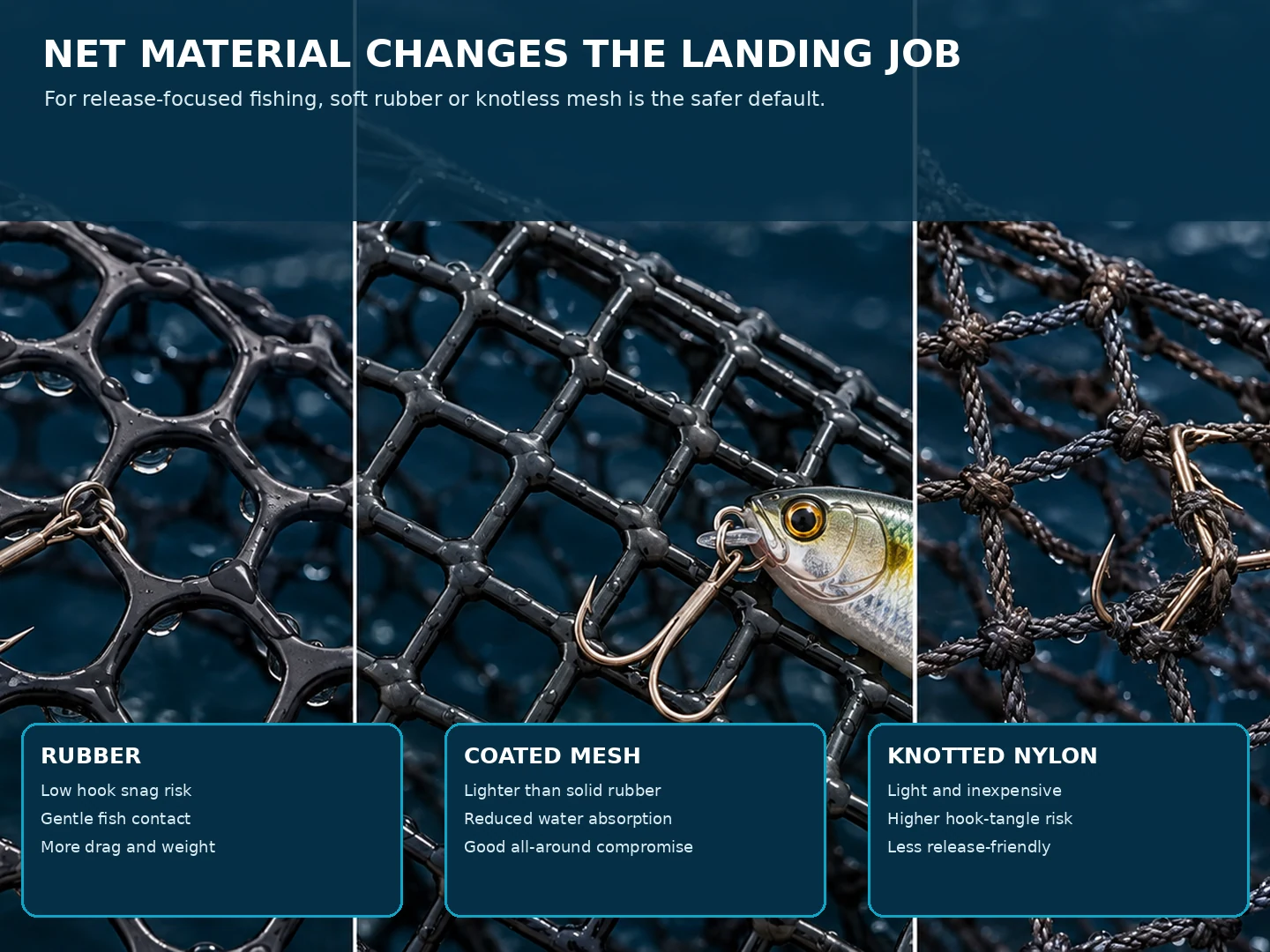
3. Favor rubber or soft knotless mesh for release-focused fishing
NOAA Fisheries recommends a wet, soft knotless mesh or rubber landing net because those materials can reduce damage to eyes, fins, scales, and the protective mucus coating. The National Park Service similarly favors rubber or small, soft knotless mesh for landing fish. That guidance is especially relevant if you release most of your catch or fish lures with multiple hooks.
Solid rubber tends to resist hook penetration and is easy to rinse, but it can be heavier and create more drag in the water. Rubber-coated or PVC-coated mesh is often lighter while still reducing snags compared with bare knotted nylon. Traditional nylon remains light and inexpensive, but it is the least attractive option here for treble-heavy catch-and-release use.
4. Folding and telescoping are different features
A folding hoop reduces the footprint of the basket. A telescoping handle changes reach. Some nets do both, some do only one, and some fixed-handle nets are intentionally simple. If storage is your main problem, prioritize the folded dimensions. If the fish is physically below you, prioritize reach.
5. A floating net is useful only if the rest of the design fits
Flotation is valuable around kayaks, canoes, and wading because a dropped net is easier to recover. It is not a substitute for the correct hoop or handle. A floating 16-inch hoop is still too small if your normal target is a large salmon, and a buoyant short handle is still short from a tall pier.
Best net type by fishing platform
| Platform | Handle priority | Hoop priority | Mesh priority |
|---|---|---|---|
| Wading / fly fishing | Short and controlled | Compact to medium | Rubber or soft knotless |
| Kayak | One-handed control, moderate reach | Medium, easy to stow | Rubber or coated mesh |
| Boat | Moderate to long reach | Match target species | Rubber or coated mesh |
| Bank / pier | Longer reach often matters | Medium to large | Choose around release and hook type |
Short and controlled
Compact to medium
Rubber or soft knotless
Control before maximum reach
Medium, easy to stow
Rubber or coated
Reach matched to deck height
Match target species
Rubber or coated
Long reach often matters
Medium to large
Match release and hook type
How we researched these fishing nets
Current product identity
We matched the named model, exact variant, and Amazon US ASIN rather than treating every size under a family listing as interchangeable.
Decision-relevant specs
We prioritized hoop size, handle reach, mesh construction, folding behavior, weight, flotation, and platform fit because those change how the net works at the final stage of landing a fish.
No fabricated field claims
Recommendations are based on documented specifications, current product information, and buyer decision logic. The article does not present GearAndFish as having physically used these products.
Fish handling
Release-care guidance was checked against NOAA Fisheries and National Park Service recommendations for rubber or soft knotless landing nets and reduced handling.
Fish-handling references: NOAA Fisheries catch-and-release best practices and National Park Service catch-and-release guidance.
Best fishing net FAQ
What is the best material for a fishing landing net?
For catch-and-release fishing, rubber or soft knotless mesh is the best starting point. NOAA Fisheries and the National Park Service both recommend rubber or soft knotless landing nets because they reduce abrasion and handling damage compared with rough knotted mesh. Rubber also tends to snag treble hooks less often, though it can be heavier in the water.
Is a rubber fishing net better than nylon?
Usually for release-focused fishing and treble-hook lures, yes. Rubber is less prone to hook tangles and is gentler on fish. Nylon is lighter and often cheaper, so it can still make sense for simple light-duty use where weight and price matter more than hook management.
What size fishing net do I need for bass?
A medium hoop is enough for most bass fishing. Around 16 to 20 inches across is a practical range for many freshwater setups, but handle length should match your platform. A kayak may need more control, while a boat or pier may need more reach.
Should a fishing net float?
Flotation is useful for kayaks, canoes, and wading because dropped gear is easier to recover. It is a convenience feature, not a replacement for correct hoop size, handle length, and fish-friendly mesh.
How long should a landing net handle be?
Use the shortest handle that still reaches the fish comfortably from your normal fishing position. Short handles are easier to control while wading. Kayaks usually benefit from moderate reach and one-handed control. High-sided boats, docks, and steep banks may justify 50 to 75 inches or more.
Can I use the same landing net in fresh and salt water?
Many aluminum-frame nets can be used in both, but rinse the frame, hinges, fasteners, and mesh with fresh water after saltwater use and let the net dry before storage. Always follow the manufacturer care instructions for the exact model.