
GearAndFish is reader-supported. As an Amazon Associate I earn from qualifying purchases. When you buy through links on our site, we may earn an affiliate commission, at no extra cost to you. Learn more.
Fishing reel sizes look simple until two reels with the same number have different weights, line capacities, and body dimensions. In practice, most US searches for fishing reel sizes are really asking how spinning reel numbers such as 1000, 2500, 3000, 4000, and 5000 translate into an actual setup. The short version: use the number to narrow the class, then choose the exact reel by line capacity, rod balance, and the fishing you plan to do.
Size numbers are not an industry standard. The ranges below are practical starting points, not universal specifications. Always let the exact model’s published line capacity and weight override the number printed on the reel.
Fishing reel sizes: the simple starting point
For spinning tackle, 1000 to 2000 is the light and ultralight end, 2500 to 3000 is the most useful general freshwater range, 4000 steps into heavier freshwater and inshore work, and 5000 to 8000+ adds the capacity and mass used for heavier inshore, surf, and offshore situations. That progression is only a shortcut. A 3000 from one brand is not guaranteed to match a 3000 from another.

Fishing reel sizes chart: 1000 to 8000+
This chart is deliberately conservative. It is meant to get you into the right neighborhood before you compare exact reel specifications.
| Common size class | Typical role | Common line starting point | Good fit when | Move up when |
|---|---|---|---|---|
| 500 to 1000 | Ultralight | Light mono or thin braid | Panfish, trout, small water, tiny lures | You need more capacity or a longer, more powerful rod |
| 2000 to 2500 | Light freshwater | Light to medium-light line | Trout, crappie, finesse bass, light walleye work | Your line, lure, or rod starts pushing the light setup |
| 2500 to 3000 | General freshwater | Medium-light braid or mono | Bass, walleye, larger trout, mixed freshwater use | You need noticeably more capacity or heavier line |
| 4000 | Heavy freshwater and inshore | Heavier braid or mono | Pike, catfish, salmon, redfish, snook, striped bass | Long runs, surf, or heavier line demand more reserve |
| 5000 to 6000 | Heavy inshore and light surf | Higher-capacity braid or mono | Large catfish, salmon, stripers, pier and surf setups | The exact application needs still more capacity or drag system capability |
| 8000+ | Surf and heavy saltwater | High-capacity heavy line | Long surf casts and larger saltwater applications | You are moving into a purpose-built big-water setup |
500 to 1000
Panfish, trout, small water
Light mono or thin braid
You need more capacity or rod balance
2000 to 2500
Trout, crappie, finesse bass
Light to medium-light line
Your line or lure choice gets heavier
2500 to 3000
Bass, walleye, larger trout
Medium-light braid or mono
You need more reserve capacity
4000
Pike, salmon, redfish, snook, stripers
Heavier braid or mono
Surf or long runs need more capacity
5000 to 6000
Large catfish, salmon, stripers, pier and surf
Higher-capacity braid or mono
The exact application needs more reserve
8000+
Long surf casts and larger saltwater work
High-capacity heavy line
This is a purpose-built class, not an all-round choice
What the reel size number actually means
The number is best treated as a manufacturer’s size label, not a measurement. Within one reel family, moving from 1000 toward 3000, 4000, and larger sizes usually brings a larger spool and more line capacity, and often more reel weight. But the size label itself does not tell you an exact spool diameter, weight, or drag rating.
A current Shimano example makes the point. In the Sedona FJ family, the US-spec 2500HG is listed at 8.5 oz while the C3000HG is 8.6 oz. They are almost the same weight, yet the C3000HG carries more line. Shimano lists the 2500HG at 8 lb/140 yd and 10 lb/120 yd mono, while the C3000HG is 6 lb/230 yd, 8 lb/170 yd, and 10 lb/140 yd. Both are rated to 20 lb maximum drag. In other words, the label change can be more about spool capacity than a dramatic jump in the whole reel.
You can check the current family specifications on Shimano’s Sedona FJ specifications.
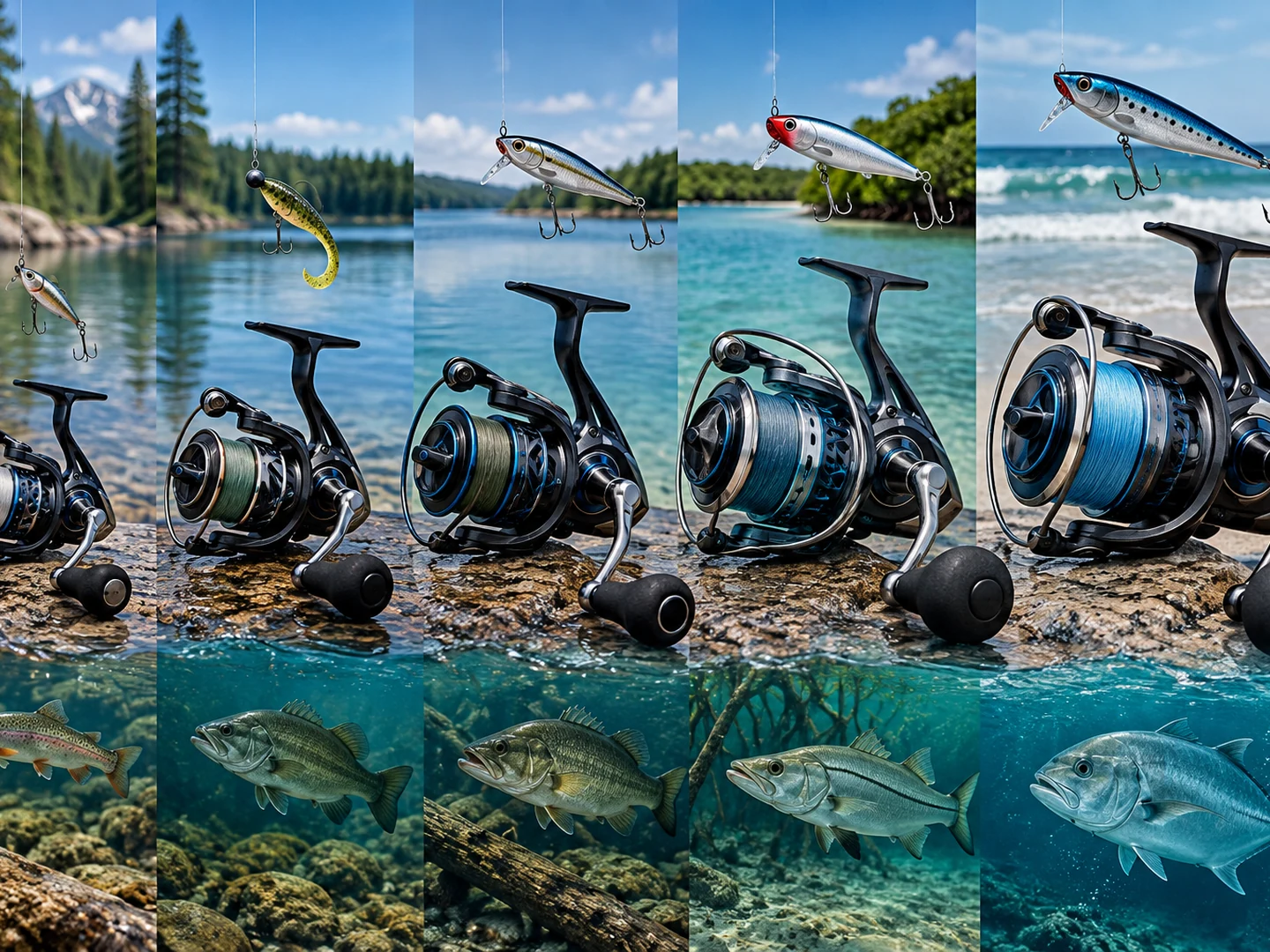
How to choose the right spinning reel size
1. Start with the line you actually need
Line capacity is the cleanest way to translate a vague size class into a specific reel. Decide the line type and breaking strength that fit your technique, then ask how much of that line you realistically need. Thin braid can put a surprising amount of line on a compact spool, so a bigger number is not automatically necessary just because you want stronger line.
2. Match the reel to the rod, not just the fish
A reel can have enough drag and line for the target species but still feel wrong on the rod. A very small reel can make a longer or more powerful rod tip-heavy, while an oversized reel can add unnecessary mass to a finesse setup. Rod power, rod length, lure weight, reel weight, and where you hold the grip all affect the finished balance.
3. Add capacity only when the fishing needs it
Moving from a 2500 or 3000 to a 4000 makes sense when heavier line, larger fish, current, structure, or longer runs create a real capacity need. It does not make sense simply because 4000 sounds stronger. If your existing size holds enough of the line you use and balances the rod well, extra spool capacity can become dead weight.
4. For saltwater, size and saltwater readiness are separate decisions
A larger reel is not automatically better protected from saltwater. Construction, sealing, corrosion-resistant components, drag design, and maintenance matter independently of the number on the spool. If saltwater is your main use, compare reels designed for that environment after you settle on the capacity class.
2500 vs 3000 reel: which size should you choose?
Choose a 2500 when you want the lightest practical general freshwater setup and the published line capacity already covers your fishing. Choose a 3000 when you want extra reserve line or a slightly larger spool without necessarily stepping into a much heavier reel.
The important part is to compare two sizes inside the same reel family first. That removes some of the brand-to-brand noise. In the current Sedona FJ example above, the 2500HG and C3000HG have nearly identical listed weights, but the 3000-class spool carries more line. Another manufacturer’s 2500-to-3000 jump can look different.
For many bass and walleye spinning setups, either class can work. Finesse anglers often have no reason to carry more reel than a well-balanced 2500, while a 3000 is useful when one setup needs to cover a broader range of line and presentations. If you are shopping rather than just learning the numbers, see our best spinning reels roundup.
When a 4000, 5000, or larger reel makes sense
A 4000 is where many spinning families begin to feel clearly more substantial. That extra capacity can be useful for heavier freshwater fishing, current, inshore saltwater, and species that can make longer runs. The trade-off is usually more reel mass and a setup that may feel clumsy on light rods.
The current PENN Battle IV 4000 is a useful calibration point. PENN lists the standard 4000 at a 6.2:1 gear ratio, 15 lb maximum drag, mono capacities of 270 yd/8 lb, 220 yd/10 lb, and 165 yd/12 lb, plus braid capacities of 360 yd/15 lb, 260 yd/20 lb, and 185 yd/30 lb. Those numbers show the kind of reserve that separates a 4000-class saltwater-oriented reel from a compact freshwater setup. See the current PENN Battle IV specifications for the whole size family.
Move beyond 4000 because you need the line capacity, rod match, and environment, not because larger always means safer. For saltwater-specific buying choices, our best saltwater spinning reels guide goes deeper into models built for that job.
Two real reels that help calibrate the size classes
These are not a mini roundup. They are current, exact model examples that show what a medium 3000-class reel and a more substantial 4000-class reel look like on paper.
| Exact reel | Size context | Useful published specs | What it demonstrates | Amazon |
|---|---|---|---|---|
| Shimano Sedona FJ C3000HG | 3000-class freshwater all-rounder | 8.6 oz; 10 lb/140 yd mono; 20 lb/140 yd PowerPro; 20 lb max drag | A 3000 can add capacity without a big weight jump inside the same family | Check availability |
| PENN Battle IV 4000 | 4000-class heavier freshwater and inshore reference | 270 yd/8 lb mono; 260 yd/20 lb braid; 15 lb max drag; 6.2:1 | A 4000 adds meaningful line reserve for bigger-water applications | Check availability |
Shimano Sedona FJ C3000HG
8.6 oz
10 lb/140 yd
20 lb/140 yd
20 lb
PENN Battle IV 4000
8 lb/270 yd
20 lb/260 yd
6.2:1
15 lb

Do these size numbers apply to baitcasting and conventional reels?
Not cleanly. The familiar 1000, 2500, 3000, and 4000 ladder is most useful for spinning reels. Baitcasters often use frame-size labels such as 50, 70, 100, 150, or 200, while conventional and trolling reels can use their own manufacturer-specific systems. The same rule still applies: the number is a shortcut, while actual capacity, reel dimensions, weight, drag system, and intended line class define the usable setup.
If you are still deciding between reel types, start with our baitcaster vs spinning reel guide rather than trying to translate size numbers directly between the two designs.
Common fishing reel size mistakes
- Treating a 3000 as universal. Compare exact capacity and weight when changing brands.
- Buying extra capacity you will never use. More line often means more reel than a light setup needs.
- Choosing only by target species. The rod, lure, line, current, cover, and casting style matter too.
- Assuming more maximum drag means a better size match. Drag rating is one specification, not a sizing system.
- Ignoring the exact child variant. A model family can change materially from 2500 to 4000 even when the product name stays the same.
Choose the smallest reel that comfortably meets the real requirement
If two sizes both hold enough of your chosen line, work with the rod, and suit the water you fish, the smaller or lighter option is usually the cleaner choice. Move up only when the bigger reel solves a specific capacity, balance, durability, or environment problem.
How this guide was researched
GearAndFish checked the current US search intent for fishing reel sizes, then compared current manufacturer specifications and exact sellable reel variants. The article uses manufacturer data for model-level specifications and current Amazon US ASIN mapping for the two commercial examples. No GearAndFish product testing is claimed.
FAQ about fishing reel sizes
What is the most versatile spinning reel size?
For many freshwater setups, a 2500 or 3000 is the most practical starting range. A 2500 favors lighter, more compact setups, while a 3000 often adds line capacity with only a modest increase in size or weight. Check the exact model specs before deciding.
Is a 3000 reel bigger than a 2500?
Usually within the same reel family, yes, especially in spool capacity. But the difference can be small and the numbers are not standardized across brands. Compare the published capacity and weight of the exact 2500 and 3000 models.
What reel size should I use for bass?
A 2500 or 3000 spinning reel covers a large share of bass fishing when paired with suitable line and a medium-light or medium rod. Heavier line, heavier cover, or a more powerful rod can justify moving toward a 3000 or 4000, but the exact reel specifications matter more than the label alone.
Is a 4000 reel too big for bass?
It is often more reel than a finesse bass setup needs, but it is not automatically wrong. A 4000 can make sense when the rod, heavier line, current, or crossover inshore use calls for more capacity. If a 2500 or 3000 already meets those needs, the smaller reel is usually easier to balance.
Do Shimano, Daiwa, and PENN reel sizes match exactly?
No. Size labels are manufacturer-specific. Use them to narrow the class, then compare actual line capacity, reel weight, spool dimensions when published, retrieve rate, and other exact-model specifications.