
GearAndFish is reader-supported. As an Amazon Associate I earn from qualifying purchases. When you buy through links on our site, we may earn an affiliate commission, at no extra cost to you. Learn more.
A line counter reel tells you how much line has left the spool. That makes a trolling pass repeatable, but the display is not a depth finder and it is not automatically accurate. Here’s how the counter works, how to check it against 100 measured feet, and how to keep multiple trolling rods on the same system.
GearAndFish research note: This is a setup and calibration guide based on manufacturer documentation and specialist trolling instruction. We have not claimed to test these reels or measured their accuracy ourselves.
How to calibrate a line counter reel
Fill the reel with the line you’ll actually troll, measure 100 feet on shore, reset the counter to zero, and pull out exactly that much line under light tension. If the display reads under 100, the working spool diameter is too large for that calibration and you generally remove some line. If it reads over 100, add line or backing. Recheck until the number matches, then record the result and test again at the distances you normally fish.
Follow the calibration steps or check what your reading means.
What is a line counter reel, and what does it measure?
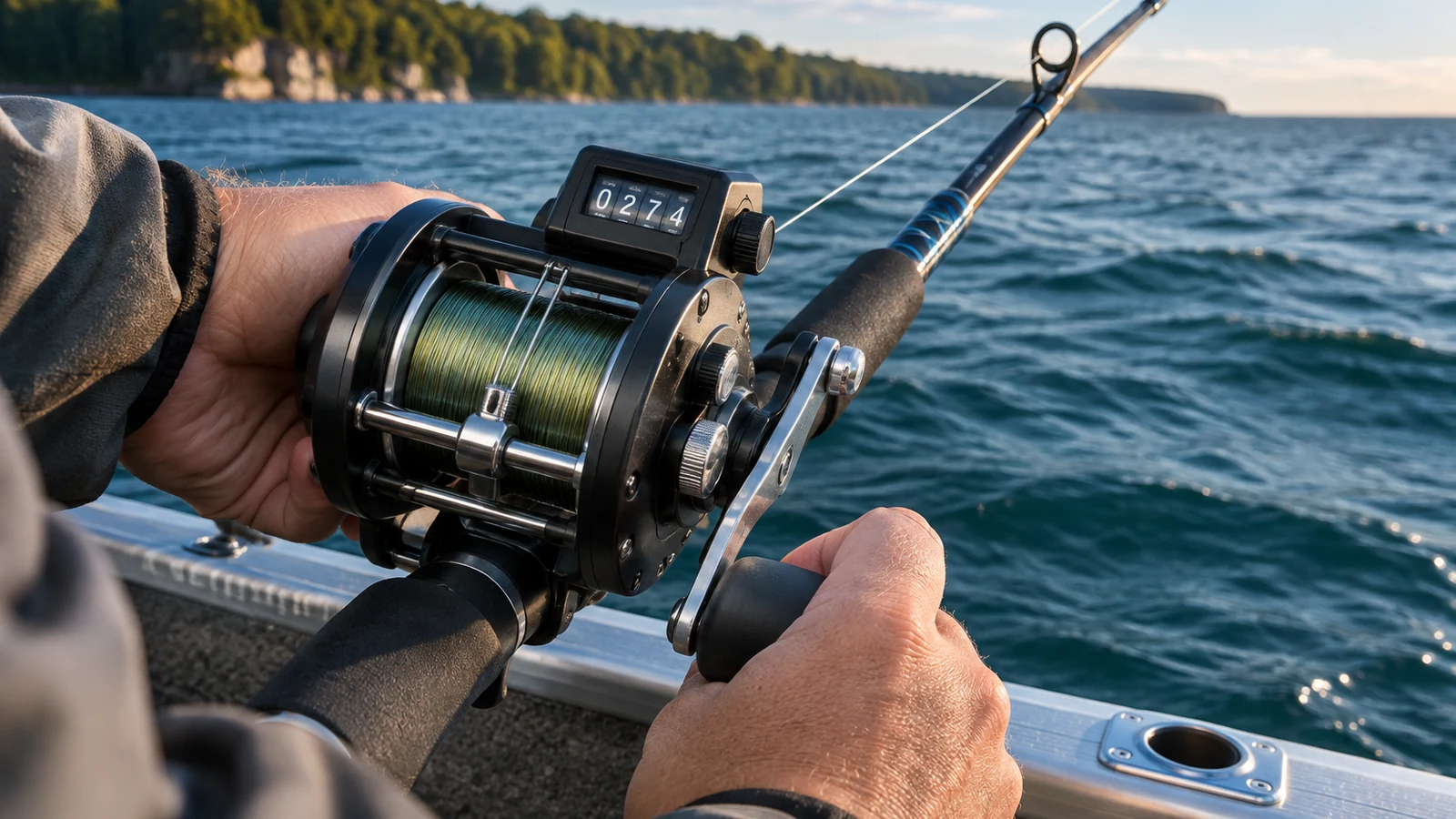
A line counter reel is a conventional or low-profile trolling reel fitted with a counter that displays an estimated length of line paid out. On common mechanical models, a gear mechanism counts spool rotations and turns them into a readout in feet. A dedicated counter is useful when you want to return a crankbait, planer board, diver, or other trolling presentation to the same line-out setting after a strike.
For example, you might learn that a certain lure worked with a counter reading of 135 at a given speed and setup. You can return that rod to 135 or send a comparable rod back to a matching line-out setting. That is much more useful than guessing from how many seconds you let the reel free-spool.
The catch: a counter estimates distance from rotations. It does not run a tape measure along the line, and it cannot determine how deep the lure is swimming.
Why spool fill and line diameter change the number
Think of two circles: a full spool and a half-empty spool. A turn of the full spool releases more line because its working circumference is larger. Once the spool gets smaller, it needs more rotations to deliver the same 100 feet. A factory-calibrated counter assumes a particular relationship between rotations and payout; your actual line diameter, backing volume, and fill level can shift it.
Thinner braid, thicker monofilament, and bulky leadcore or copper do not build the same spool profile. The pound-test number alone doesn’t tell you line diameter. That’s why simply switching from mono to braid without rechecking the counter can make two seemingly identical reels disagree.
Line out is not the same as trolling depth
If your counter says 100 feet, you have approximately 100 feet of line leaving the reel if it is calibrated correctly. That does not mean the lure is 100 feet below the surface or even 100 feet directly behind the boat.
Running depth depends on lure design, trolling speed, line diameter, weight, current, rod-tip height, and whether the setup uses a diver, downrigger, planer board, leadcore, or copper. Curved or angled line in the water makes the geometry different from straight-line distance.
Use the counter as a reliable input to a lure-specific dive chart or a repeatable presentation. Match the chart’s line type, speed, lure and conditions as closely as possible; a counter alone cannot promise a depth.
How to calibrate a line counter reel: the 100-foot method
You need a tape measure or accurately measured course, two clear markers, the reel on its trolling rod, and the actual working line. A small line clip or another gentle way to secure the end helps. Choose an open, unobstructed area away from traffic and overhead power lines. Keep hooks off the line while measuring.
- Spool the system you plan to fish. Decide on backing, main line, and any specialty line first. Load the reel to a safe, manufacturer-appropriate level, not over the lip. If you expect to adjust the amount, leave access to the supply spool before trimming the line.
- Mark an accurate 100-foot course. Measure from a fixed starting mark to the 100-foot marker. Put the rod tip at the starting point when comparing payout, rather than adding an unmeasured rod length.
- Set the counter to zero. With the working end at the rod tip or starting mark, press the reset control. Check that the digits return to zero before pulling any line out.
- Pay out the line under light, consistent tension. Keep the rod and line straight enough to avoid slack loops. Stop with the line end at the measured 100-foot marker.
- Write down the displayed number. A reading of 100 is your target at this test distance. Readings of 94 or 107 indicate a mismatch that you should investigate before relying on exact dive-chart lead lengths.
- Adjust spool fill in small increments. If the display is low, remove some line and try again; if it is high, add more line or backing. Do not exceed the reel manufacturer’s safe fill guidance to force a perfect display.
- Test again and record the setup. Once the 100-foot check is close, retest at a second relevant distance if your normal leads are much shorter or longer. Note reel model, working line, backing, approximate fill, and displayed readings.
Don’t cut all your line first. Adding line back is easier if you have not separated the working line from the original filler spool. If your reel is already completely full and still reads high, don’t overfill it. Keep a correction note instead, or review whether the reel and line configuration suit your intended method.
Counter reads 94 or 107 at 100 feet: what should you do?
| Displayed at 100 actual feet | Likely explanation | First adjustment |
|---|---|---|
| 94 feet | Fewer spool rotations than the counter expects; working spool diameter is comparatively large. | Remove a little line, then measure again. |
| 100 feet | Counter and measured distance agree at this reference distance. | Record it and test other working leads if needed. |
| 107 feet | More spool rotations than expected; working spool diameter is comparatively small. | Add line or backing within safe fill limits, then remeasure. |
These are directional troubleshooting rules, not universal add/remove quantities. The amount of correction per yard varies with reel geometry, line diameter, and the current fill. Specialist trolling instructors also recommend testing with a measured 100-foot reference rather than trusting a factory counter at face value.
Can you correct the number without changing line?
Yes, approximately. If a counter displays 110 at exactly 100 measured feet, a note that says “100 actual = 110 displayed” is useful at that reference point. But don’t apply one fixed percentage to every lead length: effective spool diameter changes as line comes off. Check around the distances you actually fish, especially for long deep-water spreads.
What about digital line counters?
Not all electronic counters use the same measurement system. Some electric reels have a model-specific line-setting or recalibration procedure; follow that exact reel’s manual rather than treating the mechanical add/remove method as a universal electronic setting. A digital display is not proof of accuracy by itself.
Make several trolling rods agree with each other
The real payoff comes from consistency. A spread with one rod reading 100 at 100 actual feet and another reading 112 at the same distance is hard to reproduce. When every reel is checked against the same course with its working line, matching numbers become much more meaningful.
- Keep the same reel model and size together when practical, but calibrate each one individually.
- Use consistent backing and working line diameter across rods expected to share the same setting.
- Zero the display from the same starting point each time you let a lure out.
- Record counter numbers beside the actual lure, trolling speed, board/diver setup, and approximate conditions.
- Recheck after a major break-off, lost line, a respool, or a move to a substantially different line diameter.
One working note might read: “Rod 2, shallow crankbait, 2.0 mph, board setup, counter 125.” That is a repeatable recipe for that rig, not a claim that the crankbait ran at a particular depth.
Line counter reel examples: match the format to your trolling setup
You don’t need a new reel to calibrate an existing one. If you’re equipping a new spread, these are four real, currently identifiable reel formats to evaluate. They’re examples of reel designs, not a second “best reels” ranking. The key purchase checks are right- or left-hand retrieve, sufficient capacity for your complete line system, a readable counter, and appropriate handling on the rod.
Compact round reel: Shimano Tekota A 300HG LC
The Shimano TEK300HGLCA is a right-hand 300-size line-counter model with a published 6.6:1 ratio and 12-ounce weight. It’s an example of a compact trolling reel where fast pickup is useful if you frequently reset planer boards. Capacity still matters: Shimano specifies 230 yards of 12-pound mono for this exact version, so assess the complete backing and working-line system before purchase.
Check Shimano Tekota A 300HG LC on Amazon
Low-profile handling: Daiwa Lexa LC300 PWR-P
The right-hand LEXA-LC300PWR-P has a 5.5:1 ratio and a top-mounted counter that reads in feet. Its low-profile layout is worth considering if you prefer a baitcaster-style grip. It is not automatically a better choice for long copper or very heavy backing; check the published capacity for your specific line diameter.
Check Daiwa Lexa LC300 PWR-P on Amazon
Traditional line-counter layout: Okuma Cold Water CW-203D
The CW-203D is a conventional round line-counter reel with a mechanical feet display, a wide-mouth levelwind and a 5.1:1 ratio. That layout is useful to consider when you’re building repeatable rod-holder trolling setups and need clearance for a bulkier line system. Like any mechanical line counter, its display should be checked with the actual loaded line.
Check Okuma Cold Water CW-203D on Amazon
Higher-capacity conventional: PENN Squall II 20LWLC
For long or heavy-line spreads, a larger frame can make more sense than a compact 300-class reel. PENN’s SQLII20LWLC is a size-20 line-counter variant published with 315 yards of 20-pound mono capacity. Extra capacity helps accommodate substantial backing or demanding trolling line systems, but it also changes how much line you should load during calibration.
Check PENN Squall II 20LWLC on Amazon
Want product-by-product trade-offs rather than calibration instructions? See our best line counter reels for trolling guide, which compares the available formats, line capacities, and buyer roles in more detail.
Does mono, braid, or leadcore need a different calibration?
Yes, whenever changing line alters the spool profile. Monofilament is relatively bulky for its strength and provides stretch. Braid often packs more length into the same spool volume. Leadcore and copper require their own capacity calculations and can change the working fill significantly. Calibrate the completed rig rather than assuming a setting from a different line system will carry over.
Backer line is part of that system. Two reels with the same outer 100 yards of braid can read differently if one has much more backing beneath it. Keep those layers intentional and document what you used. If your mainline is slipping on the spool, follow the reel and line manufacturer’s secure spooling instructions before calibrating; counter accuracy doesn’t fix a slipping spool.
Five mistakes that make line counters less useful
- Reading the display as lure depth. It reports estimated line out, not the lure’s position in the water column.
- Testing a partly spooled reel, then topping it off. The calibration no longer describes the final spool diameter.
- Copying another rod’s number without comparing counters. Different sizes, line diameters, and backing volumes can diverge.
- Zeroing at inconsistent starting points. A lure at the rod tip and a lure trailing 10 feet behind the boat should not both be treated as the same zero.
- Assuming a one-point correction holds forever. Major line loss and long payouts can change the difference between actual and indicated line.
Simple calibration checklist to keep with your trolling gear
- Reel model and retrieve side recorded
- Backing, working line, and leader setup documented
- Spool safely filled to its normal fishing level
- Actual 100-foot reference measured
- Counter reset at the same start point
- Display compared with actual line under light tension
- Adjustments or correction notes saved
- Retest planned after respooling or significant line loss
If you’re shopping specifically for a fast-reset 300-size system rather than a large-capacity conventional reel, the Shimano Tekota A 300HG LC listing on Amazon is one current example. You still need to calibrate it with your own working line before relying on the display.
How we checked this guide
We separated calibration intent from our existing commercial reel roundup, checked current instructional search results, and cross-referenced the direction of spool-fill adjustments with guidance from Okuma, Mercury Marine, and specialist trolling writer Mark Romanack. Model examples were limited to identified variants with live Amazon US product pages and manufacturer-supported details. We did not conduct an on-water test, measure counter error ourselves, or treat the number on a reel as a depth measurement. Product selection and availability can change; confirm the exact reel variant before ordering.
Line counter reel FAQ
Are line counter reels accurate out of the box?
They can be useful and repeatable, but a factory setting may not match your line diameter and spool fill. Measure 100 feet with the completed line system and compare it with the displayed reading before relying on a precise lead length.
If the counter shows 110 at 100 feet, should I add or remove line?
For a typical mechanical spool-rotation counter, a high reading at 100 actual feet points to a smaller-than-expected working spool diameter. Add line or backing in small increments if there is safe room on the spool, then retest. Never overfill solely to force the reading to 100.
Does 100 feet of line out mean my lure is 100 feet deep?
No. The counter estimates line released from the reel. Lure depth depends on the lure, speed, line, weights, and other rigging and water conditions. Use appropriate dive information and repeatable settings rather than equating line-out distance with depth.
How often should I recalibrate a line counter reel?
At minimum, check it after loading new line, changing line diameter or backing, or losing a substantial length of line. Rechecking at the start of a season or before relying on a new set of dive-chart numbers is also sensible.
Will the same counter number match across different reel models?
Not necessarily. Different spool sizes and line fills can give different actual payout at the same displayed number. Check each reel against the same measured course if you want consistent line-out settings across a trolling spread.