
GearAndFish is reader-supported. As an Amazon Associate I earn from qualifying purchases. When you buy through links on our site, we may earn an affiliate commission, at no extra cost to you. Learn more.
An Alabama rig turns one cast into a compact school of swimbaits, which makes it especially useful when bass are tracking shad or other baitfish in open water. The key is not adding more hardware. It is building a legal rig whose total weight matches your rod, then controlling depth with jighead weight, swimbait size, line, and retrieve speed.
This guide is based on current rigging guidance, current state fishing regulations, current Amazon US product listings, and a review of the present US search results for Alabama rig setup and technique. Regulations can change, so check the rules for the water you plan to fish before tying one on.
A practical Alabama rig setup
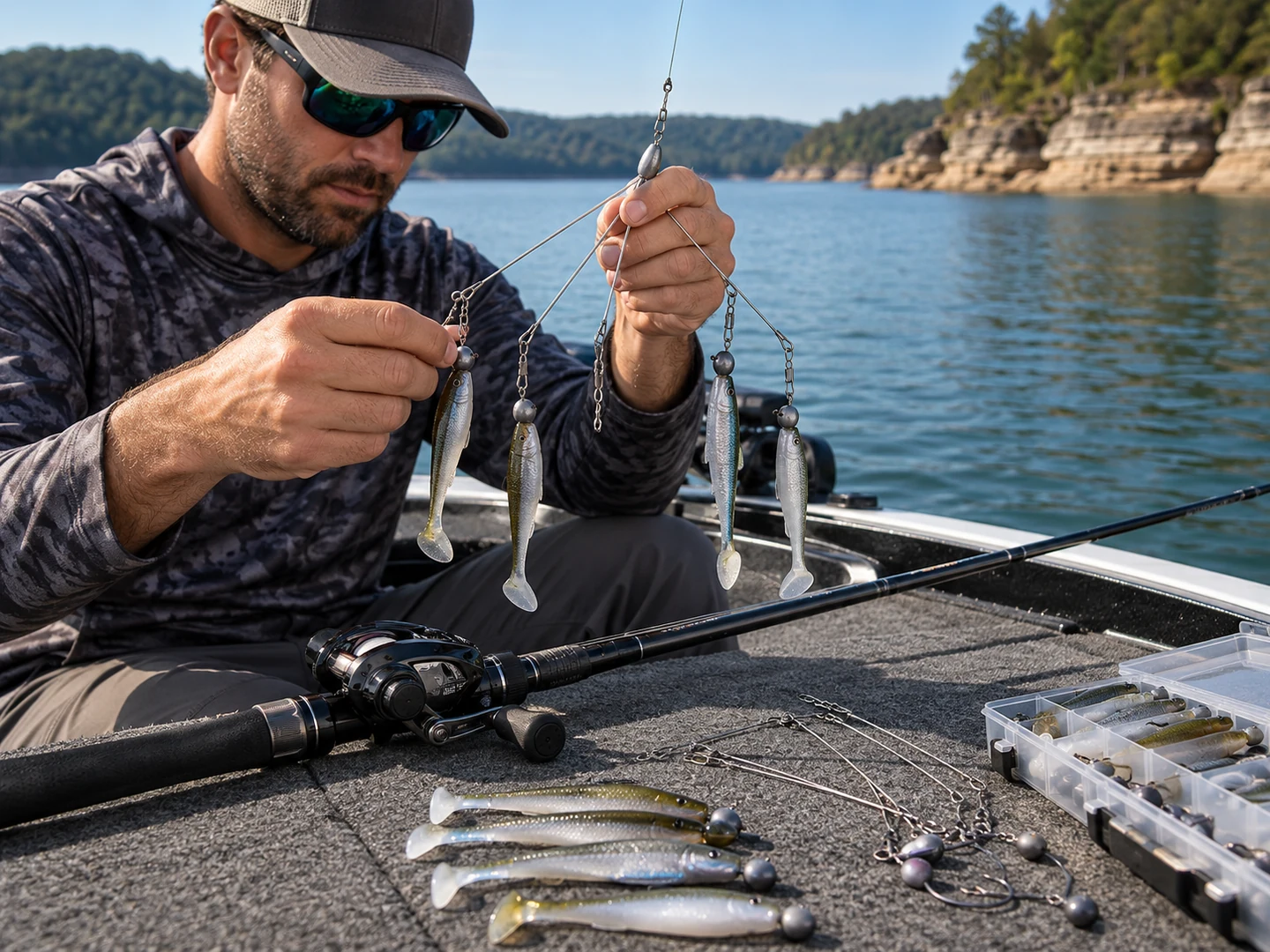
Start with a compact umbrella rig, 3 to 4 inch paddle-tail swimbaits, and jigheads light enough to reach your target depth without making the finished rig harder to cast than necessary. A long heavy casting rod rated for the total loaded rig weight, a sturdy baitcasting reel, and heavy line make the system much easier to manage. Common starting points are 1/8 to 1/4 ounce jigheads, around 20 pound fluorocarbon for a direct connection, or roughly 50 to 65 pound braid when line strength and rig recovery are priorities.
Before rigging hooks: verify the legal hook count where you are fishing. The same five-arm frame can be legal in one state and require hookless teasers on some arms in another.
What is an Alabama rig?
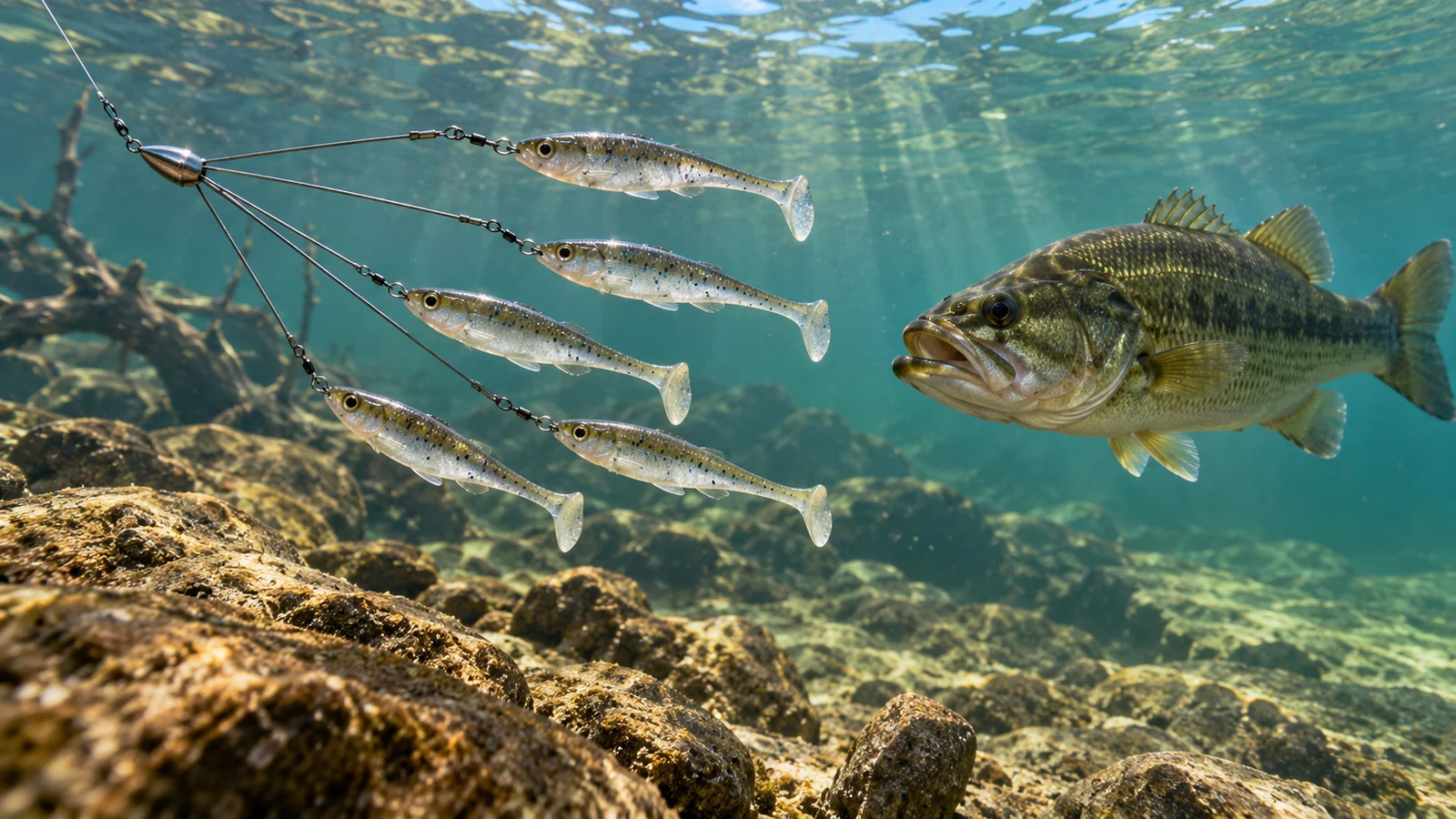
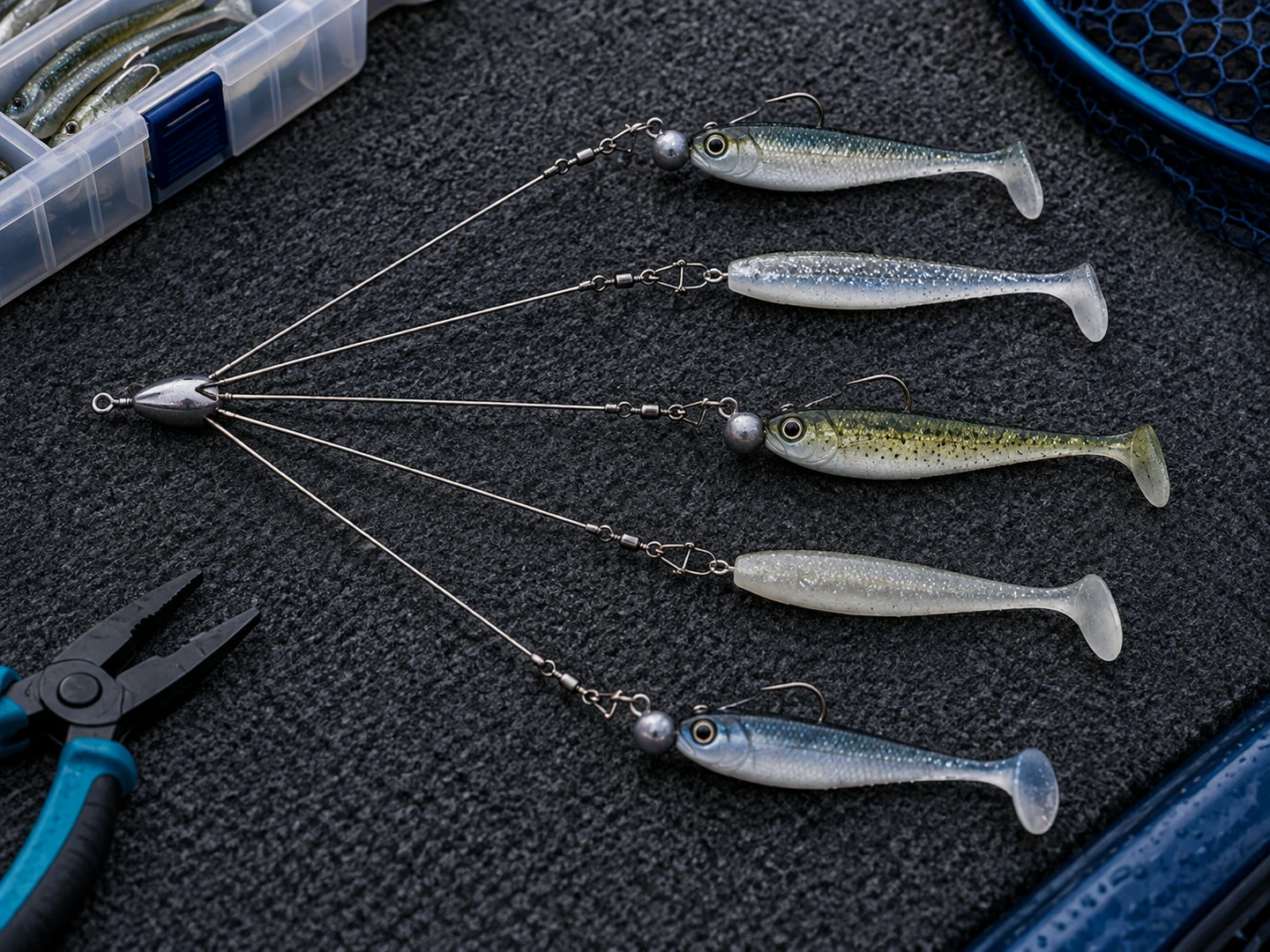
An Alabama rig, often called an A-rig or castable umbrella rig, uses several flexible wire arms to present multiple small baits behind one central head. The goal is to imitate a small group of baitfish rather than a single isolated meal.
Most bass versions use a compact frame with multiple snaps or swivels at the ends of the wires. Jigheads and soft-plastic swimbaits attach to those arms. Some frames also include spinner blades, which add flash without adding another hooked lure.
The important distinction is that the frame and the number of hooked baits are separate decisions. You can own a five-arm rig and still configure fewer than five hooks when local rules require it.
Check the legal hook count before you build the rig
There is no single nationwide hook-count rule for Alabama rigs. State regulations, water-specific rules, and tournament rules can differ, so treat legality as step one rather than an afterthought.
For example, the Missouri Department of Conservation says Alabama and similar rigs may use only three lures or baits with hooks, while extra attachment points can carry hookless baits or attractors. The Kansas Department of Wildlife and Parks currently states that an umbrella rig, also known as an Alabama rig, may have up to five hooks.
Those examples show why copying another angler’s five-hook setup without checking your own rules is a bad shortcut. Look up the current regulation for your state and the specific water, then check any event rules if you are fishing a tournament.
What you need for an Alabama rig
- Umbrella rig frame: usually a compact multi-arm frame designed to be cast, not a large trolling umbrella.
- Jigheads: enough hooked heads to match the legal hook count, plus hookless teasers if needed.
- Soft swimbaits: 3 to 4 inch paddle tails are an easy starting range for many bass situations.
- Heavy casting rod: choose by the complete rig weight after heads and plastics are installed.
- Sturdy baitcasting reel: prioritize line capacity, durability, and comfortable retrieve speed over a very high gear ratio.
- Heavy line: commonly heavy fluorocarbon or braid, selected for cover, depth, abrasion, and how badly you want to recover a snagged rig.
If you are buying the frame rather than building from parts, the Yum Lures Yum Yumbrella Flash Mob Junior is a currently verified Amazon US option and a useful reference point for the compact castable style discussed here.
How to set up an Alabama rig step by step
- Confirm your legal hook count. Decide how many arms will carry hooked jigheads and which, if any, need hookless teasers.
- Open the wires evenly. Spread the arms enough that the swimbaits can swim without constantly tangling. A moderate fan is a better starting point than an extremely tight bundle.
- Choose jighead weight for depth. For many bass setups, 1/8 or 1/4 ounce heads are sensible starting points. Go lighter for slower, shallower presentations and heavier when you need to reach deeper fish or maintain control in current.
- Rig each swimbait straight. A crooked plastic can roll or pull the whole school out of balance. Thread each bait so the body tracks directly behind the head.
- Balance the rig. Some anglers use slightly heavier heads on the lower arms to help the rig track upright. This is optional, not a requirement.
- Tie to the front eye. Use a knot you trust with the selected line and inspect the connection carefully. The rig is expensive enough that a weak knot becomes a costly failure.
- Check the finished weight. Add the frame, every jighead, every plastic, blades, and hardware. That total needs to fall inside your rod’s lure-weight rating.
The last step is the one most first-time A-rig anglers underestimate. Five small jigheads can turn into a surprisingly heavy package once the frame and swimbaits are included.
How heavy should the jigheads be?
Jighead weight is your main depth-control tool, but it works together with swimbait size and retrieve speed. Heavier heads make the rig sink faster and help it stay down during a faster retrieve. Lighter heads let the rig ride higher and make the finished package easier to cast.
A good baseline is to begin with 1/8 ounce heads for shallower or slower work and move toward 1/4 ounce when you need more depth or control. That is a starting range, not a rule. Water depth, current, swimbait bulk, line, and the frame itself all change the sink rate.
If you need conventional swimbait heads, Berkley Fusion19 Swimbait Fishing Jigheads have a current Amazon US listing. Amazon may group multiple sizes or colors under one listing, so select the exact weight and hook size you need rather than assuming every variation is identical.
Rod, reel, and line for an Alabama rig
Rod: rate it for the loaded rig
Around 7 feet 6 inches to 8 feet is common territory for A-rig rods because the extra length helps move a heavy package smoothly. More important than the label “heavy” or “extra heavy” is the printed lure-weight rating. Current fishing guidance frequently lands in the 1 to 3 ounce class for full-size bass A-rigs, but your actual rig may be lighter or heavier.
A rod that is under-rated encourages the exact casting motion you do not want: a sharp snap that overloads the blank. A properly rated rod lets you use a broad, controlled sweep.
Reel: sturdy beats ultra-fast
A baitcasting reel is the usual match because it handles heavier line and repeated casts with a bulky lure well. A moderate retrieve around the middle of the baitcaster range makes it easier to slow-roll the rig without constantly fighting a high-speed reel. Line capacity and a solid drag matter more than chasing the highest gear ratio.
If you are still deciding how a baitcaster fits this technique, our best baitcasting reels guide explains the tradeoffs that matter across different fishing jobs.
Line: fluorocarbon or braid can both work
Straight fluorocarbon around 20 pound test is a common A-rig choice because it offers abrasion resistance, low visibility, and some stretch in a heavy moving-bait system. Heavy braid is attractive when strength, sensitivity, and getting an expensive rig back from a snag are bigger priorities.
For anglers who prefer braid, the mapped PowerPro Microfilament Braided Fishing Line, 300 Yard 65 LB listing is a current heavy-line option on Amazon US. Before choosing braid automatically, compare it with the tradeoffs in our braided fishing line guide.
Quick setup changes by depth and conditions
| Situation | First adjustment | Why it helps |
|---|---|---|
| Shallow water | Lighter heads, slower sink | Keeps the rig above bottom and cover |
| Suspended bait | Count it down, then use a steady retrieve | Lets you repeat the depth where fish are holding |
| Deep water or current | Increase head weight gradually | Improves depth control without guessing |
| Rig rolls or tracks sideways | Check straight plastics and wire balance | Corrects drag and imbalance before adding weight |
| Short strikes | Make one hooked bait an obvious trailing target | Gives fish a clear bait to isolate |
Go lighter first
Use a repeatable countdown
Add weight gradually
Fix balance before adding weight

How to fish an Alabama rig
1. Start with a steady slow roll
For the first few casts, do not overwork the rig. Let it reach the target depth and reel steadily enough to make every tail swim. A smooth retrieve keeps the bait school compact and gives you a baseline for speed and depth.
2. Use a countdown for suspended fish
When bass or bait are suspended, consistency matters more than a magic retrieve. Cast, let the rig sink for a repeatable count, then begin the retrieve. If you get a bite after a five-count, repeat it. If the rig contacts bottom at eight, you now have a rough ceiling for that cast and weight combination.
3. Add short speed changes
A brief acceleration, reel-handle pulse, or subtle rod movement can make the school flare and regroup. Use those changes sparingly. The A-rig already creates a lot of visual information, so constant jerking can make it harder to control depth.
4. Keep it near baitfish, not just structure
The rig is built around a bait-school illusion. It can work along points, channel swings, bridge areas, bluff ends, open-water breaks, and other places where bass intercept bait. If electronics or surface activity show suspended forage away from the bank, an A-rig can reach fish that are not relating tightly to bottom cover.
5. Sweep into the fish
When the rod loads, keep reeling and use a firm sweep rather than an exaggerated snap hookset. A heavy rig already carries momentum, and a smooth load helps keep the rod, line, and multiple-wire frame under control.
How to cast an Alabama rig without beating up your gear
An A-rig is closer to casting a small chandelier than a normal crankbait. The safest, most efficient motion is a broad swing that loads the rod progressively.
- Leave enough line between the rod tip and rig to let the package swing smoothly.
- Start the backcast low and controlled instead of snapping the rig straight overhead.
- Let the rig’s weight load the rod through a wide arc.
- Accelerate forward smoothly and release without a hard stop.
- Thumb the spool before splashdown if needed to reduce tangles.
If the cast feels violent, check the total rig weight against the rod rating before changing your casting technique. The rod should be carrying the load, not surviving it.
When the Alabama rig makes the most sense
The A-rig is strongest when bass are keyed on baitfish and you need to show them a compact group rather than one lure. Early prespawn is a widely used window because bait and bass often move into predictable staging areas, but the rig is not limited to spring. It can be useful whenever bass are chasing shad, herring, shiners, or similar forage and the water is open enough to retrieve multiple exposed hooks.
It is less comfortable in dense wood, brush, or vegetation where several hooks can turn every cast into a snag. In those places, a single-hook presentation such as a Texas rig may be easier to work through cover. When bass want a slow bottom presentation instead of a moving bait school, a Carolina rig or Ned rig can fit the job better.
Common Alabama rig mistakes
- Ignoring regulations: a legal five-hook setup in one state does not make five hooks legal everywhere.
- Rating the rod for one jighead: the rod sees the weight of the entire finished rig.
- Starting too heavy: more weight can make the rig harder to cast and push it below the fish.
- Rigging crooked plastics: one rolling swimbait can pull the school out of balance.
- Closing the wires too tightly: baits can tangle each other in the air or during the retrieve.
- Fishing it only on bottom: many of the best A-rig situations involve suspended fish.
- Making every retrieve complicated: a steady retrieve is usually the best baseline before adding pulses or speed changes.
- Repeatedly over-bending the wires: adjust the spread as needed, but unnecessary reshaping can fatigue wire over time.
Alabama rig troubleshooting
The rig keeps rolling
First make sure every swimbait is threaded straight and the wires are spread symmetrically. If the frame still rolls, reduce retrieve speed or rebalance the lower arms before adding more overall weight.
The baits tangle on the cast
Open the wires slightly and switch from a sharp snap cast to a smooth sweeping cast. Also check that oversized swimbaits are not crowding each other.
You cannot keep the rig down
Give it a longer countdown, slow the retrieve, or increase jighead weight in small steps. Smaller or less buoyant swimbaits can also help the rig run deeper at a given speed.
You are snagging constantly
Move away from dense cover, raise the rig in the water column, or switch presentations. An A-rig is not automatically the right tool just because bass are present.
Fish follow but do not commit
Try a smaller bait profile, a different color contrast, or one slightly different trailing bait that gives fish a target. Then change retrieve speed before rebuilding the entire rig.
How we built this guide
We compared current Alabama-rig setup guidance from established fishing publications, checked current state-rule examples from Missouri and Kansas, reviewed the live US search results for the topic, and re-opened each Amazon.com US listing used by a CTA. GearAndFish did not physically test the products in this article. The recommendations are task-based: each product is included only because it helps assemble or fish the rig described above.
Alabama rig FAQ
Is an Alabama rig legal in every state?
No. Hook-count rules and other restrictions vary by jurisdiction, water, and sometimes tournament organization. Check the current rule for the exact place you plan to fish before attaching hooked baits.
How many hooks can you put on an Alabama rig?
There is no single nationwide number. Missouri currently limits Alabama and similar rigs to three hooked lures or baits, while Kansas says an umbrella rig may have up to five hooks. Your local rule controls.
What size jigheads should I use on an Alabama rig?
For many bass setups, 1/8 to 1/4 ounce jigheads are a practical starting range. Use lighter heads to keep the rig higher and heavier heads when you need more depth or current control, while staying within the rod’s total lure-weight rating.
What line should I use for an Alabama rig?
Heavy fluorocarbon around 20 pound test is common, while roughly 50 to 65 pound braid can make sense when maximum strength and recovering an expensive rig matter more. Choose line as part of the rod, reel, cover, and depth system rather than by one fixed rule.


