

GearAndFish is reader-supported. As an Amazon Associate I earn from qualifying purchases. When you buy through links on our site, we may earn an affiliate commission, at no extra cost to you. Learn more.
Braid vs fluorocarbon is not a winner-takes-all choice. Straight braid is the better tool when you want maximum line-to-lure feedback, high strength for diameter, and dependable handling in vegetation. Straight fluorocarbon makes more sense when you want a sinking mainline, lower underwater visibility, and no leader knot. For many finesse spinning and mixed-use setups, braid with a fluorocarbon leader is the most practical middle ground.
GearAndFish does not claim field testing for this comparison. The decision rules below are based on current manufacturer specifications, current Amazon.com US variants, line-material behavior, current US search intent, and published rigging guidance.
Braid vs fluorocarbon: which should you use?
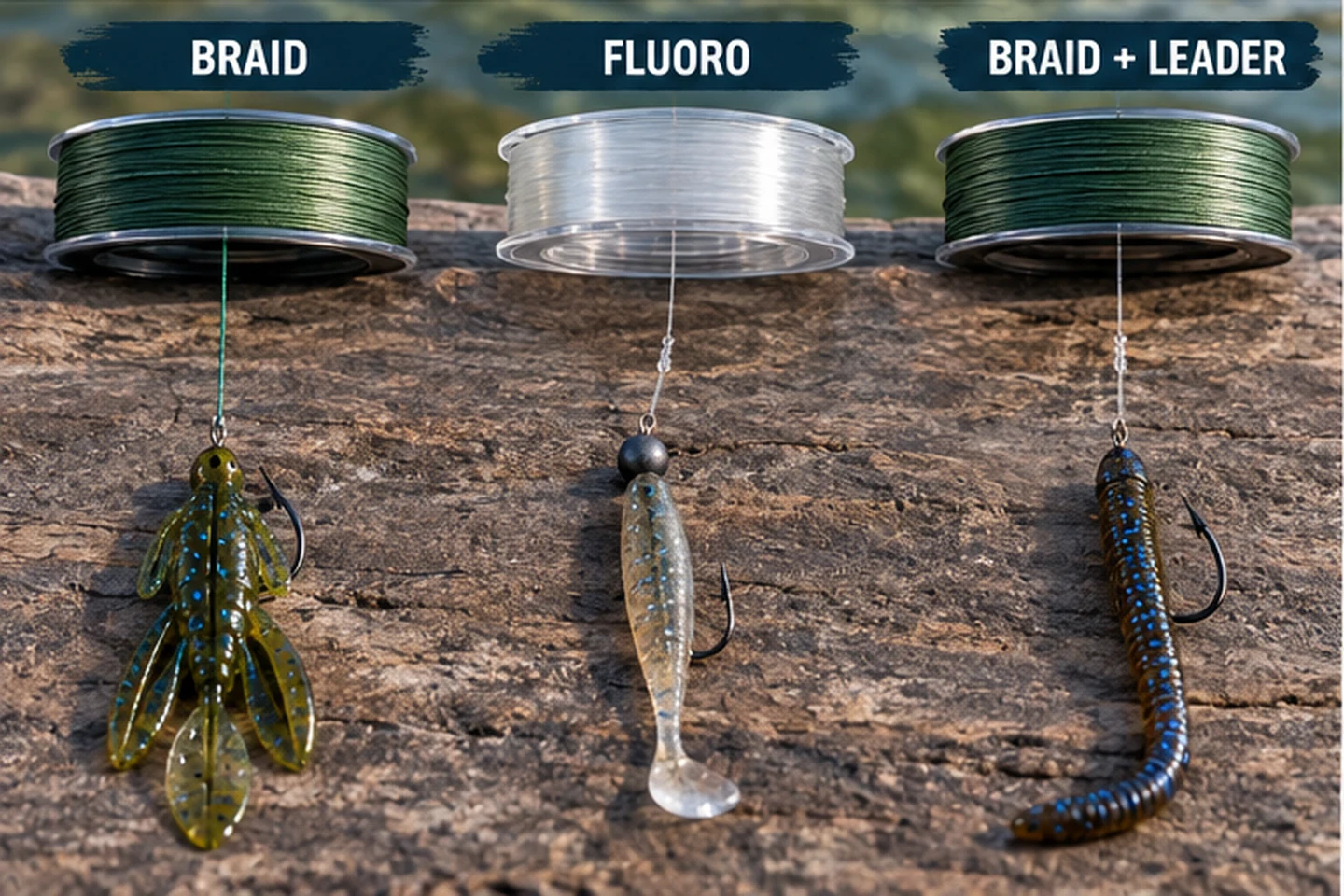
Choose straight braid for frogs, heavy vegetation, many power-fishing setups, and situations where direct feel matters more than low visibility. Choose straight fluorocarbon for clear-water or bottom-contact presentations when you want the line to sink and prefer a one-line system without a connection knot. Choose braid plus a fluorocarbon leader for finesse spinning, drop shots, Ned rigs, and versatile freshwater or inshore setups where easy mainline handling and a lower-visibility terminal section both matter.
There is one important exception: for some topwater presentations and treble-hook techniques, monofilament can still be a better third option because its buoyancy and added stretch may suit the lure and hook setup better than either braid or fluorocarbon.
Braid vs fluorocarbon at a glance
| Factor | Braided line | Fluorocarbon line | What it means on the water |
|---|---|---|---|
| Stretch | Very low | Low, but more give than braid | Braid transmits taps and bottom contact more directly; fluoro adds some shock absorption. |
| Diameter for a given break strength | Usually smaller | Usually larger | Braid can pack more strength onto a small spool and cut through vegetation well. |
| Underwater visibility | Relatively visible | Lower visibility than conventional mono and braid | Fluoro is useful near the lure when fish are line-shy or the water is very clear. |
| Water-column behavior | Generally stays higher and does not sink like fluoro | Sinks | Fluoro can help bottom-contact and subsurface lures stay connected to the presentation. |
| Spool handling | Very manageable once spooled correctly, especially on spinning reels | Can have more memory and stiffness, especially in heavier tests | Braid is often easier as a spinning-reel mainline; straight fluoro is more common on baitcasters than on small spinning spools. |
| Cover | Excellent in grass and vegetation; sharp rock and shell can fray it | Often preferred around hard cover near the lure | The best choice depends on whether the problem is vegetation or hard, abrasive structure. |
| Connection complexity | Simple if tied direct; more complex with a leader | Simple when used as a full mainline | Braid plus leader adds one knot that must be tied correctly and checked. |
| Best default use | Heavy cover, high sensitivity, power fishing | Clear water, sinking presentations, straight-line baitcasting | For finesse spinning and mixed use, braid plus fluoro leader often combines the strengths of both. |
Braid
Very low stretch and direct feedback. Strong choice when detecting light bites or feeling bottom is the priority.
Fluorocarbon
Lower visibility underwater and a sinking line path. Strong choice for clear water and many subsurface presentations.
Braid plus fluoro leader
Easy-handling, low-diameter braid on the spool with fluorocarbon only where stealth and hard-cover contact matter most.
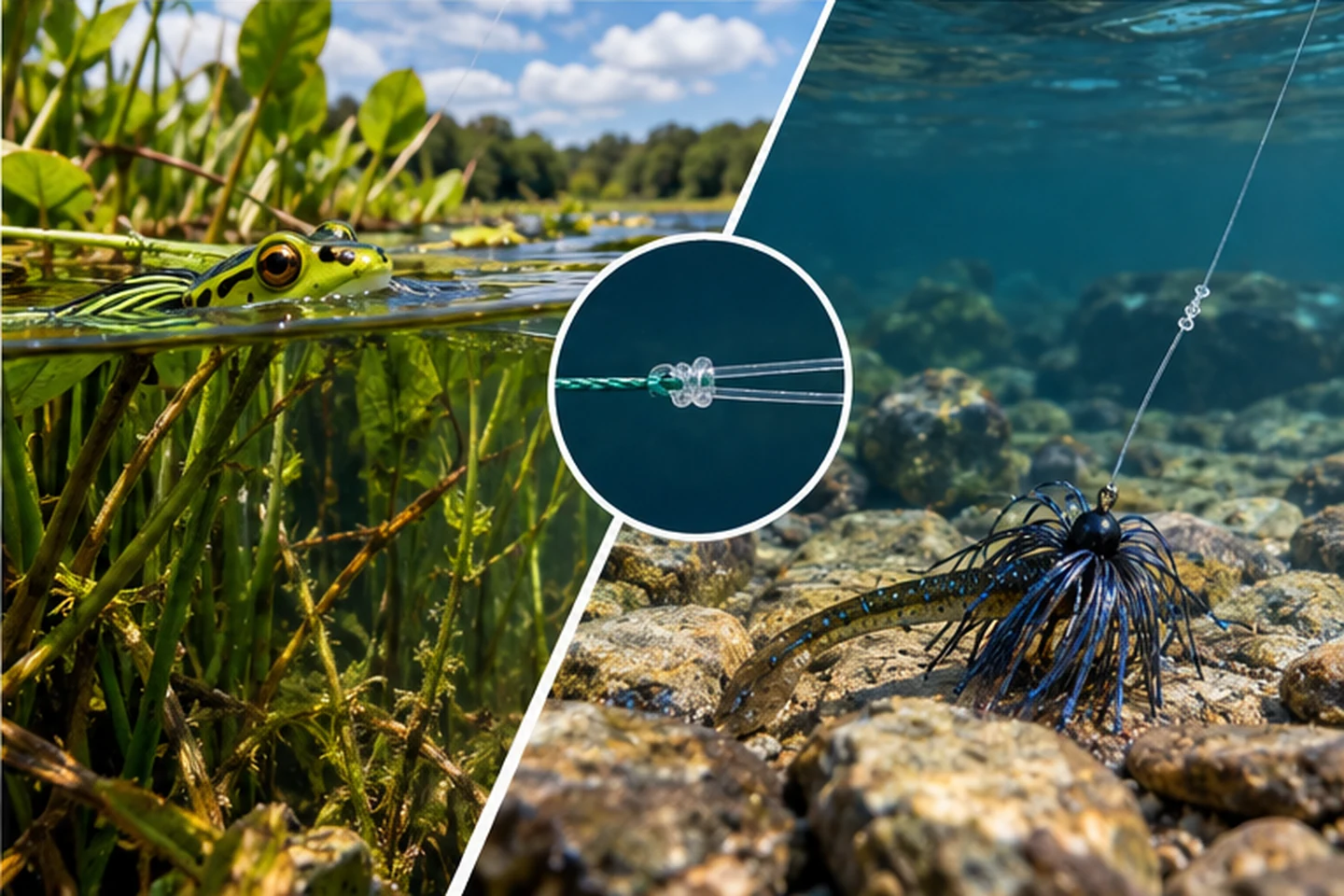
Match the cover type
Braid excels in vegetation. Fluorocarbon is often useful near rock, wood, shell, and other abrasive hard cover.
What braid does better
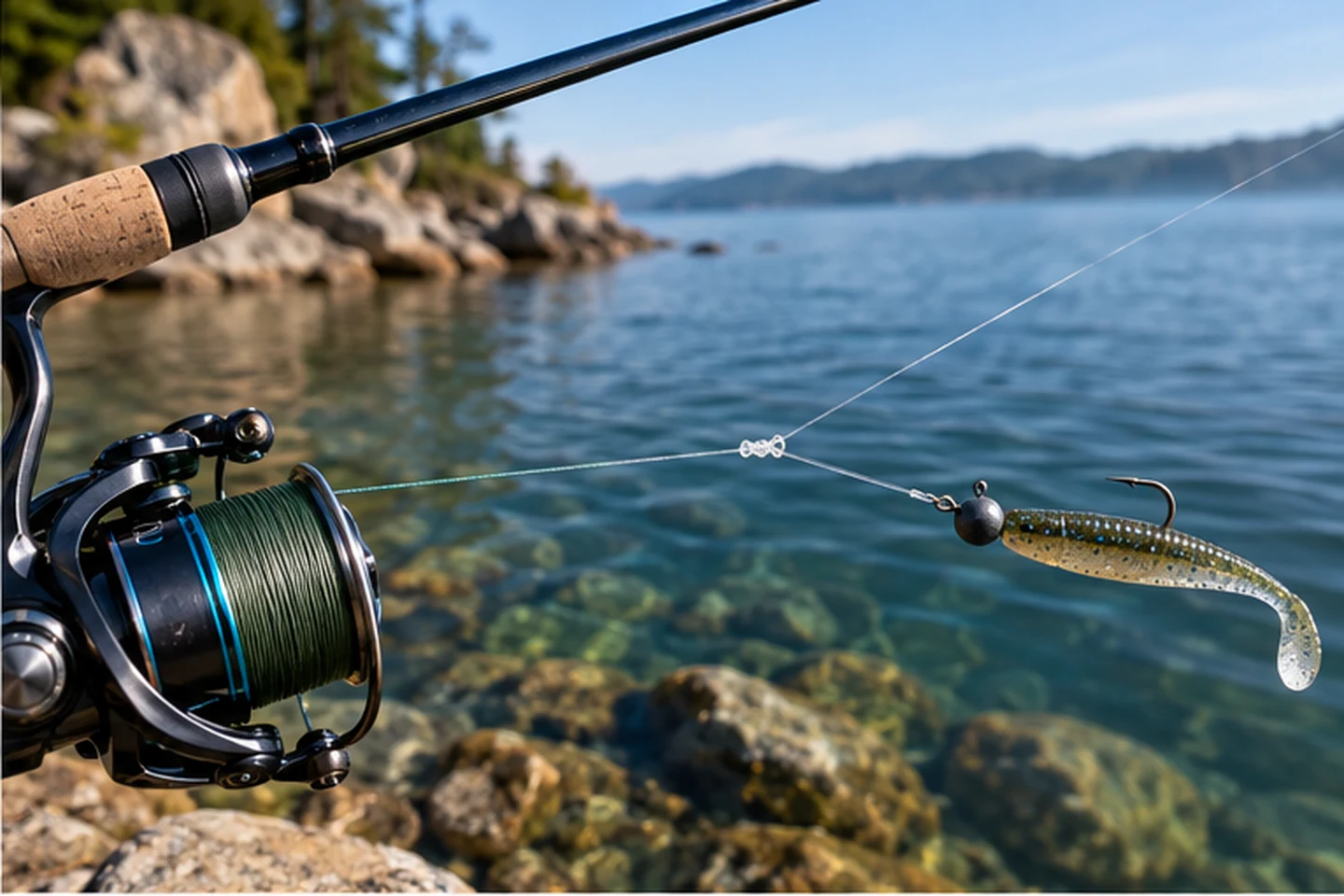
Braid’s biggest advantages are low stretch, small diameter for its break strength, and a very direct connection to the lure. Those traits are valuable when you need to detect subtle contact, drive a hook at distance, or pull fish through grass.
Lily pads, hydrilla, reeds, mats, and other soft cover are classic braid territory because high strength can be packed into a relatively small diameter and the line can work through vegetation without the same concern about visibility near the lure.
On spinning reels, thin braid lays on the spool with little memory compared with many fluorocarbons. That is one reason a braid mainline is so common for finesse spinning rigs.
The trade-off is that braid is easier to see, has almost no cushion, and can be vulnerable to fraying when repeatedly dragged across sharp rock, mussels, shell, or similarly abrasive structure. It also requires knots that grip slick braided fibers reliably. When those disadvantages matter, adding a fluorocarbon leader can be smarter than abandoning braid as the mainline.
What fluorocarbon does better
Fluorocarbon is useful when you want the line near the lure to be less visible underwater, when a sinking line helps the presentation, and when you want a harder, more abrasion-oriented terminal section around rock, wood, shell, docks, or similar cover.
It is also the simpler system when you want to avoid a leader knot entirely. A baitcaster filled with an appropriate fluorocarbon mainline can go from reel to lure with one terminal knot. That simplicity can matter if you fish techniques where a leader connection would regularly pass through the guides or if you simply do not want another knot in the system.
It is better described as lower visibility underwater than conventional mono and braid, with less direct stretch response than braid but still some give under load. Marketing phrases such as “virtually invisible” and “virtually no stretch” should not be read as absolute physical claims.
The main handling trade-off is memory. Fluorocarbon can spring off smaller spinning spools, especially as line diameter rises. Softer formulations help, but for many finesse anglers the cleaner solution is still braid on the reel with a fluorocarbon leader.
Choose straight braid if these are your priorities
- Heavy vegetation: frogs, punching, pitching, and other presentations where you may need to move fish through grass or mats.
- Maximum feedback: techniques where small ticks, bottom changes, or long-distance contact matter.
- Small-diameter strength: useful when reel capacity, current, lure action, or vegetation favors a thinner line profile.
- Simple power setup: no leader knot to inspect, retie, or pull through guides.
Straight braid is less attractive when fish are extremely line-conscious in clear water, when your lure is repeatedly rubbing sharp hard cover, or when you need more stretch to protect small treble hooks.
Choose straight fluorocarbon if these are your priorities
- Lower visibility near the lure: especially in clear water or pressured fisheries.
- A sinking line: useful for many jigs, Texas rigs, crankbaits, jerkbaits, and other subsurface presentations.
- One-line simplicity: especially on baitcasting gear where you do not want a mainline-to-leader knot.
- Hard-cover contact: when the terminal section regularly touches rock, wood, shell, or dock structure.
Straight fluorocarbon is less attractive on small spinning reels when line memory starts to hurt casting and line control. It is also a poor default for floating topwater lures because the line sinks and can pull the presentation downward.
Choose braid plus a fluorocarbon leader for the most flexible setup
This is the hybrid system many anglers are really deciding on when they search braid vs fluorocarbon. The braid stays on the reel, where its small diameter and low memory are useful. Only the final section is fluorocarbon, where lower visibility and hard-cover durability matter most.
For finesse spinning, a practical starting point is a light braid mainline with a lighter fluorocarbon leader sized to the species, cover, hook, and lure. GearAndFish’s current drop shot rig guide and Ned rig guide both use this logic: braid handles the reel and casting duties while fluorocarbon handles the final connection near the bait.
The only real cost is the connection knot. An FG knot, Alberto knot, or double uni can all work when tied correctly for compatible diameters, but the knot must be compact, fully seated, and inspected after hard use. If you dislike leader knots, straight fluorocarbon may be the cleaner choice even if it is less forgiving on a spinning spool.
Which line setup fits common fishing techniques?
| Technique or condition | Good starting setup | Why |
|---|---|---|
| Finesse spinning | Braid plus fluorocarbon leader | Manageable mainline plus a lower-visibility terminal section. |
| Drop shot and Ned rig | Braid plus fluorocarbon leader | Direct bite detection without asking a full spool of light fluoro to handle like braid. |
| Frogs and matted grass | Straight braid | High strength for diameter and dependable performance in vegetation. |
| Jigs and Texas rigs around rock or wood | Straight fluorocarbon or braid plus fluoro leader | Sinking line and a fluorocarbon terminal section are useful around hard cover. |
| Crankbaits and jerkbaits | Often straight fluorocarbon | Sinking line and some added give can fit many subsurface treble-hook presentations. |
| Topwater with treble hooks | Braid or monofilament, depending rod and lure | Fluorocarbon sinks; mono remains worth considering when you want buoyancy and more stretch. |
| Clear-water inshore lure fishing | Braid plus fluorocarbon leader | Braid provides capacity and handling while fluoro is used where fish and abrasive structure meet the line. |
Braid + fluoro leader
Easy mainline handling with a lower-visibility terminal section.
Straight braid
High strength for diameter and strong vegetation performance.
Straight fluoro or braid + leader
Use fluorocarbon where hard-cover contact is the main concern.
Usually not straight fluorocarbon
Braid can work, while mono is still useful when buoyancy and extra stretch are desirable.
Three current Amazon examples for the three line systems
This is not a second roundup. These are current, verified US product examples that make each setup concrete. Choose line test and spool size for your reel, lure, cover, and target species rather than copying one number across every technique.
Straight braid example: Sufix 832 Advanced Superline
Sufix lists 832 as an eight-fiber braid made from seven HMPE fibers plus one GORE Performance Fiber, with 32 weaves per inch. The exact Amazon variant mapped here is 30 lb, 150 yd, Low Vis Green. GearAndFish also uses this exact child ASIN in the live Best Braided Fishing Line guide.
Check Sufix 832 availability on Amazon
Straight fluorocarbon example: Seaguar InvizX
InvizX is a 100% fluorocarbon freshwater mainline that Seaguar positions around soft handling, low memory, castability, sensitivity, and fast sinking. The exact Amazon child mapped here is 12 lb, 200 yd, a useful reference point for a straight-fluorocarbon baitcasting setup.
Check Seaguar InvizX availability on Amazon
Braid-to-leader example: Seaguar Blue Label
Blue Label is purpose-built fluorocarbon leader material rather than a full-spool mainline. Seaguar describes it as a double-structure 100% fluorocarbon leader for freshwater and saltwater use. The exact Amazon child mapped here is 20 lb, 25 yd.
Should braid and fluorocarbon use the same pound-test?
Usually, no. The useful line size depends on the whole system, not just the material. A finesse spinning rig may use braid that is stronger than its fluorocarbon leader because the braid’s small diameter helps handling while the leader is sized for lure action, visibility, cover, and break-off behavior. A frog setup may go the other direction and use much heavier straight braid because vegetation extraction matters more than subtle presentation.
Use reel capacity, rod power, hook size, lure weight, target species, and cover as the deciding inputs. Manufacturer diameter charts are more useful than comparing pound-test labels alone because different materials and brands can reach the same break-strength class at very different diameters.
Common braid vs fluorocarbon mistakes
Assuming fluorocarbon is always more abrasion-resistant
Abrasion resistance is product-specific and cover-specific. Fluorocarbon is often chosen for leaders around rock, shell, and wood, but braid is extremely effective in vegetation. The useful question is what the line will actually rub against.
Using fluorocarbon on every spinning reel because it is less visible
Visibility is only one variable. If the line jumps off the spool, coils heavily, or hurts casting, braid plus a fluorocarbon leader can deliver the terminal-section benefit without making the entire reel harder to manage.
Using straight braid for every treble-hook bait
Low stretch can make a setup feel extremely direct, but the rod and hooks need enough forgiveness to keep fish pinned. A moderate-action rod, a leader, or monofilament may create a better balance depending on the lure.
Ignoring the leader knot
A braid-to-fluoro system is only as good as its connection. Tie a knot that matches your line diameters, lubricate and seat it carefully where appropriate, trim tags cleanly, and inspect it after abrasion or hard fights.
How we built this comparison
GearAndFish treated this as a material and setup decision, not as a disguised product roundup. We checked current US search results to confirm that braid vs fluorocarbon has a distinct comparison intent, then cross-checked line behavior and product examples against current manufacturer pages and exact Amazon.com US child variants.
Product availability and variant selections can change. The linked Amazon destinations were verified for the packaged variants on October 2, 2026.
Braid vs fluorocarbon FAQ
Is braid or fluorocarbon better for spinning reels?
For many spinning setups, braid is easier to manage as the mainline because it has very little memory and a small diameter. Adding a fluorocarbon leader gives you lower visibility and a tougher terminal section near the lure. Straight fluorocarbon can still work on spinning reels, especially in lighter tests and softer formulations, but spool size and line memory matter.
Is braid more sensitive than fluorocarbon?
Braid generally provides the most direct feedback because it has very low stretch. Fluorocarbon is also sensitive, especially in bottom-contact applications, but it has more give than braid. Rod action, line slack, lure weight, current, and distance also affect what you actually feel.
Should I use fluorocarbon leader with braid?
Use a fluorocarbon leader when you want braid’s spool handling and sensitivity but also want a lower-visibility, hard-cover-friendly section near the lure. It is especially common for finesse spinning, drop shots, Ned rigs, and many inshore lure setups. Skip the leader when heavy vegetation, simplicity, or a direct braid connection matters more.
Does fluorocarbon sink?
Yes. Fluorocarbon is denser than water and sinks, which is one reason it is popular for many subsurface and bottom-contact presentations. That same trait is why straight fluorocarbon is usually not the first choice for floating topwater lures.
Is braid good in clear water?
It can be. Clear water does not automatically rule out braid, but its visibility is one reason many anglers add a fluorocarbon leader. If fish are not line-shy, the water is stained, the lure is moving quickly, or the presentation is in heavy vegetation, straight braid may still be practical.
Can I use fluorocarbon as a leader and mainline?
Yes, but use the correct product type. Fluorocarbon mainline is formulated for filling a reel, while dedicated leader material is sold in shorter spools for the terminal section. In this package, Seaguar InvizX is the mainline example and Seaguar Blue Label is the leader-material example.


