
GearAndFish is reader-supported. As an Amazon Associate I earn from qualifying purchases. When you buy through links on our site, we may earn an affiliate commission, at no extra cost to you. Learn more.
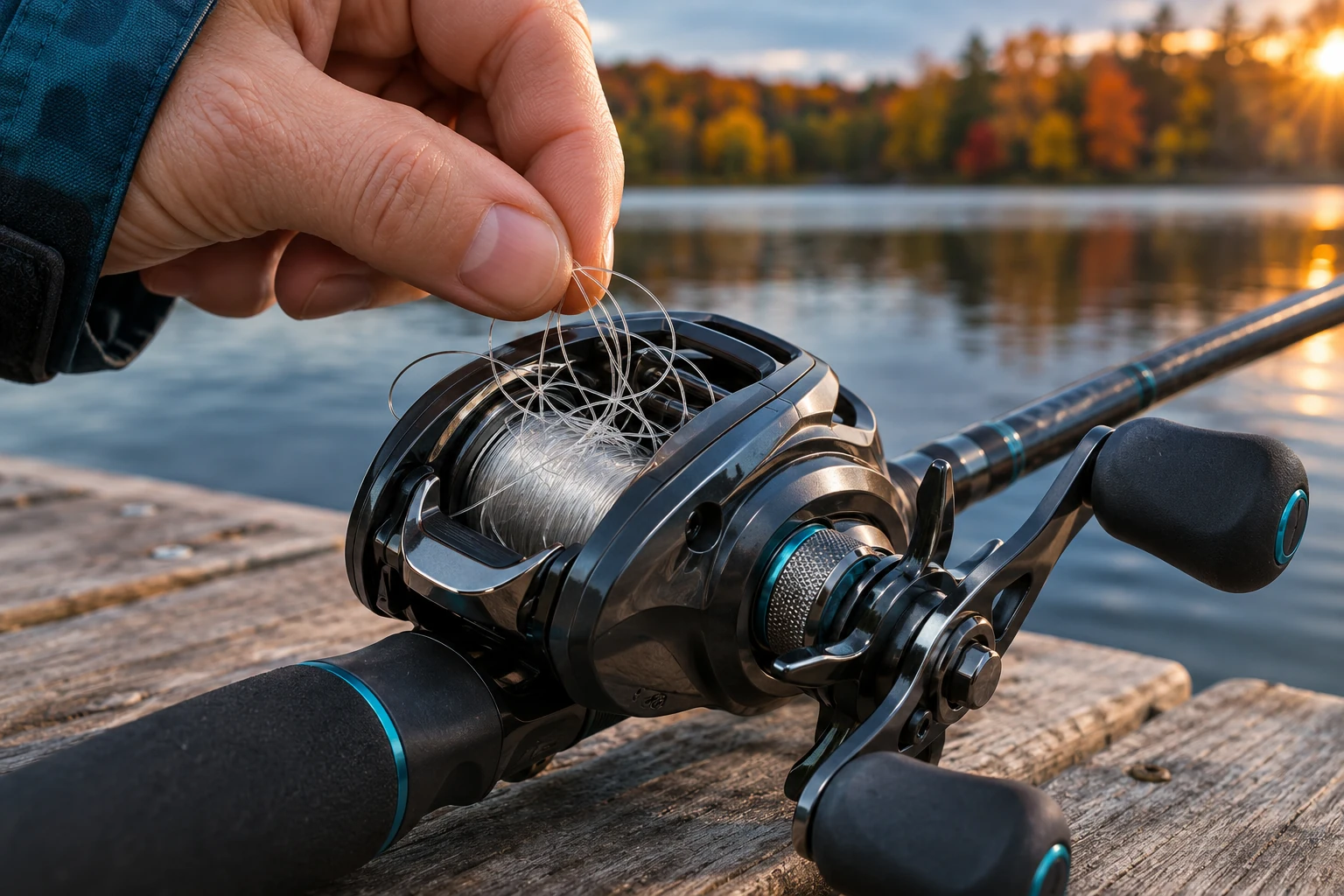
A baitcaster backlash is usually a spool-speed problem, not a ruined reel. If the spool keeps turning after the lure slows, loose line stacks up and catches itself. Here’s how to free a bird’s nest without making it worse, identify which part of the cast caused it, and dial in the reel before you try again.
How to fix baitcaster backlash right now
Stop cranking. Press the thumb bar, gently pull line from the reel, and lift the crossing loop that is locking the spool. Repeat until the line pays out freely. Then inspect it for kinks, cuts or crushed sections before winding it back under light tension. For the next cast, add braking, use a smooth stroke and stop the spool with your thumb before the lure lands.
Bird’s nest on the spool? Follow this rescue sequence
Put the rod down somewhere stable if you need two hands. Keep your fingers away from hooks and never force braided line against your skin. You can clear many shallow tangles without taking the reel apart.
- Stop immediately. Do not keep turning the handle or yank the line through the level-wind guide. Both actions can tighten buried loops.
- Disengage the spool. Depress the thumb bar while controlling the spool with your thumb. Find the main line leading out through the rod guides.
- Pull out line slowly. Draw the main line away from the reel a little at a time. As soon as it stops, do not increase the force.
- Locate the locking loop. Follow the line back to the spool. A loop crossing over another wrap is commonly what stops the outgoing line. Lift that loop with a fingernail or a smooth, blunt pick. Avoid hook points, sharp needles and anything that can nick line or damage the spool finish.
- Pull again and repeat. Removing one crossing loop often exposes the next. Work from the surface inward instead of grabbing a handful of coils.
- Check the freed line. Feel along the portion that was trapped. Remove any section with abrasion, serious kinks, flattened spots or weakened braid. If the snarl is deeply embedded, cutting away damaged line is safer than forcing it loose.
- Wind back under steady, modest tension. Lay the line evenly and keep the spool from accumulating loose coils. Keep fingers clear of the level wind and handle.
Don’t fish a badly compromised line. A tangle that pulls free may still have damaged mono or fluoro, or a pinched braid section that will fail on the next hard cast or fish.
The thumb-and-reel method: when it helps and when to skip it
For a shallow overrun, some anglers use a variation of the thumb-pressure method: engage the reel, press a thumb firmly on top of the tangled line, turn the handle a few times against light resistance, then release the spool and pull the main line gently. The aim is to expose a buried crossover, not to grind a knot tighter.
Try this only if the snarl is minor and the reel turns without force. Stop if resistance builds. For deep nests, very thin braid, or line already wedged below the surrounding wraps, the manual loop-by-loop approach is more controlled. Never use high drag force or a hard crank as a substitute for untangling.
Why your baitcaster keeps backlashing
On a baitcaster, the spool rotates to release line. The lure must pull line off quickly enough to keep up with the spinning spool. If the lure abruptly slows, hits a branch, runs into a headwind or touches down, line demand falls while the spool still has momentum. Extra line lifts into loose coils, and one coil catches the next. That’s the bird’s nest.
Backlashes aren’t all identical. The point in the cast where the tangle begins tells you what to adjust. Brake settings matter, but so do lure weight, the casting stroke, line fill and thumb timing. Your star drag is not the casting brake; it primarily controls line slip under load during a fight.
| When the backlash starts | Likely trigger | First adjustment |
|---|---|---|
| At release | A sharp snap, poor lure/rod match or insufficient initial braking | Smooth the cast and raise appropriate braking |
| Midflight | Lure stalls in wind or spool runs faster than line demand | Increase brake slightly, keep the cast lower and feather the spool |
| At splashdown | Spool keeps spinning after the lure stops | Stop the spool with your thumb just before the lure lands |
| Early in the next cast | Loose or unevenly wound line, buried braid, damaged line | Strip back to clean wraps and respool evenly under tension |
Look at abrupt rod acceleration, lure weight and braking. Start with a smoother cast.
A slowing lure is being outrun by the spool. Add braking and thumb contact.
Stop the spool before the lure touches down.
Check loose wraps, damaged line and line packed unevenly on the spool.
Set up a baitcaster to prevent the next bird’s nest
1. Start with a lure the rod can load
Use a practice weight or lure inside the rod’s printed casting-weight range. For a typical medium-heavy freshwater casting setup, a moderate-weight, reasonably aerodynamic practice plug is easier to learn on than a tiny weightless worm or a big, wind-catching spinnerbait. Practice on open ground with a hookless plug and plenty of clearance from people, pets, roads and power lines.
2. Follow your reel’s instructions for spool tension
On conventional designs, tighten the spool-tension knob just enough to tame obvious side-to-side spool play, then make small adjustments. A common beginner exercise is the lure-drop test: with the rod pointed forward and the spool released under thumb control, adjust tension so the practice weight descends in a controlled way and does not create an overrun when it reaches the ground. Some newer reels specify a near-zero-play setting instead of a heavy drop-test setting, so use your reel manufacturer’s directions first. Do not overtighten the knob just to make the reel backlash-proof. Excessive tension can rob distance and mask poor timing.
3. Turn the casting brakes up for practice
Magnetic systems usually have a numbered outside dial. Centrifugal designs may use internal blocks, pins or an outside adjustment, depending on the model. Start toward the high-control end of the manufacturer’s range. Make short casts and reduce braking a notch only after several clean, repeatable casts. If your reel has more than one brake control, don’t assume settings translate directly between brands.
4. Cast smoothly and use your thumb
Hold the spool under your thumb while pressing the thumb bar. Make a steady, progressive cast without whipping the rod. After release, maintain light thumb contact or stay ready to feather the spool if line begins to fluff up. As the practice plug reaches the target, press your thumb down firmly to stop the spool. That final stop matters even with a sophisticated brake system.
5. Change one setting at a time
Do not simultaneously loosen spool tension, reduce brakes and switch to a lighter lure. Adjust one variable, cast repeatedly and note what happened. When a headwind arrives, raise the brake slightly and favor a lower, controlled trajectory. If the bait is far too light for the rod, changing to a better-matched presentation is often more effective than fighting the reel’s settings.
Three useful gear choices for learning or recovering from backlash
You do not need to replace a functioning baitcaster to solve ordinary overruns. These are optional, job-specific examples: a forgiving practice line, a compact cutter for line you cannot safely recover, and a reel that illustrates adjustable magnetic braking. Every product below maps to its own Amazon.com US listing; check the exact variant and current offers before ordering.
Practice line: Berkley Trilene Big Game, 12 lb clear monofilament
For common freshwater bass practice, a midweight monofilament is an approachable starting point because it is easier to see and untangle than very thin braid. The mapped example is 12 lb clear, 1,175 yards (manufacturer part BGQS12C-15). That large spool is much more line than one reel needs, but leaves extra line for re-spooling after mistakes. Match line diameter to your reel’s stated capacity rather than buying solely by breaking strength.
Cleanup tool: Boomerang Original SNIP, black
If the tangled line has to be cut away, a dedicated line cutter is handier than improvising with a hook. The Original SNIP uses retractable tethering and serrated stainless-steel blades designed for mono, fluorocarbon and braid. The mapped black variant corresponds to manufacturer model BTC203. Cut only when you have decided the damaged line is not worth saving, and keep the blades away from the spool.
Check Boomerang SNIP on Amazon
Adjustable-brake example: KastKing Royale Legend II, right-hand 7.2:1
Not a required upgrade, but an example of the control you should look for if buying a first baitcaster. This exact right-hand 7.2:1 Royale Legend II version offers an external 10-step magnetic brake adjustment. That makes it possible to start conservatively and change one step at a time while practicing. A brake system can reduce overruns; it does not eliminate the need to stop the spool at touchdown.
Does braid or fluorocarbon make backlash worse?
Line management changes the difficulty of recovery more than the fundamental cause. Thin braid can bite beneath tight wraps, making a backlash especially stubborn. Stiff fluorocarbon may spring into loose loops if spooled carelessly; its memory also becomes more noticeable in heavier diameters. Monofilament can be easier for a learner to follow and pick apart, but it can still kink and weaken after a bad nest.
- Mono: a reasonable practice choice when you want inexpensive line that is straightforward to untangle.
- Braid: useful for many cover-oriented techniques, but avoid winding loose wraps over buried tight ones; check any section that has dug into the spool.
- Fluorocarbon: control spool fill and manage memory, especially when using heavier tests on smaller low-profile reels.
Regardless of line type, leave the spool at the fill level recommended by the reel maker. Overfilling can allow loose coils to spill over the spool lip; underfilling changes line pickup and casting behavior. If the spool is badly uneven after a nest, strip off enough line to rebuild the lay evenly.
A simple ten-minute practice routine
- Choose an open space, a hookless casting weight suited to the rod, and a nearby visible target.
- Check that the spool is evenly filled; start with conservative braking.
- Make five short, low-effort casts, stopping the spool with your thumb before every landing.
- Make five slightly longer casts without changing the brake. If line begins to fluff, add thumb pressure instead of trying to hit a distance target.
- Only after repeated clean casts, lower braking one increment and repeat. If you get an overrun, return to the previous setting.
The goal is repeatability, not distance. When you can land the plug cleanly ten times in a row, experiment with slightly more distance or a different lure weight. If the reel suddenly starts nesting after you switch baits, reset tension and braking for the new load.
Backlash troubleshooting checklist
- Problem: the line locks up halfway through a cast. Check whether braid is digging into lower wraps or a previous bird’s nest left a hidden crossover. Remove line to the first smooth section before casting again.
- Problem: every hard cast nests immediately. Ease off the casting force, confirm lure weight matches rod rating, and increase appropriate braking.
- Problem: casts look fine until the lure hits water. Practice stopping the spool with your thumb as the lure approaches the surface.
- Problem: only headwind casts nest. Raise braking, lower the trajectory and consider a more aerodynamic lure with adequate weight.
- Problem: the spool will not spin smoothly even after line is cleared. Check for line caught around the spool shaft and consult the reel manual. Do not force the handle or pry on side plates.
How we built this troubleshooting guide
We checked current US-language search results and separate GearAndFish article intents, then cross-checked baitcasting basics with the Texas Parks and Wildlife casting guide, a Zebco baitcast reel manual and specialist casting instruction. The Amazon examples were selected for distinct roles rather than treated as products that magically prevent backlash. Exact US ASIN destinations were inspected for the three mapped variants. We have not personally evaluated these items on the water for this article, and we do not claim measured tangle rates, casting distances or guaranteed current seller availability.
For background on reel controls, see what a baitcaster is and how it works. If you are shopping for a more beginner-friendly reel rather than troubleshooting one you already own, see our beginner baitcaster comparison.
Baitcaster backlash FAQ
Can I fix a bird’s nest without cutting the line?
Often, yes. Release the spool, pull slowly and lift the crossing loops one by one. Cut out any section that is severely kinked, abraded or pinched rather than risking a weak spot.
Should I tighten the drag to stop backlash?
No. The star drag regulates how the reel yields line under load. Spool tension, casting brakes and your thumb are the primary casting controls.
Why does my baitcaster backlash only into the wind?
A headwind can slow a lure suddenly while the spool continues rotating. Add a little braking, cast with a lower trajectory and keep your thumb ready to slow the spool.
Can magnetic brakes prevent every bird’s nest?
No. Brakes reduce spool overrun, but lure stops, line dig-in, sudden wind changes and thumb timing can still produce tangles.
What line should beginners use to practice casting?
A moderate monofilament matched to the reel’s stated capacity can be economical and relatively easy to untangle. For many conventional freshwater bass setups, 12 to 15 lb mono is a practical starting range, not a universal requirement.