
GearAndFish is reader-supported. As an Amazon Associate I earn from qualifying purchases. When you buy through links on our site, we may earn an affiliate commission, at no extra cost to you. Learn more.
The anti-reverse switch on a spinning reel can change how the handle behaves when a fish runs. But many current reels leave the lever off entirely. Here is how to identify the control, use it safely, and decide whether you need it on your next reel.
This guide is based on current manufacturer instructions, published reel specifications, and fishing education resources. It does not reflect firsthand reel testing. Always check the manual for your exact reel model and generation.
What does the anti-reverse switch on a spinning reel do?
ON stops the handle and rotor from turning backward during normal use, while the drag can still let the spool release line under pressure. OFF, on reels with a switch that supports it, allows the handle and rotor to turn backward so you can control line payout by back-reeling. No visible switch does not mean no anti-reverse: many newer reels have anti-reverse engaged all the time.
Anti-reverse switch ON vs. OFF
In a spinning reel, the handle drives gears that turn the rotor and its bail around the spool. The anti-reverse mechanism resists reverse rotation of that drive system. The drag is a different mechanism: it controls how much force is needed to turn the spool and release line while the bail is closed.
| Setting | What the handle does | How a fish can take line | Best default |
|---|---|---|---|
| Anti-reverse ON | Turns forward to retrieve; resists reverse rotation | Through the set drag | Yes, for most anglers |
| Anti-reverse OFF (switch-equipped reels) | Can turn backward as well as forward | Through the drag or by actively back-reeling | Only if you deliberately use the technique |
| No switch | Usually forward-only during normal use | Through the drag | Normal, not a missing feature |
Handle resists backward rotation
The fish takes line through your drag. This is the easy default.
Handle can reverse
You can back-reel deliberately, but must control the handle and line tension yourself.
Anti-reverse can still be present
Many modern reels keep it engaged without an external switch.
Do not confuse the anti-reverse lever with the drag knob on the front of the spool or a baitfeeder/free-spool control found on some specialized reels. They perform different jobs. A reversible handle mounting position also has nothing to do with whether the handle can turn backward.
Where is the anti-reverse switch?
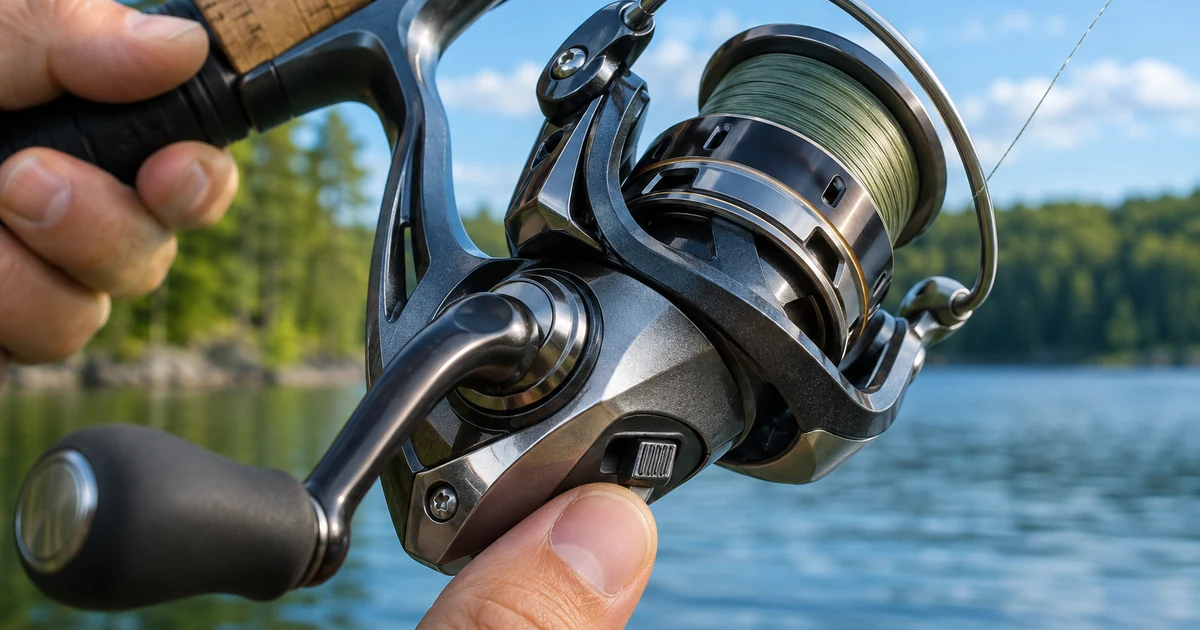
If your reel has one, look near the underside or back of the reel body, around the neck or below the rotor. It is commonly a small lever that moves between two stops. Its exact location and labeling vary. Some reels mark the positions with ON/OFF symbols; others do not.
- With no hook under load, hold the reel firmly and close the bail.
- Turn the handle normally, then gently try moving it backward. Do not force it.
- If an external lever is present, move it to its other position and repeat the gentle check.
- Return the switch to the position that prevents reverse handle rotation before fishing unless you deliberately practice back-reeling.
If you cannot find a lever, stop looking for a hidden button. Consult the parts diagram or instruction manual. On a switchless reel, the anti-reverse bearing may be inside the body and permanently engaged during normal operation.
Should anti-reverse be on while fishing?
For most freshwater and inshore fishing, yes. With anti-reverse engaged, the handle is stable when you set the hook or when a fish surges. A correctly set drag pays out line without requiring you to reverse the handle manually. That makes fish fighting more consistent, particularly for someone who is still learning to manage rod angle and tension.
After a strike, lift the rod smoothly and let the drag work if the fish pulls hard. Do not continue cranking aggressively when the drag is slipping; doing so can add line twist. Instead, keep the rod loaded and retrieve when the fish stops taking line.
The anti-reverse setting does not replace drag adjustment. A locked-forward handle and a drag tightened beyond the line’s working limit can still lead to snapped line or pulled hooks.
When would you turn anti-reverse off?
The practical reason is back-reeling. With the switch off, you can let the handle turn backward in a controlled way to give a fish line, rather than relying entirely on the spool drag. Some experienced light-line anglers still prefer that direct feedback, particularly when working with trout, panfish, or finesse presentations.
There is a meaningful trade-off: a sudden run can spin the handle backward faster than expected, and if your grip slips you can lose line control. Back-reeling is not the same as leaving the bail open, and it is not a substitute for a functional drag. Practice with a gentle pull in a safe setting, with no sharp hooks or moving fish, before considering it on the water.
If you have no reason to back-reel, there is no performance penalty in leaving the switch on. Do not buy a reel with a lever simply because it looks like an extra feature.
Does a good spinning reel need an anti-reverse switch?
No. A reel can have a perfectly functional anti-reverse mechanism without a switch. Whether you need the external lever depends on your preferred fish-fighting technique, not on a universal quality ranking. Some manufacturers deliberately remove the opening or control in a switchless design, which can simplify sealing against moisture. That does not make every switchless reel waterproof.
Consider these questions before ordering:
- Do you actually back-reel? If yes, confirm the current model and size have a user-selectable switch rather than relying on photos of an older version.
- Do you rely on drag? If yes, concentrate on drag adjustability, reel size, balance and line management first.
- Do you fish spray or saltwater? Look for model-specific corrosion and water-resistance claims. Never infer saltwater suitability just from the absence of a lever.
- Are you replacing an old favorite? Product lines change; anti-reverse controls can disappear even when the reel keeps the same family name.
Three real reel examples: switch vs. switchless
These are feature examples, not a claim that the three reels are directly comparable in size or price. The 20-size President, 2500-size Sahara and 4000-size Inspira suit different setups. The point is to show how the anti-reverse choice appears on current, identifiable models.
| Exact model | Anti-reverse decision | Who should look at it | Amazon US |
|---|---|---|---|
| Shimano Sahara FJ 2500 (SH2500FJ) | External anti-reverse switch | Anglers who specifically want a back-reeling option | Check on Amazon |
| Pflueger President 20 (PRES20X, new model) | Do not assume it has the old President lever | Light-line users comfortable with drag-only line payout | Check on Amazon |
| Okuma Inspira ISX 4000 (ISX-4000XA) | Switchless, with anti-reverse roller bearing | Anglers favoring an uninterrupted body/control layout | Check on Amazon |
Shimano Sahara FJ 2500
Exact model SH2500FJ. Shimano confirms a selectable anti-reverse switch.
Pflueger President 20
Exact model PRES20X. Older generations may differ; verify the controls of the listing.
Okuma Inspira ISX 4000
Exact model ISX-4000XA. Anti-reverse works without an external on/off lever.
Which design should you choose?
Shimano Sahara FJ 2500: if the switch is non-negotiable
Shimano explicitly specifies an anti-reverse switch on the Sahara FJ series. The 2500 model is a reasonable size to investigate for common freshwater spinning uses, but match line capacity and rod balance to your actual setup. This is the most straightforward example here if you want the ability to turn anti-reverse off intentionally.
See Shimano Sahara FJ 2500 on Amazon
Pflueger President 20 new model: if you mainly use the drag
The current PRES20X listing is a compact spinning reel. It belongs in this discussion because a familiar model name can conceal a generational change: owners of older Presidents have publicly noted the disappearance of the anti-reverse switch in newer versions. Do not order it expecting the older back-reeling lever; confirm the seller’s photos and model code first.
See Pflueger President 20 on Amazon
Okuma Inspira ISX 4000: if you want a switchless construction
Okuma identifies the Inspira ISX as switchless and describes a Quick-Set anti-reverse roller bearing. The ISX-4000XA is a larger reel than the other two examples, so do not treat it as a size-for-size alternative. Its significance here is design: anti-reverse can remain active even when the external on/off lever is removed.
See Okuma Inspira ISX 4000 on Amazon
Buying reminder: A switch is a control preference, not a proxy for drag performance, sealing, bearing quality, or long-term durability. Decide on size and use case separately.
Anti-reverse not working? Check these before taking the reel apart
The handle turns backward when it should not
First verify the switch position on the exact model. If the lever is definitely in the locked position but the rotor still reverses, stop applying force. Dirt, damaged components or a failed clutch could be involved. Follow the reel maker’s service guidance rather than forcing the handle or adding random oil into the anti-reverse bearing.
The handle will not turn backward
If the reel has no external switch, that is generally normal. If it has a switch, recheck the ON/OFF marking before assuming it is broken. Do not pry the switch or disassemble a sealed reel simply to make back-reeling possible.
Line keeps coming off when anti-reverse is on
That may be the drag doing exactly what it is designed to do. Check that the bail is closed and the line is routed through its roller. Then test drag tension carefully by pulling line from in front of the reel. A drag that is too loose can release line easily even with anti-reverse engaged.
The reel makes a small clicking or ticking sound
Sound alone does not prove a fault. Mechanism designs differ, and drag clicks are separate from reverse-handle locking. Evaluate whether the handle unexpectedly reverses under gentle load, and consult the model manual if the behavior has changed.
The bottom line
Keep anti-reverse engaged for ordinary fishing and let a properly set drag control runs. Choose an external switch only if you genuinely want to back-reel, and confirm the feature on the exact current variant before purchasing. A spinning reel without an anti-reverse switch is not automatically missing anti-reverse.
For a full beginner sequence that covers bail control, drag and casting, see our guide to using a spinning reel. For line-management problems rather than reverse-handle behavior, follow the spinning-reel spooling guide.
How this guide was researched
We separated anti-reverse operation from drag operation using Zebco’s published reel support guidance and Okuma’s anti-reverse lever manual. The Sahara FJ switch and Okuma Inspira ISX switchless design were cross-checked against their manufacturers. Pflueger new-generation lever changes were treated as owner-reported rather than as a brand-wide specification. Amazon US product mappings correspond to the exact model numbers named here. No personal tests, measurements, or current inventory promises are claimed.
Spinning reel anti-reverse FAQ
Should the anti-reverse switch be on or off?
Leave it on for normal fishing. That keeps the handle from turning backward and lets the drag control line payout. Turn it off only if your model allows it and you deliberately use back-reeling.
Does a spinning reel without an anti-reverse switch still have anti-reverse?
Usually yes. Many modern spinning reels use an always-engaged anti-reverse mechanism without an external lever. Check your exact reel manual for confirmation.
Does switching anti-reverse off make the spool free-spin?
No. It allows backward handle and rotor rotation on switch-equipped reels. It is not the same as opening the bail or selecting a baitfeeder/free-spool function.
Is back-reeling better than using drag?
Not for most anglers. Back-reeling gives experienced anglers manual control of line payout, but it also adds the risk of losing control during a sudden run. A properly adjusted drag is easier and more consistent.
Why did some manufacturers remove the anti-reverse switch?
It can simplify the reel’s controls and remove a possible point of moisture entry. That is one design trade-off, not proof that every switchless reel is waterproof or superior.